
24/7 Customer Support

Free returns

Same-day & Next-day Delivery

Quality Guaranteed

Unlock Your Welcome Offers: FREE Delivery | Up to 80% OFF | Free 30-day JoyPlus trial
Download the APP
Bringing the café experience home is an appealing thought, but the journey to becoming a home barista is often paved with confusing marketing and disappointing purchases. Many aspiring coffee enthusiasts invest in a new machine only to find it gathering dust because it fails to deliver on its promises. As a Joybuy Product Recommendation Officer, my role is to help you see past the hype and focus on what truly matters.
Before you commit, let's look at the common pitfalls that UK buyers encounter when choosing a manual bean to cup coffee machine. Understanding these can save you both money and frustration.
To avoid these issues, focus on a few non-negotiable specifications. These are the features that separate a capable machine from a countertop ornament.
Virtually all espresso machines will advertise 15-bar pump pressure, and for good reason. This is the industry standard required to force hot water through finely-ground, compacted coffee, ensuring a full extraction of oils and flavours that results in a rich shot topped with a stable crema. While higher numbers like 20-bar are sometimes marketed, 15-bar at the pump (which translates to around 9-bar at the group head) is the sweet spot. Equally important is active temperature control. Different coffee beans and roast levels extract optimally at slightly different temperatures. A machine that offers at least a few temperature settings gives you a vital tool for perfecting your brew.
A manual bean to cup coffee machine lives or dies by its grinder. Do not settle for anything less than an integrated burr grinder. Blade grinders smash beans into uneven particles, leading to inconsistent extraction. Burr grinders, on the other hand, crush beans between two revolving abrasive surfaces, producing a much more uniform grind. Look for a machine with multiple grind settings (8 or more is a good starting point). This allows you to "dial in" your coffee, making fine adjustments to achieve the perfect extraction time and taste for any type of bean.
If you enjoy milk-based drinks like lattes, cappuccinos or flat whites, the steam wand is a critical feature. Many entry-level machines have a simple panarello-style frother, which can inject air to create stiff foam but offers little control. To create silky microfoam—the key to pouring latte art—you need a proper coffee machine with a grinder and steam wand that allows you to control the texturing and heating of the milk. This type of wand gives you the hands-on experience of a real barista.
Instead of a generic list, we've matched our recommendations to specific user needs, helping you find the right fit for your home.
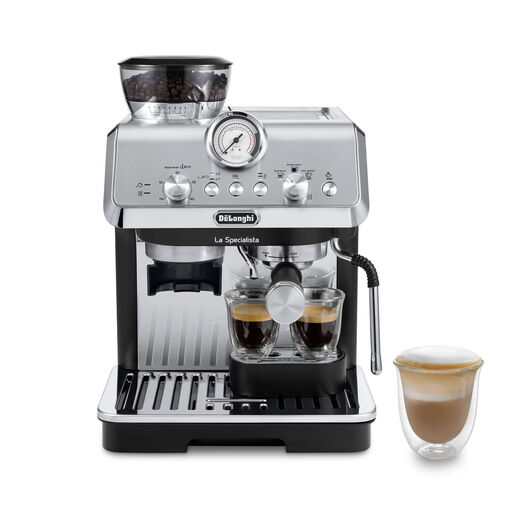
Why This Fits Their Persona: This machine is designed for those who want to learn the craft of coffee making. It provides the essential tools and controls—like multiple grind settings and a proper steam wand—without being overly intimidating. The included barista kit (tamper, dosing funnel, milk jug) means you have everything you need to start practising from day one.
It directly counters the "jack of all trades" pitfall by including quality components: an 8-setting burr grinder and a My LatteArt steam wand designed specifically for creating microfoam.
Three infusion temperature settings for different beans; includes a full professional barista kit to get started immediately.

Why This Fits Their Persona: For those wanting to step up from pod machines without a large investment, the Stilosa is a solid entry point. It's a compact semi-automatic espresso machine that focuses on the essentials: a 15-bar pump and a stainless steel boiler. It requires pre-ground coffee or a separate grinder, but it delivers a genuine espresso experience at an accessible price point.
By not including an integrated grinder, it avoids the pitfall of having a poor-quality one. It focuses its value on a durable stainless steel boiler and a capable 15-bar pump, ensuring a solid foundation for making espresso.
Compact design is ideal for smaller UK kitchens; compatible with both ground coffee and ESE pods for flexibility.

Why This Fits Their Persona: This machine is for someone who loves the taste of fresh bean coffee but prefers automation for the espresso shot. It grinds, doses and tamps automatically. However, it still features a manual steam wand, offering a hands-on experience for milk frothing. It's a hybrid approach that offers convenience without sacrificing the ability to craft your own milk-based drinks.
It avoids the "too complex to use" pitfall by automating the trickiest parts of espresso making. The one-touch buttons for espresso and coffee make it accessible for daily use, while the manual wand still provides an avenue for skill development.
One-touch recipes for espresso, coffee and Americano; integrated burr grinder with 13 settings for customisation.
A great coffee machine deserves the right accessories. From double-walled glasses that keep your drink hot to the perfect milk pitcher, we have compiled a complete list of products that meet our strict selection criteria.
There is a learning curve, but that is part of the appeal for many. A good semi-automatic espresso machine provides immediate feedback. You will learn how grind size, tamping pressure and extraction time affect the final taste. Starting with a user-friendly model and fresh coffee beans will make the process much more rewarding. Most users get the hang of the basics within a week.
The lifespan of a machine depends on its build quality and how well it is maintained. Models with stainless steel boilers and robust components can last for many years with proper care. Regular cleaning and, most importantly, descaling (especially in the UK's hard water areas) are essential to prevent damage and ensure consistent performance. Always follow the manufacturer's maintenance schedule.
Daily maintenance is simple: rinse the portafilter after each use, wipe down the steam wand immediately after frothing milk and empty the drip tray. Weekly, you should clean the shower screen (where the water comes out) to remove coffee oils. Descaling is the most important periodic task and should be done every 2-3 months, depending on your water hardness and usage, to prevent limescale build-up inside the machine.