Families buying one occasional treat
An individually sold bar gives one person a stated portion for a holiday outing or a treat at home. Check its per-bar sugars rather than assuming the small pack makes it an everyday snack.


For an occasional treat for one person, a 35g marshmallow bar provides a fixed portion: Mallow & Marsh lists 15.9g sugars per raspberry bar and 19.1g per vanilla bar. A sharing pouch calls for portioning at home, while the M&S vegan pouch offers an alternative without animal-derived ingredients but is not a single bar. For regular snacks, consider options beyond confectionery.
An individually sold bar gives one person a stated portion for a holiday outing or a treat at home. Check its per-bar sugars rather than assuming the small pack makes it an everyday snack.
Marshmallow bars and pouches can differ in gelatine, milk and soya ingredients, as well as precautionary allergen statements. Compare the current packs against the household’s dietary requirements.
M&S Plant Kitchen offers a vegan marshmallow pouch for those avoiding animal-derived ingredients. It is a sharing format, not an individually sold bar, and its allergy advice still needs checking.
Start with the serving you intend to offer, then compare the ingredients and the setting in which the snack will be eaten.
| Priority | What to check | Your needs |
|---|---|---|
| Portion and sugars | Compare sugars per bar, not just per 100g. Mallow & Marsh lists 15.9g per 35g raspberry bar and 19.1g per 35g vanilla bar; pack total sugars are not the same measure as free sugars. | I want to know what one person would eat before choosing an occasional holiday treat. |
| Pack format | Check whether the product is one separately sold bar, a multipack or a pouch that you will portion yourself. Waitrose describes its pink-and-white marshmallows as a 200g pouch with approximately 26 stated servings. | For one treat on an outing, a single bar is straightforward; when several people will share, I can portion a pouch myself. |
| Ingredients and allergens | Read the current ingredients and precautionary allergen wording. The reviewed Mallow & Marsh bars contain beef gelatine; the vanilla bar contains milk and soya, while the raspberry bar contains soya. | Someone in my household avoids animal ingredients or has an allergy, so flavour alone cannot decide which product to buy. |
| Where it will be eaten | Distinguish a snack eaten at home during the holidays from food provided at school. Department for Education school-food guidance applies to England; check the particular school’s policies for food brought in. | If the treat is going to a school activity rather than being eaten at home, I need to check that school’s requirements first. |
A fixed portion does not change its nutrition: Mallow & Marsh lists 15.9g sugars for its 35g raspberry bar and 19.1g for its 35g vanilla bar. The NHS guidance on children’s free sugars uses a different measure from the total sugars shown on these packs.
Compare the per-bar nutrition information and treat the bar as occasional confectionery, not an everyday snack by default.
The reviewed single bars contain beef gelatine, and their milk, soya and precautionary allergen information differs. A vegan label does not replace a separate allergy check.
Read the ingredients and allergen statements on the current physical pack before offering it to someone with a dietary restriction or allergy.
Department for Education school-food guidance concerns provision in England’s schools, rather than the choice of a treat to eat at home during the holidays. A school may also have its own packed-lunch or allergy policy.
For a school event or food taken into school, check the school’s written requirements before buying.
These references illustrate different bar and pouch formats; they do not imply that the products are interchangeable.
Its reviewed raspberry dark-chocolate and vanilla milk-chocolate marshmallow bars are each 35g.
M&S describes its 140g Vegan Marshmallows pouch as free from animal products.
Waitrose Pink and White Marshmallows come in a 200g sharing pouch rather than a chocolate-coated bar.
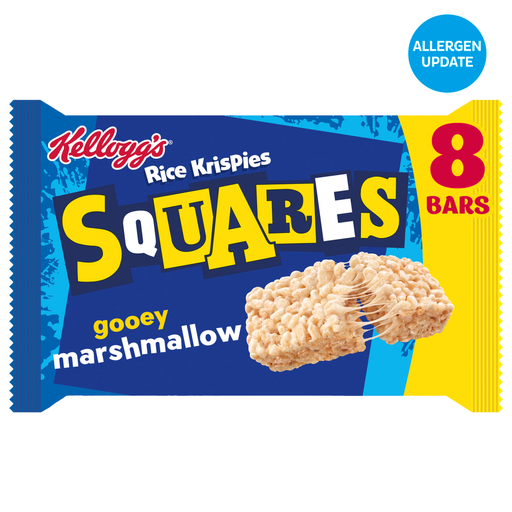
This option is a cereal-and-marshmallow bar multipack for households considering bar-sized treats, rather than a separately sold plain marshmallow bar.
 No image available
For a bar-sized cereal-and-marshmallow treat, this pack contains eight 28g bars rather than one separately sold bar. The product description states 9.0g sugars per 28g bar and lists beef gelatine, barley, wheat and milk; check the pack’s precautionary allergen wording. If separate wrapping matters for an outing, confirm the packaging before buying.
Treat the reviewed bars as occasional confectionery rather than an everyday default. Mallow & Marsh lists 15.9g or 19.1g total sugars per 35g bar. NHS guidance sets daily free-sugars maxima of 19g for children aged 4 to 6 and 24g for those aged 7 to 10, but pack total sugars and free sugars are not identical measures.
Mallow & Marsh lists 15.9g sugars per 35g Dark Chocolate over Raspberry Mallow Bar, compared with 19.1g per 35g Milk Chocolate over Vanilla Mallow Bar. That comparison is about listed sugars per bar, not overall nutritional suitability.
No. Both reviewed 35g bars list beef gelatine. If you need a vegan marshmallow, M&S describes its Plant Kitchen pouch as free from animal products, but it is not a single-bar substitute.
Check the current physical pack’s ingredients and precautionary allergen statements against the child’s requirements. GOV.UK guidance says regulated allergens in prepacked foods must be clearly labelled, and the reviewed marshmallow flavours have different ingredient and precautionary statements.
Department for Education school-food guidance applies to food provision in England’s schools, not to selecting a treat to eat at home during the holidays. If the food will be taken into school or provided at a school activity, check that school’s policy.