People wanting a sweet after training
Marshmallows may appeal as a sweet extra, but someone looking for protein in a post-gym snack should check the nutrition label rather than rely on marshmallows alone.


Choose marshmallows as a sweet extra rather than your only post-gym snack if you are looking for protein: M&S lists 0.6g or 3.2g protein per 100g for its two marshmallow products. The British Dietetic Association advises carbohydrate-rich food and fluids when quick recovery is required; if pre-set portions also matter to you, check for separately wrapped pieces rather than treating a sharing bag as a multi-pack.
Marshmallows may appeal as a sweet extra, but someone looking for protein in a post-gym snack should check the nutrition label rather than rely on marshmallows alone.
A vegan-labelled marshmallow offers a different ingredient choice from the M&S and Waitrose conventional products that list beef gelatine. Vegan labelling does not replace a check of the exact product’s allergen statement.
Separately wrapped pieces may suit someone who does not want to divide a sharing bag. Check the number and weight of the pieces before relying on a pack for pre-set portions.
Decide whether you want a sweet alongside other food or a snack containing protein, then compare the pack format and the label for the portion you intend to eat.
| Priority | What to check | Your needs |
|---|---|---|
| Post-gym use | The British Dietetic Association advises carbohydrate-rich food and fluids when quick recovery is required. Compare carbohydrate and protein on the snack label. | After demanding or repeated training, I want to know whether my snack provides protein as well as carbohydrate. |
| Sugars and serving | Check sugars per 100g and for the serving you plan to eat. Waitrose & Partners lists 4.7g sugars per stated serving and 61.5g per 100g for its Pink and White Marshmallows. | A sharing pouch leaves me to decide and measure my own portion. |
| Pack format | Check whether the marshmallows are individually wrapped, then check the piece count and weight. A serving count on a sharing pouch does not mean it contains sealed portions. | I want something I can carry without dividing up a loose bag. |
| Ingredients and allergens | M&S lists beef gelatine in its Soft Marshmallows and labels its carrageenan-containing Plant Kitchen product vegan. Check the current allergen statement separately. | I avoid animal gelatine, but I also need to assess any allergy requirements on their own. |
M&S lists 0.6g protein per 100g for its vegan marshmallows and 3.2g per 100g for its Soft Marshmallows. Those figures matter if protein is part of what you want from the snack.
Compare protein as well as carbohydrate on the label, and choose other food alongside the sweets if you want both.
A pouch can state a number of servings without containing individually sealed portions. That distinction matters when you want to carry one portion to the gym.
Confirm the number of inner packs or wrapped pieces, and the amount in each, before buying for that purpose.
M&S labels its Plant Kitchen marshmallows vegan, but its product information says they are not suitable for people with milk, nut or peanut allergies.
Check the exact pack’s ingredient and allergen statements independently of its vegan label.
Department of Health and Social Care guidance on HFSS promotions applies to businesses operating in and selling to England. Department for Education school-food guidance concerns food provided in state-funded schools in England; these are different settings from a home-packed lunchbox.
For a school lunchbox, check the school’s policy and the rules relevant to its setting. Do not assume an individual marshmallow product has a particular HFSS classification without checking that product.
M&S lists conventional Soft Marshmallows in a 180g bag and Plant Kitchen Vegan Marshmallows in a 140g bag.
Waitrose & Partners lists Pink and White Marshmallows in a 200g sharing pouch, with approximately 26 stated servings.
Tesco Groceries lists Tesco Marshmallows 200g and Tesco Mini Marshmallows 60g among its marshmallow products.
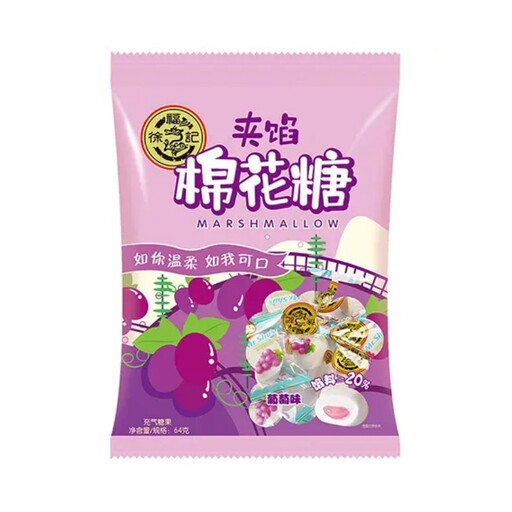
This grape marshmallow option is relevant if you want a sweet to carry after the gym. Check its portion format and label if you need separately wrapped pieces or want to compare nutrition per piece.
 No image available
A 64g grape marshmallow pack to consider if you want a sweet after training. If separate portions matter, confirm the piece count, piece weight and sugars per piece; check the current ingredient and allergen label if you avoid egg.
Not if you want your snack to provide protein as well as carbohydrate. M&S lists 0.6g or 3.2g protein per 100g for its two marshmallow products. The British Dietetic Association advises carbohydrate-rich food and fluids when quick recovery is required; compare the rest of your snack or meal with what you need after that session.
No. A sharing bag can state several servings without containing individually sealed portions. If you want one portion for a gym bag, check whether the exact product contains wrapped pieces and how much each piece weighs.
The conventional M&S Soft Marshmallows and Waitrose Pink and White Marshmallows list beef gelatine. M&S also labels its carrageenan-containing Plant Kitchen marshmallows vegan. Check the current label of the exact product, including its separate allergen statement.
The Department of Health and Social Care’s HFSS promotion guidance applies to businesses operating in and selling to England; it does not itself determine a school’s policy for a home-packed lunchbox. Department for Education school-food guidance concerns food provided in state-funded schools in England. Check the policy for the particular school and do not assume a specific marshmallow product’s HFSS classification.