Shared-kitchen portion organisers
If several people freeze their own portions, accessible compartments and a clear system of names and dates matter more than an open space that lets small containers get buried.


For labelled portions of cooled mashed potato, start by comparing freezers with accessible drawers: they make it easier for people sharing a kitchen to separate and retrieve their food. An under-counter model suits a restricted space, while a tall upright offers more room for several batch cooks; a chest freezer makes more sense for bulk storage if there is floor space and a way to organise its contents. Whichever format fits, check that the freezer can maintain the Food Standards Agency’s recommended domestic storage temperature of −18 °C and cool the food promptly before freezing.
If several people freeze their own portions, accessible compartments and a clear system of names and dates matter more than an open space that lets small containers get buried.
If meal portions need extra frozen storage but the kitchen has only a worktop-height gap, measure that space before choosing an under-counter freezer.
If batches take up substantial space, a chest freezer is worth considering where there is dedicated floor space and users can keep containers organised.
Choose the storage layout that fits the portions and the room, then check temperature capability and the upkeep each format requires.
Choose when: Portions are modest and the available space is beneath a worktop.
Trade-off: Check that its compartments still hold everyone’s containers.
Choose when: Several users need accessible storage for separate meal portions.
Trade-off: It needs a suitable full-height location and a clear delivery route.
Choose when: Bulk storage takes priority and there is dedicated floor space.
Trade-off: Small portions need baskets or clearly marked zones so users can find them.
Choose when: The kitchen already has suitable built-in housing.
Trade-off: The cabinet dimensions and door-hinge arrangement must match the appliance.
| Concern | What to check | Who this matters to |
|---|---|---|
| Freezing temperature | Check that the freezer compartment can maintain −18 °C; the Food Standards Agency recommends this temperature for domestic freezers. Consider how you will check its temperature in use. | If I am storing cooked portions for several people, dependable freezer temperature comes before convenience features. Around 36% of consumers put temperature control first. |
| Portion organisation | Check whether the intended containers fit the drawers and can be separated and retrieved without disturbing other food. | When everyone has their own portions, I need to find mine without confusing them with someone else’s. Around 29% of consumers prioritise keeping portions organised. |
| Kitchen fit | Measure the appliance space and delivery route, allowing for ventilation and the door or lid to open. For an integrated model, check the housing and hinge type. | A freezer is only useful to me if it fits without blocking access around our shared kitchen. Around 21% of consumers put space and installation fit first. |
| Upkeep | Compare the exact models’ defrosting arrangements and stated energy information after confirming that their storage layouts suit you. | If no one has a regular defrosting job, I would rather choose a manageable maintenance routine. Around 14% of consumers place upkeep first. |
Two freezers that fit the same space can have different internal layouts. Capacity in litres does not tell you whether portion containers will sit flat or remain easy to find.
Measure a typical container and compare it with the drawer or shelf layout as well as the appliance dimensions.
An integrated appliance needs compatible housing and a suitable cabinet-door hinge arrangement.
Measure the existing unit, identify its hinge type and check the installation instructions for the exact replacement model.
A mismatch can mean cabinet-door changes or other installation work.
A large mass takes longer to cool and occupies space that other users may need.
Cool the cooked mashed potato promptly, divide it into smaller portions and freeze it once cooled. NHS guidance advises cooling food as quickly as possible, ideally within one to two hours, before refrigerating or freezing it.
Those model features do not establish the temperature of a freezer in its particular installation.
Check the model’s temperature setting, follow its ventilation requirements and monitor the compartment temperature during use.
These model examples illustrate different installation formats; check the specifications of the exact appliance you intend to buy.
The freestanding UFF4584 illustrates an under-counter option for a restricted kitchen space.
The GSN33VWEPG illustrates a tall freestanding freezer with drawer-led storage.
The HTSD18F013H1 illustrates a tall integrated freezer for a fitted kitchen.
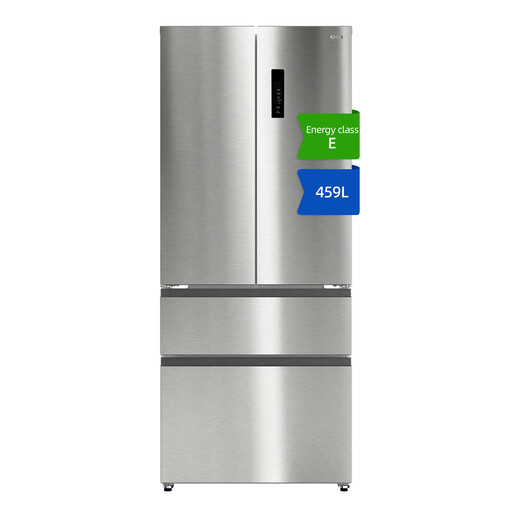
This combined fridge-freezer is a choice to consider if the shared kitchen also needs refrigerated storage. Check that its freezer compartment fits your labelled portions and can maintain the required storage temperature.
 No image available
Consider this four-door fridge-freezer if a combined appliance suits the kitchen and its freezer space accommodates the portions people plan to store.
The product name specifies 459 L overall capacity, an 80 cm width, Total No Frost and an E energy rating.
Check the freezer compartment’s container fit and its ability to maintain −18 °C after installation; allow space for ventilation and door opening.
Yes, once it has been cooled promptly. NHS guidance advises cooling food as quickly as possible, ideally within one to two hours, before refrigerating or freezing it; smaller, shallow portions help it cool.
Aim for −18 °C: the Food Standards Agency identifies this as the recommended temperature for domestic freezers. Check the actual compartment temperature rather than assuming a selected setting confirms it.
Divide cooled mashed potato into smaller containers and label each one with its contents, date and owner. Place portions where other users can identify and retrieve theirs without confusing them with someone else’s food.
Yes: appliance choice must fit the food business’s own temperature-control and monitoring procedures, not just household storage needs. GOV.UK food-business guidance calls for cooling cooked dishes before freezing, dividing food into smaller portions and labelling frozen food; the Food Standards Agency’s MyHACCP guidance also addresses facilities for monitoring food temperatures.