
24/7 Customer Support

Free returns

Same-day & Next-day Delivery

Quality Guaranteed

Unlock Your Welcome Offers: FREE Delivery | Up to 80% OFF | Free 30-day JoyPlus trial
Download the APP
Whether you're recovering from an intense workout, seeking relief from a stiff neck after a long day at your desk or simply looking to ease everyday muscle tension, a massage gun can be a valuable addition to your wellness routine. These powerful devices, also known as percussion massagers, are designed to deliver rapid pulses deep into muscle tissue, helping to soothe soreness and improve flexibility.
However, the market is filled with options, each with different features, power levels and price points. This guide is designed to help you understand the key factors to consider, cut through the marketing hype and find a muscle recovery tool that genuinely suits your lifestyle and needs.
Choosing the right device comes down to more than just its appearance. Here are a few practical points to consider before making a decision.
These three technical specifications determine the power and intensity of your massage.
Consider where and how you plan to use your massage gun. If you need relief on the go—at the gym, in the office or while travelling—a portable massage gun that is lightweight and compact is essential. Pay attention to the handle design. An ergonomic grip makes it easier to hold the device for extended periods and reach awkward spots, such as your lower back, turning it into a versatile electric back massager.
Most massage guns come with interchangeable heads designed for different muscle groups. A cushioned head is good for sensitive areas, while a fork-shaped head can work well around the spine or Achilles tendon.
For those who value a calm environment, a quiet massage gun is a must. Check the decibel (dB) rating if available, as some models are significantly quieter than others. Finally, look for special features that match your needs, such as a heated massage gun for enhanced muscle relaxation or app connectivity for guided routines.
Here are our recommendations, selected to cater to a range of common needs, from portability to specialised relaxation features.
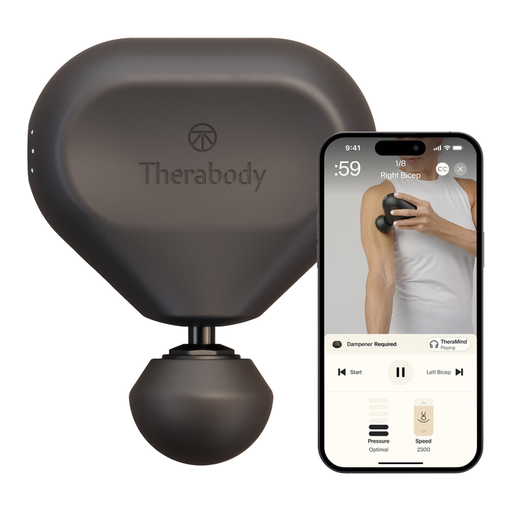
Why It Stands Out: The Theragun Mini 3rd Gen is built for life on the move. Now significantly smaller and lighter than its predecessor, it delivers effective percussive therapy without taking up valuable space in your bag. It proves that a powerful muscle recovery tool can also be incredibly convenient.
Pros:
Who is it for? Frequent travellers, athletes and anyone who needs a compact and reliable portable massage gun to use at the gym, in the office or away from home.
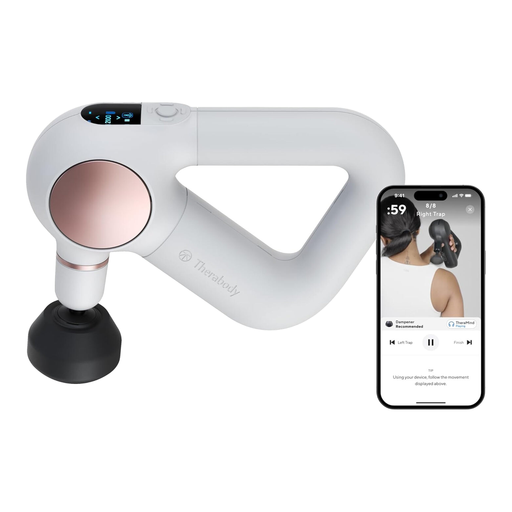
Why It Stands Out: The Theragun Sense is more than just a massage gun; it's a device focused on overall wellbeing. It combines effective percussive therapy with guided routines and calming features, making it an excellent tool for reducing stress and promoting relaxation. Its quiet operation ensures a peaceful experience.
Pros:
Who is it for? Individuals who prioritise relaxation and stress reduction alongside muscle recovery and those who would benefit from guided routines on a quiet massage gun.
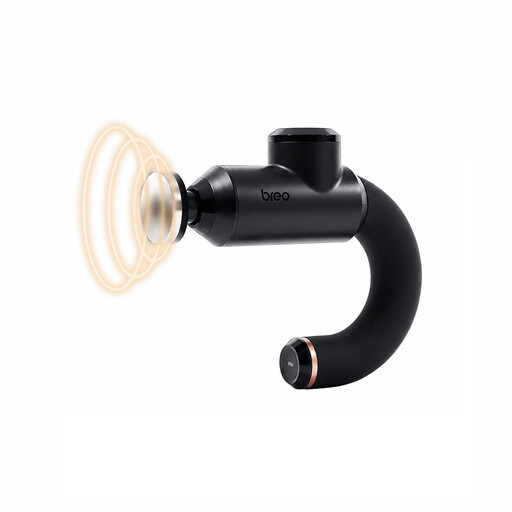
Why It Stands Out: This device combines two effective recovery methods in one: deep percussion and heat therapy. The Breo Sport-M0500 features a fast-heating head that helps to relax stiff muscles even more effectively, while its powerful motor delivers the intensity needed for serious post-workout recovery.
Pros:
Who is it for? Users seeking the combined benefits of heat and percussion, particularly athletes and individuals with chronic muscle stiffness who need a powerful heated massage gun.
While these three models cover a wide range of needs, your perfect match might be waiting. If you're looking for different features, power levels or designs, there are many other excellent devices to discover.
Browse our full collection to find a rechargeable massage gun that fits your specific recovery goals.
1. How often should you use a massage gun? For general use, a session of 1-2 minutes per muscle group is often sufficient. You can use it for post-workout recovery to help reduce soreness or for a few minutes during the day to ease tension from sitting. It's important to start on a low setting and listen to your body; avoid using it on bones, joints or injured areas.
2. Can a massage gun help with back pain? Many people find a percussion massager helpful for relieving muscle-related back tension, particularly in the upper and lower back. It can function as an effective electric back massager when used correctly. However, you should always avoid applying it directly to the spine. For chronic or severe back pain, it is always advisable to consult a healthcare professional.
3. What is the difference between a percussion massager and a vibration massager? The main difference is amplitude. A percussion massager, like the ones featured here, uses a deep, piston-like motion to penetrate muscle tissue, making it ideal for targeting knots and aiding deep muscle recovery. A vibration massager typically has a much lower amplitude and provides a more superficial, generalised soothing effect on the surface of the skin and muscles.