Hosts stocking a self-service tea tray
Portioned bags let guests make a drink without measuring powder. For a planned stock of 240, count the bags in each pack and multiply by the number of packs ordered.


For a self-service holiday-cottage tea tray, portioned matcha green-tea bags are simpler for guests to prepare: 20- or 40-bag packs can be combined to make 240 sachets. These are green-tea blends containing matcha, not 100% matcha powder. Choose powder instead if you can provide measuring equipment, a whisk or shaker, and clear instructions.
The useful distinction is whether guests will make a drink from a tea bag or prepare a measured portion of powder.
Portioned bags let guests make a drink without measuring powder. For a planned stock of 240, count the bags in each pack and multiply by the number of packs ordered.
100% matcha powder suits a setup with portion instructions and a whisk or shaker. It needs more preparation and cleaning than a tea-bag tray.
Keep the delivered packs' ingredients, allergen information and preparation directions accessible. Check labels before describing a drink as pure matcha or caffeine-free.
Set the number of portions first, then choose a format guests can prepare with the equipment in the cottage.
Choose when: Guests need a self-service drink without measuring or shared mixing equipment.
Trade-off: The Clearspring and Pukka bags described here are green-tea blends containing matcha, not pure matcha.
Choose when: You can provide measured portions, preparation instructions and a whisk or shaker.
Trade-off: Guests must mix the drink and clean the equipment; powder is not a direct replacement for a tea bag.
| Priority | What to check | Your needs |
|---|---|---|
| Portion count | Confirm bags per box and boxes per case. Three Clearspring Matcha Genmaicha cases of four 20-bag boxes make 240 bags; six Pukka 40-bag packs also make 240. | I want a count I can plan against between cottage turnovers, without asking guests to portion powder. |
| What is in the drink | Read the ingredient list. Clearspring Matcha Genmaicha lists 2.5% matcha; Pukka Supreme Matcha Green lists 2%. Clearspring matcha powder lists matcha as its sole ingredient. | If I call the guest offering pure matcha, the product needs an ingredient list that supports that description. |
| Preparation | Check whether the drink uses a tea bag or measured powder. For powder, check the maker's portion and mixing directions and provide suitable equipment. | Guests using an unattended tea tray should be able to make the drink with what the cottage provides. |
| Pack information | On delivery, check ingredients, allergen information, best-before dates and storage directions. Keep the current pack information available to guests. | I need the description and information beside the drinks to match the packs actually put out. |
A guest expecting a drink made from 100% matcha powder may instead receive a green-tea infusion containing a small proportion of matcha.
Describe bags as matcha green-tea bags. Use “100% matcha” only when the delivered product's ingredient list supports it.
A 240-bag plan based on smaller packs depends on both the bag count and any case quantity being correct.
Write down the required configuration before ordering: for example, three four-pack cases of 20-bag Clearspring Matcha Genmaicha, or six confirmed 40-bag Pukka packs. Recheck the format when reordering.
Powder needs measuring and mixing, so guests cannot use it in the same way as a tea bag.
If you offer powder, leave portion instructions and a suitable whisk or shaker beside it, with a dry place to store the product.
Mixing equipment also adds cleaning between uses.
The information guests see should reflect the food and drink actually supplied to them.
Check each delivered pack's ingredients, allergen information, best-before date and storage instructions before putting it out.
These references cover different formats and pack sizes; a brand's inclusion does not mean every product in its range suits a 240-portion plan.
Offers Matcha Sencha and Matcha Genmaicha tea bags as well as 100% matcha powder.
Supreme Matcha Green comes in a 20-bag format, and Pukka describes a large pack of 40 individually wrapped sachets.
Its 30g ceremonial matcha powder is an option for a prepared matcha drink rather than a bag-based tea tray.
teapigs has a Matcha category in its UK range.
Waitrose & Partners lists 20-bag Clearspring Matcha Sencha and Pukka Supreme Matcha Green products.
These options represent two different ways to provide individual portions: matcha Genmaicha tea bags for a tea tray and matcha pods for a cottage with a suitable machine. Pods are not tea bags, and neither format should be described as a 240-bag carton.
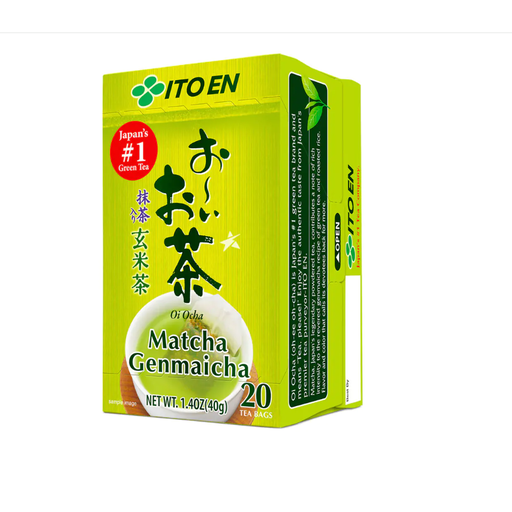 Image unavailable
For a guest tea tray, 12 boxes of 20 bags make 240 individually portioned tea bags. This is a matcha Genmaicha tea-bag product, not 100% matcha powder. Check the delivered pack's ingredients, allergen information and best-before date before guest use.
 Image unavailable
For a pod-based drink setup, 24 boxes of 10 make 240 capsules, not 240 tea bags. Check compatibility with the cottage's Nespresso Original line machine before ordering, and check the delivered pack for preparation, ingredient and best-before information.
No. The Clearspring and Pukka bags discussed here are green-tea blends containing 2% or 2.5% matcha, while Clearspring's matcha powder lists matcha as its sole ingredient. Check the particular pack before describing what guests will receive.
Three Clearspring Matcha Genmaicha cases, each holding four boxes of 20 bags, make 240 bags. Pukka also describes a 40-sachet Supreme Matcha Green pack, of which six would make 240; confirm that pack format when ordering.
Provide portion instructions and a whisk or shaker rather than treating powder like a tea bag. Clearspring gives a method using 1g of its powder, while JING specifies 1.5g per 160ml cup for its product; follow the directions for the powder you supply.
Keep the delivered packs' current ingredient and allergen information available. If you supply drinks as a food business, consult the applicable GOV.UK guidance for England, Northern Ireland and Wales or Food Standards Scotland guidance for Scotland, taking account of how the drinks are provided.
If you want to offer one, choose a separate drink whose label confirms that it is caffeine-free; do not describe matcha or green tea that way. Do not use a caffeine figure for matcha powder as an estimate for a tea bag.