Hosts serving individual cups
A pyramid bag lets each guest brew a cup without measuring or whisking powder. JING describes using its pyramid bags in a mug or pot with room for water to circulate; follow the instructions for the tea you buy.


For quick individual cups at a book club, choose a matcha-infused pyramid bag if the pyramid shape matters; an ordinary matcha tea bag is another option if it does not. For a tasting centred on drinking the ground leaf, choose 100% matcha powder and allow for measuring and whisking. Check the ingredients before buying: the Joybuy EDO pyramid-bag listing describes 98% green tea and 2% green tea powder, not 100% matcha.
A pyramid bag lets each guest brew a cup without measuring or whisking powder. JING describes using its pyramid bags in a mug or pot with room for water to circulate; follow the instructions for the tea you buy.
A tea bag offers an infused drink rather than a bowl of whisked matcha. Check the recipe if the matcha proportion matters: Clearspring lists 2.5% matcha powder in its Matcha Sencha sachets, while the Joybuy EDO pyramid-bag listing gives 2% green tea powder.
Choose 100% matcha powder if the point is to prepare and drink the ground leaf rather than discard an infused tea bag. That choice also means portioning and whisking each serving.
Decide whether the gathering calls for individually brewed tea or a whisked matcha tasting, then check the bag shape, ingredients and serving instructions.
Choose when: Guests will make individual infused cups and you specifically want pyramid bags.
Bear in mind: The Joybuy EDO listing describes a green-tea blend, not 100% powder for whisking.
Choose when: An individually brewed, matcha-containing tea matters more than a confirmed pyramid shape.
Bear in mind: Clearspring’s Matcha Sencha and Matcha Genmaicha are described as sachets, not confirmed pyramid bags.
Choose when: The group wants to prepare and drink the ground leaf as part of the tasting.
Bear in mind: Serving several guests takes portioning and whisking rather than simply removing a used bag.
| Priority | What to check | Your needs |
|---|---|---|
| Individual servings | Confirm the bag count, brewing instructions and whether the product explicitly says pyramid bag. Check that your mugs or pot give the bags room to infuse. | I’d like guests to make their own cups without measuring powder, and I need enough bags for everyone. |
| Matcha content | Read the ingredient percentages and distinguish an infused green-tea blend from 100% matcha powder. Clearspring lists 2.5% matcha powder in Matcha Sencha; the Joybuy EDO listing states 2% green tea powder. | If we are expecting whisked matcha, I want to buy powder rather than assume a matcha-named tea bag contains only matcha. |
| Blend and flavour | Check the other ingredients as well as the matcha. Clearspring lists sencha and roasted brown rice alongside matcha in its Matcha Genmaicha. | A roasted-rice blend might suit our planned tea selection; otherwise I can look for a straightforward sencha blend. |
| Guest information | Keep the ingredients and allergen information available, and check the product’s caffeine information where given. Tea is a caffeine source, as the NHS notes. | Some guests may avoid caffeine or need to check ingredients, so I’d like another drink available and the packaging to hand. |
A matcha-containing bag can be predominantly green tea. Clearspring lists 2.5% matcha powder in Matcha Sencha, while Pukka lists 2% matcha in Supreme Matcha Green.
Read the ingredient percentages. If guests are gathering to taste the ground leaf itself, choose a product labelled 100% matcha powder instead of an infused blend.
A listing that says “tea bag” or “sachet” does not establish its construction. Clearspring describes its matcha products as sachets, while JING and teapigs explicitly describe pyramid formats in their tea-bag ranges.
If the shape is important, confirm that the particular matcha-containing product is labelled as a pyramid bag; do not transfer a brand’s format description to a different product.
Tea contains caffeine, and guests may also need to check ingredients before drinking. A blend name alone cannot tell them whether it meets their needs.
Keep the packet available for ingredient checks and offer a clearly labelled caffeine-free alternative alongside the tea.
These examples help distinguish a brand’s matcha products from its pyramid-bag range; a format offered elsewhere in a range does not establish the shape of a particular matcha product.
Clearspring lists Matcha Sencha and Matcha Genmaicha as 20-sachet products with declared ingredient proportions.
teapigs calls its Tea Temples pyramid tea bags and describes them as containing whole leaves.
JING describes pyramid-shaped bags for its whole-leaf teas and presents matcha separately as powder to whisk.
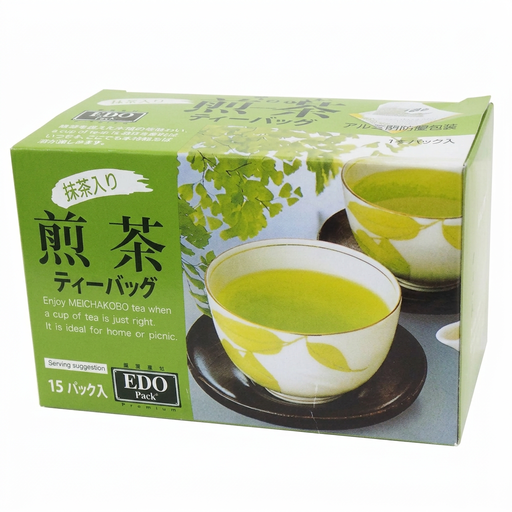
This matcha-infused sencha option is for book clubs planning individually brewed cups rather than whisked matcha.
 No image available
The pyramid-bag format lets book-club guests brew individual cups without measuring matcha powder.
The Joybuy listing states green tea (98%) and green tea powder (2%): this is an infused blend, not 100% matcha powder. Confirm the number of bags and brewing directions before planning servings, and keep the packaging available for ingredient checks.
No. A pyramid bag makes an infusion, whereas whisked matcha powder is mixed into water and drunk as ground leaf. The Joybuy EDO pyramid-bag listing gives 98% green tea and 2% green tea powder, so it is not a serving of 100% whisked matcha.
Follow the brewing instructions for the particular tea and give each bag room in its mug or pot. JING recommends space for water to circulate around its pyramid bags; Clearspring gives a 1–2 minute infusion time for its Matcha Sencha sachets, which should not be assumed to apply to another blend.
Offer a clearly labelled caffeine-free alternative rather than assuming a matcha-containing tea is suitable. Tea is a caffeine source, as the NHS notes; check the specific product information instead of estimating its caffeine content from a different tea.
Keep the original packet available so guests can check the ingredients and allergen information for the exact tea being served. Do not assume that two matcha-containing blends have the same recipe.