For a quick brewed drink with a continental breakfast, choose a tea bag whose ingredients state that it contains matcha; if pyramid bags matter, check that the exact product specifies that shape. Choose 100% matcha powder if you want the ground leaf in the drink and are happy to mix or whisk it. A brand selling both matcha and pyramid bags does not, by itself, establish that one product combines them.
Which format fits your breakfast routine?
Breakfast drinkers who want a brewed cup
A green-tea bag containing matcha suits a kettle-based routine when an infusion, rather than whisked powder, is what you want alongside breakfast. Check the ingredients: the word “matcha” does not tell you how much of the blend it makes up.
Drinkers who want pure matcha powder
A product listing 100% matcha suits a drink made by mixing the powder into water or milk. It takes a different preparation step from steeping and removing a tea bag.
Shoppers set on pyramid bags
Check the bag shape on the exact matcha product, not just on another tea in the same brand’s range. Confirm its ingredients separately: pyramid construction and matcha content answer different questions.
What should you check before choosing?
Decide whether you want an infused tea or mixed powder, then check the ingredients and packaging of the particular product.
| Priority |
What to check |
Your needs |
| Matcha content |
Read the ingredient list and any stated proportions. Clearspring lists its Matcha Sencha as 97.5% sencha and 2.5% matcha; its separate Matcha Shot lists 100% matcha powder. |
I’m happy with a green-tea infusion containing matcha, or I specifically want a drink made from pure matcha powder. |
| Bag shape |
Look for a pyramid-bag statement for the exact product. JING Tea describes pyramid bags for its whole-leaf tea range, while its cited matcha product is a separate powder. |
If the pyramid shape is why I’m choosing a bag, I want that detail confirmed for the matcha product I’ll buy. |
| Preparation |
Check the pack’s brewing or mixing directions and what you need to make the drink. A bag is infused; matcha powder is mixed or whisked into the liquid. |
On a busy morning, would steeping a bag fit better than measuring and mixing powder? |
| Caffeine |
Check the serving size and any product-specific caffeine information. Consider other caffeinated drinks served with breakfast. |
I want to keep track of caffeine across the drinks I have that day. |
| Ingredients and allergens |
Read the current pack, especially for blends or latte mixes. GOV.UK says food businesses must identify any of 14 specified allergens used as ingredients. |
For an allergy, I need the current product’s ingredient and allergen information, not an older listing. |
What is easy to confuse?
-
Reading “matcha tea” as “100% matcha”
A bag may contain mostly green tea leaves with some matcha. Clearspring, for example, lists its Matcha Sencha as 97.5% sencha and 2.5% matcha.
Use the ingredient list to distinguish a blend from a product explicitly listing 100% matcha powder.
-
Applying a brand’s pyramid-bag description to every product
A brand’s matcha powder and pyramid-bag tea range can be separate products. Bag shape alone also says nothing about a tea’s matcha content.
Check both the packaging description and ingredients for the exact product you intend to buy.
-
Forgetting other drinks when checking caffeine
Breakfast may include matcha alongside coffee or another caffeinated drink, so the matcha serving is not the only one to consider.
Check the product’s serving information and account for the other drinks you have that day.
-
Using an old ingredient panel for an allergy check
Ingredients can change. Marks & Spencer advises shoppers to read the product label because foods are redeveloped.
Check the current pack’s ingredients and allergen information, particularly for flavoured blends and latte mixes.
How do the brand ranges differ?
Clearspring
Clearspring provides examples of both a matcha-containing tea infusion and a separate pure-matcha powder product.
- Clearspring lists Matcha Sencha as 97.5% sencha and 2.5% matcha.
- Its Matcha Shot lists 100% matcha powder; that does not make the tea sachets a pure-matcha product or establish their bag shape.
JING
JING Tea describes pyramid-shaped bags for its whole-leaf tea range and offers a separate 30 g matcha powder.
- JING Tea describes its whole-leaf tea bags as spacious, pyramid-shaped bags.
- The range-level bag description does not identify its matcha powder as a matcha pyramid-bag product.
Teapigs
Teapigs describes its Tea Temples as pyramid bags packed with whole leaves.
- The Tea Temples name identifies a pyramid-bag format within the range.
- Check an individual tea’s ingredients before choosing it for matcha content.
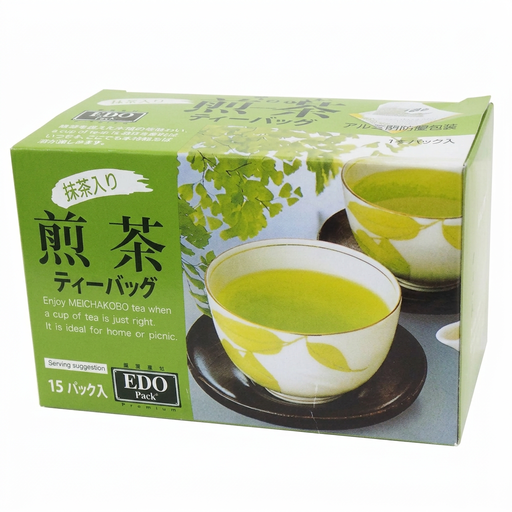
A Joybuy matcha pyramid-bag option
This listed sencha-and-matcha product is a tea-bag option for a brewed breakfast drink, rather than a powder for whisking.
 No image available
Cooling Hydration EDO Matcha Injected Sencha Pyramid Tea Bags, 30g
For a brewed breakfast cup, the product name identifies a sencha tea with matcha in pyramid bags. The stated pack size is 30g. Check the current pack for ingredient proportions, brewing directions, caffeine information and allergens.
View on Joybuy
Matcha breakfast questions
Is a matcha tea bag the same as pure matcha powder?
No. A tea bag can be a green-tea blend containing matcha: Clearspring lists its Matcha Sencha as 97.5% sencha and 2.5% matcha. Its separate Matcha Shot lists 100% matcha powder, which is mixed into the drink rather than steeped in a bag.
Does a premium matcha tea product come in a pyramid bag?
Not necessarily. Confirm the shape for the exact matcha product. JING Tea describes pyramid bags in its whole-leaf tea range, but its cited matcha product is powder; one range description does not apply automatically to the other.
Should I choose a bag or powder for a quick breakfast drink?
Choose a bag if you want to make an infusion without mixing powder; check its ingredients if the matcha proportion matters to you. Choose 100% matcha powder if you want the ground leaf in the drink and can make time to measure and mix it. Follow the directions on the product you select.
What should I check about caffeine?
Check the serving size and any caffeine information for the specific matcha product, then consider other caffeinated drinks you have that day. Do not assume that a tea bag or powder is caffeine-free.
Where should I check allergens in a matcha blend?
Check the current pack’s ingredient and allergen information, particularly for flavoured blends or latte mixes. GOV.UK says food businesses must identify any of 14 specified allergens when they are used as ingredients, and product formulations can change.


