Who is each option for?

Breakfast diners who want matcha as a powder drink

M&S Food defines matcha as finely ground, shade-grown green tea leaves, while ITO EN describes preparing it by whisking. Choose powder if that preparation matters more to you than the convenience of removing an infused bag.

Households looking for a quick bagged drink

A matcha-containing tea bag avoids whisking, but it may be predominantly green tea. Compare the ingredient list and follow the particular product’s brewing directions rather than expecting every matcha-labelled bag to make the same cup.

Hosts choosing tea for a Full Scottish breakfast

If the drink is meant to be rich and malty alongside the meal, consider a breakfast tea instead of choosing a green-tea blend for its pyramid shape. M&S Food describes its breakfast tea as rich and malty; it is a different flavour choice from matcha.

What should you check before choosing?

Matcha powder

Choose it when: You want a drink prepared from matcha powder rather than a steeped green-tea blend.

Bear in mind: Powder needs mixing or whisking; there is no bag to lift out after infusion.

Matcha-containing bag

Choose it when: A quick, infused green-tea drink suits your breakfast routine.

Bear in mind: Matcha may be one ingredient in a blend, so the bag does not replace whisked matcha powder.

Breakfast tea

Choose it when: A rich, malty cup is the flavour you want with a Full Scottish breakfast.

Bear in mind: This route does not provide a matcha drink.

Priority What to check Your needs
Matcha content Read the ingredient list and matcha percentage, not just the front label. Clearspring lists 2.5% matcha in Matcha Sencha; Tesco Groceries lists 15% in Twinings Super Green Matcha; English Tea Shop lists 6% in Mighty Matcha. These are different blends, not measures of flavour strength. If I want whisked matcha, I would choose powder. If I want a bag, I need to know what else will be infused with the matcha.
Breakfast flavour Decide whether the cup should be a green-tea infusion or a rich, malty breakfast tea. M&S Food describes its breakfast tea as rich and malty; a pyramid shape alone says nothing about flavour. With a substantial savoury breakfast, I might want a malty tea. At another point in the morning, I might prefer a green-tea drink.
Brewing Check the instructions for the exact bag. Canton Tea recommends 80°C for two to three minutes for its green-tea pyramid bags; that is not a universal direction for matcha blends. I want a straightforward morning brew, with a time and temperature I can follow for the product I buy.
Bag material Check whether the product actually uses a pyramid bag, what its material is and how the pack says to dispose of it. JING Tea describes pyramid-shaped bags that give whole leaves room to infuse; shape does not establish the material of another brand’s bag. If bag construction or disposal matters to me, I need product-specific wording rather than relying on the word “pyramid”.

Common buying mistakes

  • Reading “matcha tea” as “pure matcha”

    Clearspring states that both its Matcha Sencha and Matcha Genmaicha sachets contain 2.5% matcha; the remaining ingredients differ between the blends.

    Check the full ingredient declaration and percentage. Choose matcha powder instead if an infused blend is not the format you want.

  • Assuming a pyramid bag contains more matcha

    JING Tea describes pyramid bags in terms of space for whole leaves to infuse. Matcha, as defined by M&S Food, is a ground tea-leaf powder. Bag construction and matcha content answer separate questions.

    Confirm the bag format if it matters to you, then check the matcha percentage independently.

  • Choosing the bag before choosing the breakfast drink

    A matcha-containing green-tea blend and a rich, malty breakfast tea serve different flavour preferences. M&S Food describes its breakfast tea as rich and malty; that description should not be transferred to a matcha bag.

    Decide whether you want a green-tea drink or a malty tea with the meal before comparing bag shapes.

  • Brewing every green-tea bag like breakfast tea

    Brewing directions vary by product. Canton Tea recommends 80°C for two to three minutes for its green-tea pyramid bags.

    Follow the directions on the bag you buy rather than applying one temperature or infusion time to every blend.

Brands and retailers to compare

Clearspring

Clearspring’s Matcha Sencha and Matcha Genmaicha are bagged, matcha-containing blends with stated ingredient proportions.

  • Clearspring lists 97.5% sencha and 2.5% matcha for Matcha Sencha.
  • Its Matcha Genmaicha also contains roasted brown rice; neither listed blend is pure matcha powder.

Teapigs

Teapigs describes its Tea Temples as pyramid bags containing whole leaves and has a separate matcha range.

  • The Tea Temples range gives buyers a clearly described pyramid-bag format.
  • Check the format of the particular matcha product: a matcha range and a pyramid-bag range do not establish that the same item belongs to both.

JING

JING Tea describes spacious pyramid-shaped bags designed for whole-leaf infusion.

  • Its bag description helps explain what the pyramid format is intended to do for leaves.
  • Check an exact product’s ingredients if you want matcha; pyramid construction alone does not establish them.

M&S

M&S Food explains matcha as ground tea-leaf powder and describes its breakfast tea as rich and malty.

  • Those descriptions help separate a powder drink from a malty breakfast-tea choice.
  • Check an exact product before assuming that a matcha drink or tea uses a pyramid bag.

Waitrose

Waitrose lists Clearspring Matcha Sencha tea bags and advises shoppers to check current product labels because recipes can change.

  • The listing identifies a matcha-containing green-tea bag to compare with other formats.
  • A tea-bag listing does not by itself establish pyramid construction; check the current pack for ingredients and relevant label information.

Tesco

Tesco Groceries lists matcha powder and matcha-labelled tea bags, allowing a comparison of preparation formats.

  • Its Twinings Super Green Matcha listing states 84% green tea and 15% matcha.
  • Check the individual listing or pack for bag shape; “tea bag” does not confirm a pyramid bag.

Joybuy matcha pyramid-bag option

This option is for a steeped, matcha-labelled sencha drink in pyramid bags, rather than whisked matcha powder or a malty breakfast tea.
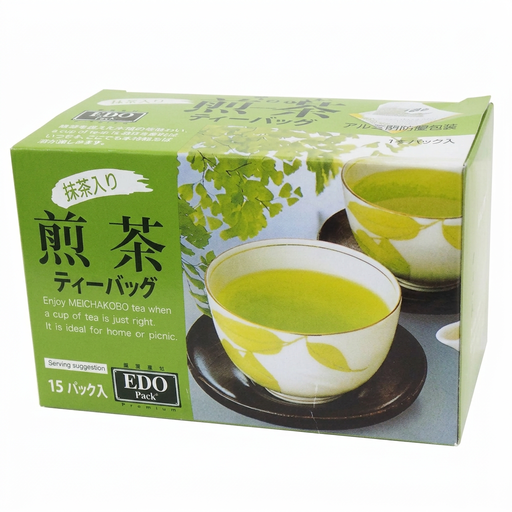
Cooling Hydration EDO Matcha Injected Sencha Pyramid Tea Bags 30g

Cooling Hydration EDO Matcha Injected Sencha Pyramid Tea Bags 30g

The stated pyramid-bag format suits a steeped drink at breakfast, rather than a whisked matcha drink. The listed blend is described as 98% green tea and 2% green tea powder; check the current ingredients to establish exactly what the powder is. Follow the pack’s brewing directions and check its bag-material information if those details matter to your choice.

View on Joybuy

Questions about matcha bags at breakfast

Is a matcha pyramid bag the same as whisked matcha?

No. M&S Food defines matcha as finely ground tea-leaf powder, and ITO EN describes preparing it by whisking. A matcha-labelled bag can instead be an infused blend: Clearspring Matcha Sencha contains 97.5% sencha and 2.5% matcha.

How can I compare the matcha in different tea bags?

Read each product’s ingredient list and stated percentage. Tesco Groceries lists Twinings Super Green Matcha as 84% green tea and 15% matcha, while Clearspring lists its Matcha Sencha as 97.5% sencha and 2.5% matcha. Those figures describe ingredients, not which drink you will prefer.

How should I brew a matcha-containing bag?

Follow the instructions for the particular product. Clearspring advises letting freshly boiled water cool before a one- to two-minute infusion for its Matcha Sencha; Canton Tea recommends 80°C for two to three minutes for its green-tea pyramid bags. Do not apply either method to every blend.

Should I add milk to a matcha bag with breakfast?

That is a matter of taste, so choose according to the drink you want. If a rich, malty cup is your aim, M&S Food describes its breakfast tea that way; it describes its Pure Green Tea as best enjoyed without milk. Neither description sets a rule for every matcha blend.

What should I check on a multi-ingredient blend?

Check the current pack’s full ingredient and allergen information, especially if a particular ingredient matters to you. Waitrose advises checking product labels because recipes can change rather than relying solely on an online listing.