Hosts planning self-service tea
Individually portioned bags let guests steep their own drinks. For 240 bags, a 20-bag format requires twelve packs; check that you can provide hot water and cups for the service.


For a self-service dinner needing 240 tea bags, twelve 20-bag packs provide the required count. Choose a matcha genmaicha blend if roasted rice suits the menu, or matcha sencha if you would rather serve tea without roasted rice. Pure matcha powder is a different serving plan: someone must measure and mix the drinks, while a single pre-packed 240-bag matcha box needs its contents confirmed with the supplier before ordering.
Individually portioned bags let guests steep their own drinks. For 240 bags, a 20-bag format requires twelve packs; check that you can provide hot water and cups for the service.
Clearspring lists roasted brown rice in its Matcha Genmaicha and sencha with matcha in its Matcha Sencha. Both are bagged blends containing 2.5% matcha, not pure matcha powder.
Pure matcha powder suits a plan to whisk drinks or prepare lattes rather than leave tea bags for guests. Allow for measuring, mixing and checking any other ingredients used in the finished drink.
Settle the serving format first, then check the ingredient list and the quantity needed for your chosen recipe.
| Priority | What to check | Your needs |
|---|---|---|
| Serving workload | For bags, check the count per pack and infusion directions. For powder, check the measure and mixing method for each drink. | I want guests to make their own tea without someone measuring and whisking every serving. |
| Product type | Read the full ingredients: Clearspring lists 2.5% matcha in each of its named bagged blends, while its premium powder lists 100% matcha. | If I expect whisked matcha, a tea bag containing matcha alongside other ingredients is not the same drink. |
| Flavour ingredients | Clearspring Matcha Genmaicha lists roasted brown rice alongside sencha and matcha; its Matcha Sencha lists sencha and matcha. Check the precise product before ordering. | Roasted rice might fit my dinner, but I would choose the sencha blend if I do not want that ingredient. |
| Quantity | Twelve 20-bag packs make 240 bags. Clearspring suggests 1g of its powder for a drink, making 240g for 240 such portions before recipe changes or spillage. | I need to know whether my target is 240 individually bagged portions or 240 drinks prepared to a particular recipe. |
| Guest information | Check caffeine details for the exact tea or powder and the ingredients of anything added to it. A powder figure cannot establish the caffeine in a brewed tea bag. | I want guests to know what is in their drink, particularly if they are watching their caffeine intake or avoiding an added ingredient. |
Clearspring’s bagged Matcha Genmaicha and Matcha Sencha each list 2.5% matcha, whereas its premium matcha powder lists 100% matcha. They also call for different preparation.
Check the ingredients and choose a bagged blend for steeped tea or powder for a drink you intend to whisk or mix.
A count of 240 does not establish that the bags contain matcha: Tesco’s named 240-bag product is black tea.
If one pre-packed box matters, confirm the exact product, ingredients and bag count with the supplier. Otherwise, twelve confirmed 20-bag packs provide 240 bags.
Clearspring’s preparation suggestion uses 1g of powder per drink. At that measure, 240 drinks require 240g before changes to the recipe or spillage, and every drink needs mixing.
Decide on the actual drink recipe and how it will be served before calculating powder quantities.
Clearspring’s estimated caffeine figure for 1g of its powder does not give the caffeine content of a bagged blend. The NHS advises that total caffeine intake during pregnancy should not exceed 200mg a day.
Identify drinks containing caffeine and check information for the exact product being served; do not calculate a tea bag’s caffeine from the powder measure.
These references cover different formats and buying routes; they do not establish that a single 240-bag matcha box is available.
Clearspring lists 20-bag Matcha Genmaicha and Matcha Sencha blends, alongside pure matcha powder in 40g, 100g and 1kg formats.
JING Tea describes separate ceremonial and latte matcha formats and offers a wholesale route for hospitality service.
Teapigs has a matcha category and a trade channel serving cafés, restaurants and hotels.
Tesco Groceries lists 20-bag matcha tea products as well as matcha powders and other drink formats.
Waitrose & Partners lists matcha-containing tea bags and matcha powder products in its green-tea range.
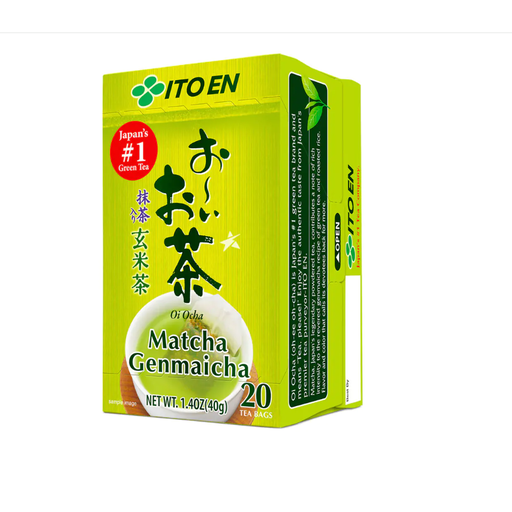
This matcha genmaicha option is a 20-bag format for a self-service dinner; twelve boxes would provide 240 bags, not one pre-packed 240-bag box.
 No image available
For self-service tea, twelve boxes of 20 bags provide 240 individually bagged portions. Check the ingredients, brewing directions and caffeine information for this specific tea before serving.
Confirm the exact contents with the supplier before relying on a single 240-bag box. The named Clearspring matcha blends come in 20-bag packs, while Tesco’s named 240-bag tea product is black tea; the bag count alone does not identify the tea.
Twelve packs make 240 tea bags, allowing one bag per serving. This calculation does not provide extra bags for additional cups or guests.
No. Clearspring’s bagged Matcha Genmaicha lists sencha, roasted brown rice and 2.5% matcha. Its pure matcha powder is a separate format that is whisked into a drink rather than steeped in a bag.
Using Clearspring’s suggested 1g measure per drink, 240 drinks would use 240g of its powder before any recipe variation or spillage. Set the recipe and portion size before ordering, since powder is not a direct substitute for 240 tea bags.
Identify matcha drinks as containing caffeine and use information for the exact product and portion served. Clearspring’s powder estimate cannot establish the caffeine in its tea bags. The NHS advises a limit of 200mg of caffeine a day during pregnancy, including caffeine from drinks and other foods.