Fairtrade-first shoppers
If certification determines what goes into your basket, check the mark on the exact matcha product. An origin or ethical-sourcing statement answers a different question.


For a Fairtrade-first matcha top-up, check the current product for an applicable FAIRTRADE Mark rather than treating organic status, Japanese origin or direct-sourcing claims as equivalent. If you want matcha to whisk or use in recipes, check that you are buying powder rather than a matcha-containing tea blend. Fairtrade certification and physical traceability of the leaves are separate questions.
If certification determines what goes into your basket, check the mark on the exact matcha product. An origin or ethical-sourcing statement answers a different question.
If you plan to whisk matcha, make a latte or use it in baking, check the ingredients and format for pure matcha powder rather than relying on the words “matcha tea”.
If knowing where the tea came from matters to you, look for specific origin and sourcing information. Assess a brand’s traceability statements separately from Fairtrade certification.
Decide whether certification, powder format or origin is essential to your purchase, then check those details on the particular product.
| Priority | What to check | Your needs |
|---|---|---|
| Fairtrade certification | Look for an applicable FAIRTRADE Mark on the current pack or product page. Check whether the claim names the product or a particular ingredient; do not substitute general ethical wording. | Fairtrade sourcing is essential to my top-up, so an organic or origin claim alone will not settle the choice. |
| Product format | Read the ingredients and identify whether the product is pure matcha powder or a tea blend containing matcha. Check how the pack is intended to be prepared. | For whisking or recipes, I want matcha powder. For a brewed tea, a matcha-containing blend may fit what I have in mind. |
| Physical traceability | Check for specific garden, origin or batch information if you need it. The Fairtrade Foundation explains that certified commodities may mix with non-certified ones, so a Fairtrade claim alone does not establish physical separation. | Knowing the origin of the leaves matters to me as well as the terms represented by certification. |
| Origin and organic status | Check the stated country of origin and organic claim on the exact product. Assess each separately from any FAIRTRADE Mark. | I may prefer Japanese or organic matcha, but I do not want either description mistaken for Fairtrade certification. |
A matcha powder can meet an origin or organic preference without establishing that it meets a Fairtrade-first buying criterion.
Check the applicable FAIRTRADE Mark on the exact product; consider origin and organic status as separate details.
A matcha-containing tea blend is not the same format as pure powder for whisking or adding to recipes.
Read the ingredient list and preparation directions before choosing your top-up.
The Fairtrade Foundation explains that certified commodities may mix with non-certified ones. A certification claim therefore does not, by itself, identify the exact leaves in a pack.
If physical traceability is essential, check for specific origin or batch information as well as the certification claim.
The product you pick up may not match an earlier listing, which matters when you are choosing by ingredients or certification.
Check the current pack’s mark, ingredients, format and weight before buying.
These examples help distinguish product formats and sourcing claims; a statement about one range does not establish certification for every matcha product.
Clearspring lists a Premium Grade Japanese matcha powder for drinking and baking.
JING Tea presents organic ceremonial matcha from Kagoshima and describes its own direct-sourcing approach.
M&S discusses Fairtrade tea and matcha drinks, but those statements need to be applied to the right product.
Waitrose lists matcha powders and matcha-containing tea products, making format an important part of the choice.
These powder options suit a top-up for preparing matcha drinks or recipes. If Fairtrade certification determines your purchase, check the applicable mark on the exact current product before choosing either one.
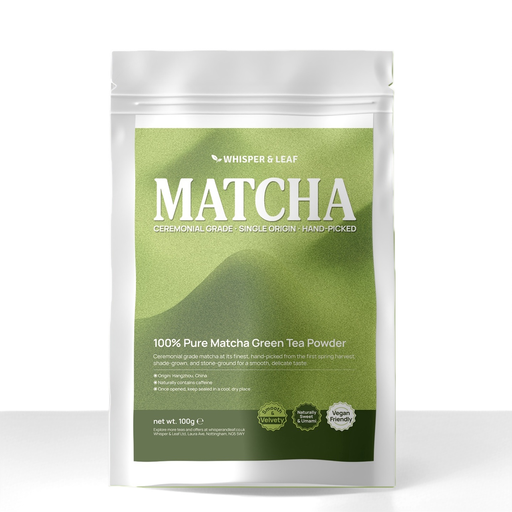 No image available
A powder option to consider if you want matcha for whisking or lattes. The listed bag size is 100g; check the current pack for an applicable FAIRTRADE Mark if certification is part of your choice.
 No image available
An organic matcha powder option in a listed 30g size for a smaller top-up. Organic wording does not establish Fairtrade certification, so check the current pack for the applicable mark if you need it.
Look for an applicable FAIRTRADE Mark on the current product and check what the claim covers. Do not treat general ethical-sourcing wording as a substitute for certification.
No. Organic status and Japanese origin describe different product characteristics from Fairtrade certification. Check each claim separately on the exact matcha product.
Not necessarily. The Fairtrade Foundation explains that certified commodities may mix with non-certified ones, so check for specific origin or batch information if physical traceability matters to you.
Choose pure matcha powder if you want to whisk it or use it in lattes and recipes. A matcha-containing tea bag is a different format for brewing, so check the ingredients and preparation directions before buying.