What matters when choosing
Decide whether you need a spot check after cooking or an alarm during cooking. Then check the probe and display against the size of your loaf and how you will use the thermometer.
| Concern |
What to check |
Who this matters to |
| Centre-temperature checks |
Choose a food probe whose tip reaches the thickest part of your loaf, with a Celsius display covering 75°C. |
When I portion a cooked loaf for later meals, I want to know what its centre has reached, not just how browned it looks; around 45% of consumers put that dependable centre check first. |
| Monitoring during cooking |
For an alarm, confirm that the probe and lead are rated for oven use and that the display remains outside. |
If I am preparing other batch-cooking tasks, I would rather be alerted than keep opening the oven to take a reading. Around 33% of consumers prioritise hands-off monitoring. |
| Simple operation |
Check display legibility, the stated temperature range and the exact model’s cleaning instructions. |
For an occasional loaf, I want a straightforward reading without managing a probe cable or alarm; roughly 22% of consumers put that simple spot check first. |
Joybuy products for spot checks
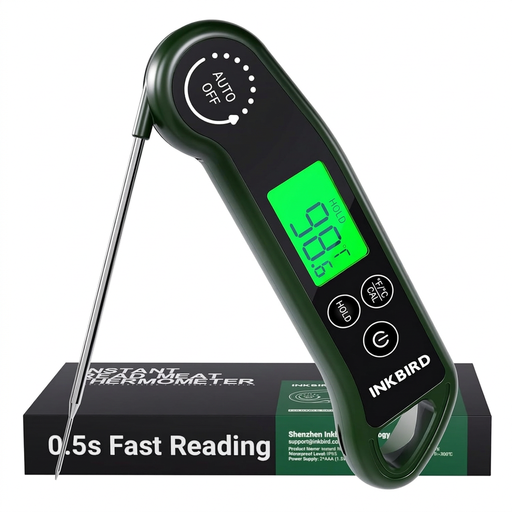
This instant-read option is relevant to an end-of-cook meatloaf check. Before choosing it, confirm that its probe reaches the centre of your usual loaf and that its Celsius range covers the temperature you need to check.
 No image available
INKBIRD RHT-11K K-Sensor Digital Meat Thermometer, Green
Consider this handheld meat thermometer for a spot check at the end of cooking, rather than continuous oven monitoring.
The product name describes an LCD screen and a 0.5-second instant function. Check how the reading stabilises, whether the probe reaches the centre of your loaf, and whether the display reads in °C across the temperature you need. Do not leave it in the oven unless the exact model is specified for that use.
View on Joybuy
Common questions
What temperature should I look for in the centre of a meatloaf?
Food Standards Scotland advises a reading of 75°C or above in the thickest part of food. GOV.UK food-business guidance gives 75°C for 30 seconds as one time-and-temperature combination for thorough cooking; follow any applicable packet or recipe instructions as well.
Where should I put the probe in a meatloaf?
Place the tip in the centre or thickest part, without touching the tin. For a large loaf, check more than one position so a reading near the edge does not stand in for the middle.
Can an instant-read thermometer stay in the oven?
Only if the exact model is designed for leave-in oven use. A standard handheld instant-read thermometer is for spot checks; with a purpose-built leave-in system such as Thermapen’s DOT, the specified probe and lead go into the oven while the display remains outside.
How should I clean the probe after a meatloaf check?
Clean the probe after use to avoid carrying food residue into another check. Follow the thermometer’s cleaning instructions, and do not immerse a handheld unit unless its instructions allow it.
What should I do with meatloaf cooked for later meals?
Cool and store the portions promptly after cooking. For England, Northern Ireland and Wales, GOV.UK advises dividing food into smaller portions, refrigerating it within one to two hours and eating leftovers within 48 hours or freezing them; Food Standards Scotland advises cooling cooked food quickly and keeping it refrigerated for up to two days.


