For a one-person meatloaf, an instant-read digital probe is the straightforward choice if you only need to check the centre near the end of cooking. Choose a leave-in oven probe if you want to monitor the temperature as it rises and receive an alert; either way, the food-contact probe needs cleaning after use.
Who each type suits
Occasional single-portion cook
If you only need a final check, a clean instant-read probe lets you take a reading at the centre of the loaf without setting up an oven monitor. GOV.UK describes using a clean food thermometer to check whether food is thoroughly cooked.
Cook who wants a stated accuracy tolerance
If measurement uncertainty matters to you, look beyond the number of decimal places on the display. Thermapen states a ±0.3°C accuracy tolerance for its Thermapen ONE, alongside a one-second reading and a calibration certificate.
Cook who wants an oven alert
A leave-in model suits you if you would rather follow the meatloaf’s temperature during cooking than rely on a final spot-check. Salter describes its leave-in thermometer as continuously monitoring temperature and sounding an alarm.
What matters when choosing
For a small meatloaf, decide whether you want one centre-temperature check or continuous monitoring, then compare the features that matter within that type.
| Concern |
What to check |
Who this matters to |
| Checking the centre |
Check that the probe can measure the centre of the loaf and that its Celsius range covers the cooking target. Look for a stated accuracy tolerance if measurement uncertainty matters to you. |
If I want reassurance that minced meat is cooked through, I need a centre reading rather than a judgement based on the crust; around 50% of consumers put that core-temperature check first. |
| Quick final check |
Compare the stated reading time and display legibility; allow the reading to stabilise before relying on it. |
When I only need one reading near the end, I want to see it clearly without holding the probe in place for long; roughly 30% of consumers prioritise a quick spot-check. |
| Monitoring during cooking |
Confirm that the probe and lead are intended for oven use and that the model offers the alert you want. |
If I would rather follow the internal temperature while the loaf cooks, an oven alert matters more than a simple final check; about 20% of consumers place continuous monitoring first. |
Mistakes to avoid
-
Confusing display increments with accuracy
A thermometer showing tenths of a degree does not necessarily measure within a tenth of a degree. Salter states 0.1°C display increments for its basic instant-read model, while Thermapen states a separate ±0.3°C accuracy tolerance for Thermapen ONE.
If that uncertainty affects your choice, compare stated accuracy tolerances rather than display resolution alone.
-
Checking the edge instead of the centre
An edge reading does not tell you the temperature at the centre of a loaf-shaped minced-meat dish. GOV.UK advises using a clean probe in the centre when checking whether food is thoroughly cooked.
Insert the probe into the thickest central part, avoiding contact with the tray, and compare the stable reading with the applicable cooking instructions.
-
Reusing a probe without cleaning it
A probe that has touched raw meat can transfer contamination to other food.
Clean the food-contact probe after each use and before using it on ready-to-eat food, following the thermometer’s care instructions.
-
Assuming any digital probe can stay in the oven
An instant-read thermometer is not automatically suitable for continuous in-oven use; an unsuitable probe or lead may be damaged or give an unreliable reading.
Choose a model explicitly intended for leave-in monitoring and check its permitted cooking conditions before use.
Relevant thermometer brands
Thermapen
An instant-read option for cooks who want a manufacturer-stated response time and accuracy tolerance.
- Thermapen states that its ONE model gives a one-second reading, has ±0.3°C accuracy and IP67 water resistance, and comes with a calibration certificate.
- Those specifications apply to Thermapen ONE; they are not a measure of how every thermometer will perform in a particular meatloaf.
Salter
Offers basic and foldable instant-read models as well as a separate leave-in monitoring model.
- Salter states a −45°C to 200°C range for its basic instant-read model and 2–3 second readings for its foldable model. Its leave-in model is described as providing continuous monitoring and an alarm.
- A 0.1°C display increment on the cited instant-read models should not be read as an accuracy tolerance.
Lakeland
Its oven-probe model is an option to consider if you want to watch the meat’s temperature while it cooks.
- Lakeland describes its oven probe thermometer as monitoring meat during cooking.
- Check the model’s permitted oven conditions and measurement specifications before comparing it with an instant-read thermometer.
Joybuy products for this task
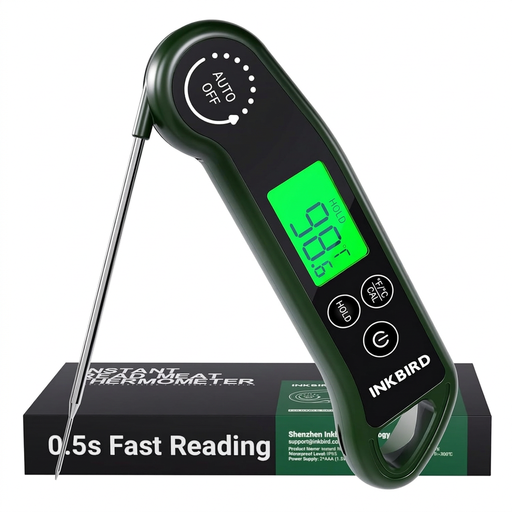
This digital meat thermometer is worth examining if you want a quick reading while roasting. Before choosing it for meatloaf, confirm that its measuring method lets you probe the centre.
 No image available
INKBIRD RHT-11K K-Sensor digital meat thermometer, green
For cooks considering a quick meat-temperature check while roasting, this model is listed as an instant digital thermometer; confirm that it can measure at the centre of a meatloaf.
The product title states a 0.5-second reading and an LCD screen. Check its temperature range, Celsius display, measurement accuracy and cleaning instructions before using it for this task.
Joybuy
Common questions
What temperature should I check for in a meatloaf?
Follow the recipe or packaging instructions where they give a specific cooking requirement. GOV.UK’s food-business guidance gives 70°C for 2 minutes as standard advice, with 75°C for 30 seconds among its alternatives; Food Standards Scotland advises 75°C for minced-meat products. Check the centre rather than relying on a browned surface.
Where should I put the probe in a small meatloaf?
Insert a clean probe into the thickest part at the centre, avoiding the tray where possible. GOV.UK describes checking thoroughly cooked food with a clean thermometer probe inserted into its centre.
Do I need to clean the thermometer between checks?
Yes. Clean the food-contact probe after each use to avoid cross-contamination, and follow the thermometer’s instructions before using it on ready-to-eat food.
When does a leave-in probe make sense for one meatloaf?
Choose a leave-in probe if you want to follow the internal temperature during oven cooking and receive a target-temperature alert. Salter describes those functions for its leave-in model; if one final centre check is enough for you, an instant-read probe is the simpler arrangement.


