Occasional holiday-cottage cooks
If you mainly want to check one meatloaf before serving, a compact probe for a manual centre-temperature reading fits the task. Check its temperature scale, range and cleaning instructions before packing it.


For a final check on a meatloaf in a holiday cottage, a compact instant-read probe is the straightforward choice: look for Celsius readings, a range covering 75°C and a probe that can reach the thickest part. Food Standards Scotland advises checking that part of the food for 75°C or above. Choose a leave-in alarm model if you want to monitor the meatloaf as it cooks, rather than take a manual reading near the end.
If you mainly want to check one meatloaf before serving, a compact probe for a manual centre-temperature reading fits the task. Check its temperature scale, range and cleaning instructions before packing it.
A large Celsius display, an adjustable viewing angle or a hold function can help when you cannot comfortably read the screen beside a hot oven.
If you want to follow the temperature during cooking without repeatedly opening the oven, consider a probe designed to stay in the food and sound an alarm at a chosen target.
Start with a probe you can use for a clean reading at the meatloaf’s centre. Then decide whether portability, screen handling or continuous monitoring matters most for your stay.
| Concern | What to check | Who this matters to |
|---|---|---|
| Centre temperature | Look for Celsius readings, a range covering at least 75°C and a probe that can reach the thickest part of the loaf. | If I am serving a minced-meat dish, I want a reading from its centre rather than judging it by cooking time. Confirming the centre temperature is the primary concern for around 36% of consumers. |
| Portability | Consider a folding or protected probe and check how its parts should be cleaned and stored. | When I pack for a cottage stay, I want a thermometer that is easy to carry and put away after a manual check. Around 29% of consumers put that practical handling first. |
| Readability | Compare Celsius display size and whether a pivoting screen or reading-hold function would help at your oven. | If the display is awkward to see beside the oven, I want to read the result without lingering near the heat. Clear reading and handling come first for around 21% of consumers. |
| Ongoing monitoring | Check that the probe is designed to remain in the food during cooking and that its alarm and cable arrangement suit your oven. | For a larger roast, I may want an alert instead of taking repeated spot checks. Continuous monitoring is the main need for around 14% of consumers. |
Loaf size, dish shape and an unfamiliar oven can affect cooking time. GOV.UK identifies minced-meat products as foods that need cooking thoroughly throughout.
Insert a clean probe into the thickest part, away from the tin. Food Standards Scotland advises checking for 75°C or above before serving.
Reusing an unclean probe can transfer contamination between checks.
Clean the probe after use and before it touches cooked food, following the thermometer’s care instructions.
A stated fast response, accuracy tolerance and calibration documentation may matter more with frequent cooking than with a single final check.
For occasional cottage use, establish that the display, range and probe suit the meatloaf check before weighing up those additional features.
A leave-in probe adds positioning and monitoring steps that a quick final reading does not require.
Choose an alarm model when you want to follow the roast during cooking; otherwise, consider an instant-read probe for the manual check.
Thermapen ONE is an instant-read option for cooks who value published response, accuracy and protection specifications.
The named Salter models cover two different tasks: a foldable probe for manual readings and a leave-in model for monitoring.
OXO’s Chef's Precision Digital Instant Read Thermometer is worth considering when screen visibility is a priority.
The Taylor Pro Digital Meat Thermometer Probe is a manual-check option with features for viewing a reading away from the oven.
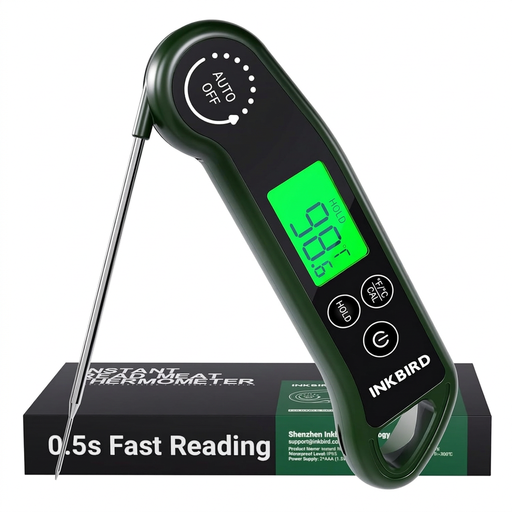
The Joybuy product below is described as an instant-read meat thermometer for a manual check, not a leave-in monitor. Check its temperature scale, range and probe design against the meatloaf task before choosing it.
 No image available
This instant-read model is a possible choice for a manual meat-temperature check and has an LCD screen. Before using it for meatloaf, confirm that it displays Celsius, covers 75°C and has a probe that can reach the thickest part; check its cleaning instructions as well.
Food Standards Scotland advises inserting a thermometer into the thickest part of the food and checking for 75°C or above. GOV.UK also identifies products made from minced meat as foods that should be cooked thoroughly throughout; follow any instructions supplied with the meat or recipe too.
Insert a clean probe into the centre or thickest part of the meatloaf, without touching the tin. Food Standards Scotland advises checking a large dish in more than one place if needed.
No: an instant-read probe can take the final centre-temperature reading. Choose a leave-in model if you also want continuous monitoring and an alarm during cooking, and position it according to its instructions.
Clean the probe after use to avoid transferring contamination, but follow the particular model’s care instructions before rinsing or immersing any part of it. Do not assume the whole thermometer can go under water simply because its probe needs cleaning.