Long-form manuscript editors
If you regularly move between chapters and revise passages, access to arrows, deletion and page-navigation commands may matter more than the smallest possible keyboard.


For frequent movement through a manuscript, start with a full-size or tenkeyless mechanical keyboard whose editing keys you can reach directly. A compact wireless model makes more sense when desk space, carrying the keyboard or switching devices matters more, while switch choice matters if you write near other people. Beside a bright window, deal with screen reflections separately: keyboard backlighting will not remove glare from the screen.
If you regularly move between chapters and revise passages, access to arrows, deletion and page-navigation commands may matter more than the smallest possible keyboard.
If you write near family, colleagues or a microphone, check the named switch variant rather than assuming every mechanical keyboard will sound alike. Printed legends also matter if you look down to find editing shortcuts.
If your draft moves between a laptop, tablet and desktop, connection options and device compatibility deserve attention alongside the space a keyboard takes up by the window.
Decide how often you need dedicated editing keys before choosing a smaller layout; then check device connections, switch sound and key visibility for the room where you write.
| Concern | What to check | Who this matters to |
|---|---|---|
| Manuscript navigation | Inspect access to arrows, Home, End, Page Up, Page Down and Delete, including any shortcuts required on a compact layout. | When I revise long chapters, I want to move and delete text without repeatedly hunting for a shortcut. Around 40% of consumers put direct editing-key access first. |
| Desk space and devices | Check the physical layout, the connection methods you need and compatibility with each device you use. | A smaller board would leave room for my notes, but I also need to move between the devices holding my draft. For around 30% of consumers, compact multi-device use comes first. |
| Sound and key visibility | Choose the exact switch variant and inspect its printed legends; position the screen and manage window light separately. | Writing near other people makes typing sound important to me, and I still need to find unfamiliar keys as the light changes. These are the leading concerns for around 30% of consumers. |
A lit keyboard can help you locate keys, but it cannot remove reflections from a display. The Health and Safety Executive advises arranging screens and lighting to avoid reflections and glare.
Adjust the screen position and window light first. Consider keyboard illumination separately if finding keys remains difficult.
A smaller board may put familiar manuscript-editing commands behind shortcuts, even when its wireless connections suit your desk.
Inspect the exact physical layout and how you will use arrows, Home, End, Page Up, Page Down and Delete before ordering.
Logitech lists Tactile Quiet, Clicky and Linear versions of the MX Mechanical Mini. The version you select matters when others share the room.
Check the named switch variant and whether its sound is suitable for your workspace; the word mechanical alone does not settle that choice.
The Health and Safety Executive notes that glare and workstation setup can contribute to awkward posture. A different keyboard does not address those conditions by itself.
Consider screen placement, chair height, available desk space, lighting and breaks alongside the keyboard, particularly during sustained writing sessions.
These product lines illustrate different layout and switch choices; check the exact variant rather than treating a brand name as a specification.
Keychron UK describes both compact low-profile and full-size UK-ISO mechanical options, including the K3 Max and K10 Pro.
The MX Mechanical Mini is a compact low-profile option for a desk shared with other devices.
Das Keyboard presents writer-oriented mechanical models with conventional editing controls and printed or blank keycap choices.
These keyboards include a full-size option and several smaller wireless or multi-mode layouts for memoir editing. Compare each physical layout and its editing-key access with the way you revise; a product title alone cannot settle how comfortably its switches will sound in your room.
 No image available
Consider this full-size option if you have desk space for a 108-key board; inspect the precise editing-key arrangement before relying on it for manuscript navigation.
The title specifies tri-mode wireless use, hot-swappable switches, an 8000mAh battery and a US layout. Silent Tactile is the named switch variant, not a measured sound level; check whether its typing sound and physical layout suit you.
 No image available
Consider this 75% wireless model if a smaller keyboard suits your desk, but check how you would reach every editing command you use regularly.
Confirm the physical key layout rather than relying on UK in the title, and assess switch sound and legend visibility if you write in a shared space.
 No image available
Its compact layout may appeal if notes and a screen compete for desk space; check the shortcuts for the editing keys you use most.
The title specifies wired, Bluetooth and 2.4G modes, PBT keycaps and a US QWERTY layout. Check whether that physical layout suits your UK typing habits and whether the selected switches sound suitable nearby.
 No image available
This 80% model is worth considering when you want a smaller desk footprint without choosing a 75% board; inspect its editing-key access before committing to it for long revisions.
The title specifies tri-mode operation and a US QWERTY layout. Check the physical key arrangement against your typing habits and assess the installed switch sound for your room.
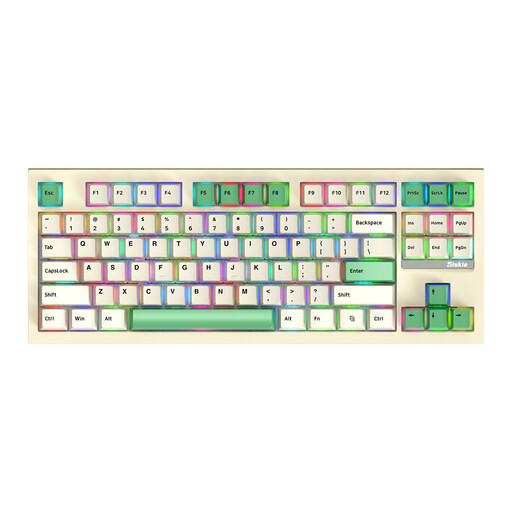 No image available
Consider this smaller 87-key layout if you want space for notes beside your manuscript; inspect the positions of Home, End, Page Up, Page Down and Delete before buying.
The title specifies detachable switches and RGB lighting. Check the physical key layout, printed legends and installed switch sound if those details affect your writing setup; lighting will not correct screen glare.
Backlighting may help you locate keys, but it will not fix reflections on your screen. Logitech says the MX Mechanical Mini adjusts its lighting to surrounding conditions; for glare, follow the Health and Safety Executive’s advice to arrange the screen and lighting to avoid reflections.
The Health and Safety Executive does not prescribe a particular mechanical keyboard. For workers who use display screen equipment daily as a normal part of work for continuous periods of an hour or more, its guidance calls for an assessment of the workstation, work conditions and individual requirements.
Choose blank keycaps only if you can already touch-type reliably without looking down. Das Keyboard cautions that blank keys are for people who do not need to find keys visually; printed legends are more useful if you look for symbols or unfamiliar shortcuts while revising.