What to check before buying
For a quiet-study writing setup, check the fitted switch first, then decide which typing feel, key arrangement and desk footprint you can work with.
| Concern |
What to check |
Who this matters to |
| Typing noise |
Check for a named silent switch or a reduced-noise claim for the exact variant; a switch designation alone cannot establish the sound of the finished keyboard. |
If I share a quiet study, I want to draft without repeatedly drawing attention to my keystrokes. Around 36% of consumers put noise control first. |
| Typing feedback |
Compare linear and tactile feel, and confirm that any replacement switches fit a hot-swappable board. |
While revising a pitch, I want the keypress to feel right over sustained typing, whether that means a smooth stroke or a tactile cue. Typing feel comes first for roughly 29% of consumers. |
| UK layout and editing keys |
If you need UK ISO, inspect the exact variant’s layout, punctuation keys and navigation cluster. |
Frequent punctuation and editing shortcuts make familiar key positions more important to me than a smaller keyboard. About 21% of consumers give layout and key access priority. |
| Desk footprint |
Check which keys a compact layout retains and which connection options the selected model offers. |
With notes, reference material and a mouse on my desk, I need a keyboard that fits the workspace without losing keys I use often. Desk and setup flexibility is the main concern for around 14% of consumers. |
Joybuy keyboards for this setup
These mechanical keyboards offer different combinations of switch choice, layout and desk footprint for writing. Check the exact fitted switches and expected typing sound before relying on any of them for a quiet study; the variants explicitly labelled US layout will not suit everyone who needs UK ISO keys.
 No image available
Ticktype DP104, Gecha Gray, Silent Tactile switches
Consider this variant if you want tactile feedback and a full-size key arrangement while drafting and editing.
Its title specifies 108 keys, hot-swap support, tri-mode wireless operation, an 8000mAh battery and a US layout.
Confirm that its Silent Tactile switch sound suits your room; choose a different layout if familiar UK ISO key positions are essential.
View on Joybuy
 No image available
MACHENIKE KG87 80%, Latte Switch, Pink
Its 80% layout is worth considering when you need to leave more desk space for pitch notes and reference material.
The title identifies tri-mode operation, Latte switches and a QWERTY US layout.
Check how this exact switch configuration sounds before choosing it for a quiet study, and make sure the US key arrangement works for your writing.
View on Joybuy
 No image available
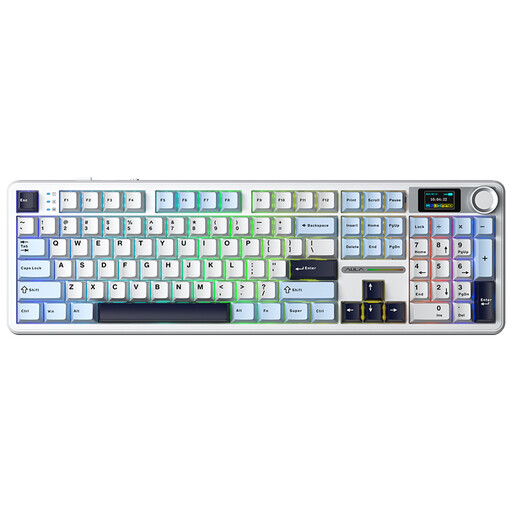
AULA F108 Pro, Reaper Linear switches, Light Blue
Consider this variant if you prefer a linear switch and want to compare wired and wireless connection options for your desk.
Its title identifies hot-swap support and Bluetooth, 2.4G and USB-C connections.
Confirm the physical layout and the sound of the fitted Reaper Linear switches before treating it as suitable for quiet-study writing.
View on Joybuy
 No image available
AULA F75 75%, QWERTY US layout
The 75% layout is an option if desk space matters, provided you are comfortable with its editing-key arrangement.
The title specifies wired, Bluetooth and 2.4G connection options, PBT keycaps and a US layout.
Check which switches are fitted to the exact variant and how they sound; the product name’s sound description does not establish quiet-study performance.
View on Joybuy
Common questions
Should I choose clicky switches for a quiet study?
A clicky switch is a poor starting point when keeping disturbance low is your main requirement. Logitech G describes clicky switches as providing audible feedback; check a named silent-switch configuration instead, while remembering that the finished keyboard can still make other sounds.
Does a red or brown switch name mean a keyboard will be quiet?
No: a broad colour or switch-family name does not establish the sound of the finished keyboard. CHERRY describes its specific MX2A Silent Red switch as linear and damped, so check the complete switch name and the exact keyboard variant rather than relying on the colour alone.
When is a hot-swappable keyboard useful for writing?
It is useful if you want the option to change switch feel later, particularly while deciding between quiet linear and quiet tactile typing. Keychron says its K4 Pro ISO supports hot-swapping MX mechanical switches; check the socket and replacement-switch compatibility for whichever board you choose.
Do I need a UK ISO keyboard for a magazine pitch?
Choose UK ISO if you rely on its familiar physical key positions for punctuation and editing. Inspect the exact product variant rather than assuming that a keyboard sold to UK consumers has that layout; Keychron UK, for example, identifies UK ISO models in a dedicated collection.
What should I do with a keyboard I replace in the UK?
Check an appropriate electrical-equipment recycling or take-back route for the old keyboard. UK guidance from the Office for Product Safety and Standards and the Department for Environment, Food & Rural Affairs identifies the WEEE Regulations 2013, as amended, as the legislation supporting recovery, reuse and recycling of electrical equipment.


