Choose a keyboard that fits your standing workstation before deciding which mechanical switches or extra features you want. The Health and Safety Executive advises keeping the keyboard central and just below elbow height; from there, a quieter switch option may suit a shared writing space, a compact layout can leave more room beside the keyboard, and a full-size layout makes sense if you regularly use a numpad. Check the exact physical layout and switch variant, since those can differ within a product range.
Who these choices suit
Long-form standing-desk writers
If you draft and revise interview profiles while standing, keyboard position, familiar key placement and switch sound may matter more to you than gaming controls. The Health and Safety Executive advises placing the keyboard centrally, just below elbow height, without twisting your back.
Multi-device interview researchers
If you check notes and source material across a computer, phone or tablet, a keyboard with switching between compatible devices may make those transitions easier. Check the connection options for the exact keyboard and devices you plan to use.
Writers who need a numpad
If preparing profiles regularly involves figures, timecodes or spreadsheets, a full-size layout keeps a dedicated numpad available. Allow for the extra keyboard width when arranging your mouse on the standing desk.
What to consider when buying
Set up the standing desk first, then decide how much switch noise you can accommodate and which keys and connections your drafting routine requires.
| Concern | What to check | Who this matters to |
|---|
| Workstation fit |
Check that the keyboard can sit centrally just below elbow height, with room to keep the mouse close. The Health and Safety Executive advises positioning the mouse in line with the elbow. |
I want to draft for extended periods without arranging the desk around an awkward keyboard position. Around 42% of consumers put workstation fit first. |
| Switch sound and feel |
Confirm the switch variant in the exact listing; a product-family name alone does not tell you whether you are choosing a quiet, linear or clicky option. |
When I write near colleagues, housemates or recorded audio, the sound and feel of each keystroke affect my choice. For around 33% of consumers, this is the primary concern. |
| Layout and workflow |
Inspect the physical UK layout, decide whether you need navigation keys or a numpad, and check connection compatibility with your devices. |
I switch between research devices or rely on particular keys while editing, so the key arrangement and connections need to suit that routine. Those workflow needs come first for around 25% of consumers. |
Mistakes to avoid
-
Expecting the keyboard to fix the workstation
A different keyboard will not, by itself, correct raised shoulders, a long mouse reach or a screen that makes you twist. The Health and Safety Executive’s positioning advice concerns the workstation as a whole.
Adjust the desk so the keyboard sits centrally just below elbow height, and check the mouse and screen positions before choosing extra keyboard features.
-
Assuming a UK listing has a UK physical layout
ANSI and ISO key arrangements differ, including around Enter and left Shift. An unfamiliar arrangement can matter when you enter punctuation and symbols frequently.
Look for an explicit UK-ISO or UK Layout option for the exact variant, and inspect its key arrangement before ordering.
-
Assuming every mechanical switch suits a shared room
Switch options differ in sound and feel. A clicky variant may be distracting near other people or recorded audio, while a quiet-sounding product description is not a measured noise result.
Check the switch named in the selected configuration and, where possible, assess whether its sound and feel suit your writing space.
-
Choosing a size without considering your keys
A tenkeyless layout removes the numpad, while a full-size layout occupies more desk width. Either compromise can be inconvenient if it conflicts with the keys you use or the space available for your mouse.
Think through a typical interview-profile assignment: choose a smaller layout if space matters more, or retain a numpad if numeric entry is a regular part of the work.
Brands to consider
Logitech
The MX Mechanical range is a low-profile mechanical option for writers interested in different switch choices and switching between compatible devices.
- Logitech UK lists Tactile Quiet, Clicky and Linear switch choices, with Easy-Switch for up to three devices.
- The range includes full-size and Mini versions. Check the exact size, switch and physical layout rather than assuming every variant has the same keys.
Keychron
The Q3 Max and Q6 Max offer UK-ISO choices at different sizes for writers considering a configurable mechanical keyboard.
- Keychron UK lists the Q3 Max as an 80% tenkeyless model and the Q6 Max as full-size, with wired USB-C, 2.4 GHz and Bluetooth connection options.
- Choose the assembled configuration, switch and size deliberately: the Q3 Max omits the numpad, while the Q6 Max takes more desk space.
Razer
The BlackWidow V4 Low-Profile HyperSpeed is a gaming-oriented option to consider if its additional physical controls would also serve your writing workflow.
- Razer’s UK listing offers a UK Layout selection and tactile-quiet, clicky or smooth-silent switch options.
- Its roller and additional controls need not influence a drafting-focused choice unless you have a use for them; check the exact switch and layout selected.
Joybuy keyboard choices
These keyboards offer different ways to balance desk space, key availability, layout and connection preferences while drafting at a standing desk. Check each variant against your physical UK-layout preference before choosing.
 No image available
Ticktype DP104, 108-key US layout, Gecha Gray, Silent Tactile switches
Consider this full-size keyboard if a numpad is part of your regular drafting or data-entry routine and you have room for it beside the mouse.
The named variant has 108 keys, a US layout, Silent Tactile switches and tri-mode connectivity. Check that the US key arrangement suits your typing needs and that its dimensions fit your desk; the switch name does not establish a measured noise level.
View on Joybuy
 No image available
AULA F75, 75% US-layout mechanical keyboard
Consider the 75% layout if you want a smaller keyboard footprint at the standing desk and do not depend on a numpad.
The title specifies wired, Bluetooth and 2.4 GHz modes and a US layout. Check the exact switch variant, keyboard dimensions and physical key arrangement before choosing it for a shared writing space.
View on Joybuy
 No image available
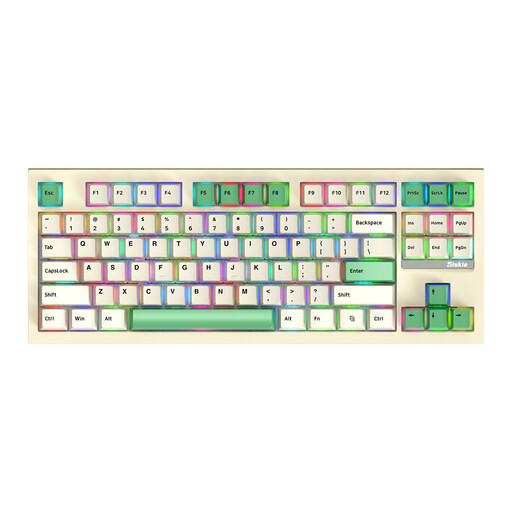
Siukie PL87W, 87-key three-mode mechanical keyboard
The 87-key format is worth considering if you want a keyboard without a numpad for your drafting desk.
The title identifies three connection modes and detachable switches. Confirm the physical key layout and dimensions against your UK typing habits and available desk space.
View on Joybuy
 No image available
HyperX Alloy Rise 75 Wireless Keyboard UK
This wireless model may interest writers looking at a smaller keyboard for a standing desk while moving between devices.
Check its physical key arrangement and dimensions for your setup: the word UK in the title does not, by itself, establish the key layout. Confirm that the switch sound suits your working environment.
View on Joybuy
 No image available
ASUS ROG Falchion Ace HFX 65, UK layout
Consider this model if a UK physical layout matters to you and a wired keyboard fits your fixed-desk setup.
The named variant specifies a UK layout. Check its dimensions against your desk and confirm suitability for your operating system; its stated compatibility is for Windows 10/11.
View on Joybuy
Common questions
Should I adjust my standing desk before choosing a keyboard?
Yes: arrange the workstation first, then choose a keyboard that fits it. The Health and Safety Executive advises keeping the keyboard central and just below elbow height, with relaxed shoulders and the mouse in line with the elbow.
Do I need a UK-ISO layout to write interview profiles?
Not necessarily, but choose UK-ISO if its physical key arrangement is the one you know and want to keep. Logitech explains that ISO and ANSI differ around keys including Enter and left Shift; confirm the exact variant rather than relying on the country where it is sold.
Is a quiet mechanical switch always preferable for writing?
No: a quieter option is worth considering when others can hear you type or recordings are made nearby, but switch feel remains a personal choice. Logitech lists Tactile Quiet, Clicky and Linear MX Mechanical variants, so check which switch the selected keyboard actually has.
Does UK display screen equipment guidance specify a mechanical keyboard model?
No particular mechanical keyboard model is specified in the Health and Safety Executive’s workstation guidance. Its guidance on UK Display Screen Equipment Regulations describes their application to employers whose workers use screen equipment regularly as a significant part of normal work, including daily continuous periods of an hour or more; keyboard choice should be considered as part of the whole workstation.


