Noise-conscious shared-desk editor
You spend long stretches editing copy beside someone else and want mechanical keys without an intrusive audible click.


For theatre-programme editing at a shared desk, start with the exact switch and the space available for typing, papers and a mouse. A compact keyboard makes sense if you can work without a dedicated number pad; choose a full-size quiet-switch model when physical numeric and shortcut keys matter more than desk width. Check the physical key layout and connection requirements of the precise variant before buying.
You spend long stretches editing copy beside someone else and want mechanical keys without an intrusive audible click.
You need room for proofs and a mouse, or you move between a computer and another device. A smaller layout must still leave the editing keys you use within easy reach.
You frequently use commands, layout-specific symbols or numeric input and need to decide whether remapped compact keys can replace dedicated physical ones.
Choose the switch variant for the people sharing your desk, then decide how much keyboard width you can give up without slowing your editing workflow.
| Concern | What to check | Who this matters to |
|---|---|---|
| Typing noise | Check the fitted switch, not just the model family. Logitech lists Tactile Quiet and Clicky as distinct MX Mechanical Mini options. | When someone works beside me, I want mechanical feedback without a pronounced click interrupting them. Around 36% of consumers would put noise control first. |
| Desk space | Measure the usable width alongside proofs and a mouse; check which arrow, function and navigation keys the compact layout retains. | I need space to spread out programme pages without pushing the mouse aside. For around 29% of consumers, fitting the editing setup on the shared desk comes first. |
| Shortcuts and devices | Check operating-system compatibility, device switching and whether remapping needs a cable or particular software. | Repeated editing commands or moving between devices shape how I work, so I want those controls to fit my setup. Shortcut and device flexibility would be the primary concern for around 21% of consumers. |
| Dedicated keys | Decide whether numeric entry and separate controls justify a full-width board; allow space for papers and mouse movement. | If I enter figures often, I would rather keep a physical number pad than rely on key layers. Around 14% of consumers would prioritise the full layout. |
The switch fitted to a keyboard affects its sound: Logitech offers Tactile Quiet and Clicky as separate MX Mechanical Mini variants, while Joybuy's keyboard guide notes that a clicky switch adds an audible click.
If disturbing a neighbour is your main concern, look for a specifically described quiet or silent switch and confirm that it is the variant selected at checkout.
Physical symbol positions can differ. Keychron identifies UK-ISO versions of its K3 keyboards, while the Ticktype DP104 listing identifies a US layout.
Check the stated physical layout and the keys you use for programme copy, rather than relying on the retailer location or keyboard size.
More dedicated keys also occupy desk width. PCMag UK describes the Kensington MK7500F QuietType Pro as taking considerable desk space.
Measure your keyboard area with proofs and a mouse in place. If a number pad is not essential, compare that fit with a compact layout.
Connection and setup requirements vary: Keychron says configuring the K3 Version 3 through Launcher requires a wired connection, while the be quiet! Light Mount is wired-only.
Check the exact model's connection modes and whether its configuration tool works with your work computer.
The MX Mechanical Mini offers a compact, multi-device route for editing.
The K3 Max and K3 Version 3 provide documented UK-ISO, low-profile 75% options.
The MK7500F QuietType Pro represents a full-size route with dedicated controls.
The Light Mount is a full-width option for a fixed, wired workstation.
The F108 Pro represents a full-size, multi-connection mechanical route.
These full-size and compact keyboards offer different ways to organise a programme-editing desk. Compare the exact switch, physical layout and space needed for each model before deciding how well it fits a shared workspace.
 No image available
Consider this if dedicated keys matter more to your editing than saving desk width; check that its US key positions suit your copy work.
The listed configuration has 108 keys, Silent Tactile switches and Bluetooth, 2.4 GHz and wired connection options. Its quiet description does not establish how it will sound beside a colleague.
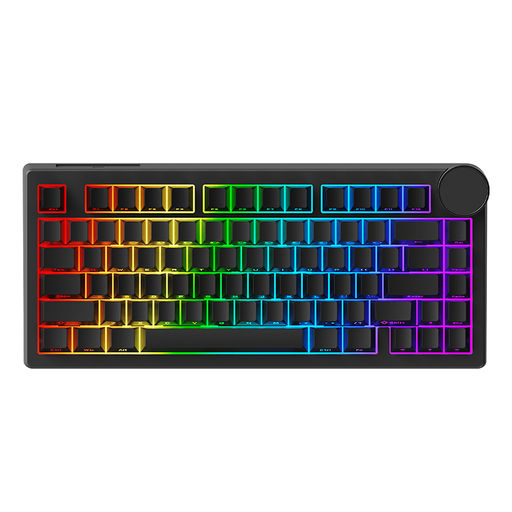 No image available
The 75% layout is worth considering when proofs and a mouse compete for desk space, provided its keys fit your editing workflow.
This is a wired model with HE magnetic switches. Check the switch sound, physical symbol layout and whether its remapping setup works on your work computer before choosing it for a shared desk.
 No image available
Consider its 80% layout if you want a smaller board but can work with the stated US key positions.
The listed variant has tri-mode connectivity and a gasket mount. Do not assume those features establish a suitable typing sound for your neighbour; check the exact switch and available desk space.
 No image available
The 75% layout may suit an editor who needs to free up desk space and switch between devices.
The listed keyboard is wireless and has linear switches. Confirm its physical key positions and switch sound for your shared desk; check whether the retained keys cover any numeric entry you do regularly.
Not if keeping the audible click down is your priority. Joybuy's keyboard guide notes that clicky switches can be loud in a shared workspace; check for a specifically described quiet or silent switch on the exact variant instead.
You do not have to choose UK-ISO, but it is worth checking if you rely on familiar UK symbol positions. Keychron identifies UK-ISO K3 variants, whereas the Ticktype DP104 configuration listed here has a US layout; compare the physical keys before buying.
Some models can. Logitech says the MX Mechanical Mini switches between up to three devices, and Keychron says the K3 Max connects by Bluetooth to three devices; confirm the connection modes and compatibility of the precise keyboard you choose.
It does for configuration through Keychron Launcher on the K3 Version 3: Keychron specifies a wired connection for that setup. Other keyboards can have different requirements, so check the configuration instructions and work-computer compatibility for your model.