Writers in shared spaces
If other people are nearby while you write, compare the exact switch option and any documented sound damping. A linear switch is a sensible starting point, but the whole keyboard affects the sound.


For essay writing, choose a switch sound and feel you can live with through a long session, then check that the physical layout and keys suit the way you type. A compact board leaves more room for notes, while a full-size board keeps a dedicated number pad; lighting can be useful as daylight changes, but it does not establish that the keys will be easy to read beside your window.
If other people are nearby while you write, compare the exact switch option and any documented sound damping. A linear switch is a sensible starting point, but the whole keyboard affects the sound.
A 75% or tenkeyless board can leave more room beside a laptop and paper notes. Check that it retains the editing keys you use, and be prepared to do without a dedicated number pad.
If you move between devices or continue writing as the light changes, confirmed device switching and adjustable illumination may be useful. Choose the layout and switch before treating either feature as decisive.
Start with the decisions that could interrupt your writing: sound, physical key layout and desk fit. Consider connection modes and lighting once those essentials work for you.
| Concern | What to check | Who this matters to |
|---|---|---|
| Switch sound and feel | Compare the exact linear, tactile or clicky switch variant and any documented case damping. | If I write near other people, I want each paragraph to be less distracting without giving up mechanical keys. Around 31% of consumers put quieter typing first. |
| UK layout and editing keys | Confirm the physical UK-ISO variant, the keys retained by its size and your device’s input-layout setting. | When punctuation and editing shortcuts are part of my routine, unfamiliar printed keys would slow me down. For around 31% of consumers, familiar key positions are the primary concern. |
| Desk footprint | Compare 75%, tenkeyless and full-size layouts against the space available for notes and a pointing device. | I need room to keep my notes beside the keyboard, but I still want a comfortable position for typing. Desk fit comes first for around 23% of consumers. |
| Connection and lighting | Check the stated connection modes, device-switching support and lighting controls for the exact model. | If I draft across devices or keep writing after the daylight changes, I want the setup to adapt without interrupting me. Around 15% of consumers prioritise that flexibility. |
Clicky switches can be more noticeable than linear ones, while case construction and damping also affect the sound. Corsair’s general switch guidance is not a sound measurement for an individual keyboard.
Check the switch in the exact variant you intend to buy and look for documented damping if noise is your main constraint.
Changing an operating system’s input setting does not change the positions or legends printed on a keyboard. That distinction matters when you type punctuation from habit.
If you rely on a UK layout, confirm UK-ISO for the exact hardware variant and check your device’s input setting.
A 75% or tenkeyless layout makes a different trade-off from full-size: it saves desk space but has no dedicated number pad.
List the navigation, function and number-entry keys you regularly use before deciding how small to go.
Lighting that responds to ambient conditions may be convenient later in the day, but it does not establish how clearly a particular keyboard’s legends will appear beside a bright window.
Consider keycap contrast and desk position in your own setup; treat illumination as a secondary feature.
Its MX Mechanical range offers low-profile options for writers weighing desk space, a number pad and device switching.
Its UK-ISO K1 Version 6 is worth comparing if physical layout and tenkeyless sizing are priorities.
Its UK K65 Plus Wireless offers a compact 75% option with linear switches and documented sound damping.
These options cover compact and full-size mechanical keyboards for a writing desk. Check the physical layout carefully: a UK label in a product name does not, by itself, confirm UK-ISO keys, and several options explicitly specify a US layout.
 No image available
Consider this 75% wireless option if desk space matters, but confirm the physical layout and printed legends before relying on familiar UK punctuation keys.
Check key visibility at your window-side desk rather than assuming that its lighting features resolve glare.
 No image available
The 80% format suits a desk where you want a smaller keyboard; this variant specifies a US physical layout, so check whether its legends fit your typing habits.
The product name also identifies a gasket mount and Latte Switch-Pink variant. Do not treat a reduced-noise description as a measured sound level.
 No image available
This 75% option may fit a desk shared with notes or a laptop, provided its specified US layout suits your punctuation habits.
Its name identifies tri-mode connectivity and a Gateron White Switch variant; check the exact keys you need for editing.
 No image available
Choose the full-size format if a dedicated number pad matters more than keeping the keyboard narrow. This 108-key variant specifies a US layout, so check its printed legends against your usual keys.
The product name identifies tri-mode connectivity, hot-swapping and an 8000 mAh battery. “Silent Tactile” is the switch variant’s name, not a measured quietness result.
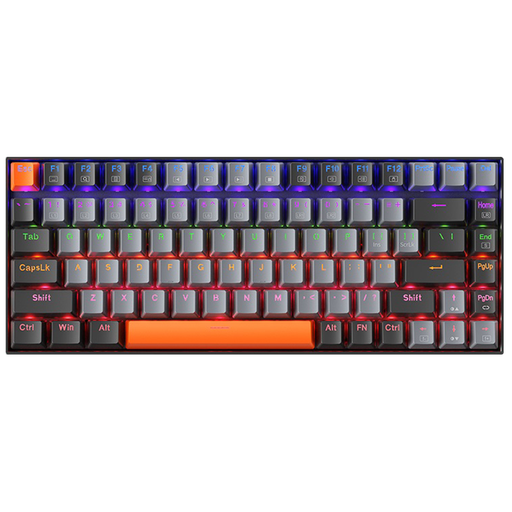 No image available
This wired 75% option suits a desk where a compact format matters more than wireless switching. Its stated US layout needs checking if you normally use UK key positions.
The product name specifies Red Switch and LED backlighting; the lighting alone does not establish bright-window key visibility.
No: a bright window alone does not make backlighting essential. Logitech describes lighting that adjusts to ambient conditions on its MX Mechanical range, which may be useful if you continue writing as the light changes; check the keys’ legibility at your own desk.
Choose a confirmed UK-ISO variant if you want the printed legends and physical key positions to match your usual UK typing habits. Microsoft Support explains that Windows input layouts can be changed, but a software setting cannot change the keyboard’s physical keys.
Start with linear or explicitly quiet switch options and check whether the board has documented damping. Corsair’s general guidance describes linear switches as quieter than tactile or clicky types, but that does not establish a sound level for every keyboard or variant.
Confirm the exact connection modes, compatibility with your device and any device-switching limit for the model you choose. Also check the physical layout and switch variant: a wireless connection will not make unfamiliar keys easier to use for essay writing.