Noise-conscious shared-desk writers
You draft for extended stretches near someone else and want to consider switch and case noise before choosing a mechanical keyboard.


For a shared writing desk, start with the exact switch option and the keyboard’s sound-dampening features rather than gaming-oriented features. Then choose a physical layout that suits your punctuation, editing and numpad habits: a smaller board frees desk space but removes keys, while a full-size board keeps the numpad.
You draft for extended stretches near someone else and want to consider switch and case noise before choosing a mechanical keyboard.
You want familiar UK-ISO key positions for punctuation-heavy drafting and may need a numpad for work beyond the manuscript.
You move between writing devices or need the keyboard to fit alongside other things on a shared desk.
Check the fitted switches and layout first; once those suit your writing routine, compare desk footprint and connection options.
| Concern | What to check | Who this matters to |
|---|---|---|
| Typing noise | Confirm the fitted switch type and look for model-specific silent-switch or case-dampening details. Do not assume a mechanical keyboard is quiet because it is marketed for work. | If I draft beside someone else for hours, audible keypresses could interrupt them. Around 50% of consumers put shared-desk noise first. |
| Layout and key set | Check the selected variant’s physical layout, particularly UK-ISO key placement, and whether it retains the numpad. | Familiar punctuation positions matter when I am writing and editing a chapter; around 30% of consumers make layout and key-set familiarity their primary concern. |
| Desk space and devices | Compare the board’s size and omitted keys, then confirm its connection modes and device-switching limit. | I need room for other work on the desk, or I move between writing devices. For around 20% of consumers, workspace and device flexibility come first. |
Clicky switches are designed to give audible feedback. Logitech distinguishes its quieter linear option from clicky switches, while Razer and be quiet! describe sound-reducing features on specific models.
Check the switch fitted to the exact variant and any model-specific damping details before deciding whether its sound is likely to suit your workspace.
Physical key positions can differ between variants, affecting the punctuation keys you use while drafting.
Look for an explicitly labelled UK-ISO configuration and check the selected variant’s layout photographs or selector.
A tenkeyless (TKL) board removes the numpad. That saves desk width but may disrupt other tasks if you use a dedicated numeric keypad.
Consider the keys you use for editing, research and work beyond the novel before choosing TKL or another compact format.
Connection modes and device-switching limits vary between keyboard models.
Confirm whether the selected variant offers the wired, Bluetooth or 2.4 GHz mode you need, along with any required receiver and its charging method.
Its low-profile MX Mechanical range includes a full-size board and the smaller MX Mechanical Mini.
Its Q6 Max range includes a full-size UK-ISO configuration with wired, Bluetooth and 2.4 GHz connection options.
Its Pro Type Ultra is a full-size productivity keyboard positioned around quieter typing and multi-mode connectivity.
Its Light Mount TKL Silent Linear is listed in a UK-ISO variant.
These compact and full-size mechanical keyboards offer different ways to fit a shared writing desk. Each listed variant has a German or US layout rather than UK-ISO, so check its key arrangement before choosing it for familiar UK-layout drafting.
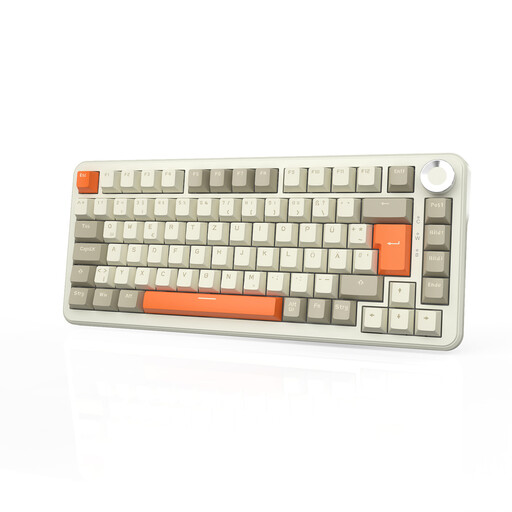 No image available
Consider this compact option if saving desk space matters and a German QWERTZ key arrangement suits your writing.
 No image available
Consider this full-size option if you use a numpad and want to assess a variant listed with Silent Tactile switches.
 No image available
Consider this smaller board if desk width and a choice of connection modes matter more than retaining a full-size key set.
Start by comparing quiet linear or explicitly silent switch options rather than clicky ones. Logitech describes its clicky switches as audible and its linear switches as quieter; check the exact switches fitted to the keyboard you intend to buy, since the complete board’s sound also matters.
Choose an explicitly labelled UK-ISO variant if familiar UK physical key positions matter to your writing. Keychron identifies UK-ISO Q6 Max variants, but a UK storefront alone does not establish the layout of every keyboard it shows.
Choose full-size if you use a dedicated numpad; choose TKL if freeing desk width matters more and you can work without it. For example, be quiet! describes its Light Mount TKL as an 80% layout without a numpad.
Some models can, but check the switching limit and connection modes of the exact keyboard. Logitech says MX Mechanical switches between up to three devices, while Keychron lists Bluetooth connections to three devices for Q6 Max; those model-specific details should not be assumed for other keyboards.