
24/7 Customer Support

Free returns

Same-day & Next-day Delivery

Quality Guaranteed

Unlock Your Welcome Offers: FREE Delivery | Up to 80% OFF | Free 30-day JoyPlus trial
Download the APP
Whether you're a seasoned mechanic, a weekend DIY enthusiast tackling your first car repair or a homeowner in need of a reliable kit, selecting the right mechanics tool set can feel overwhelming. The market is flooded with options, and it's easy to fall for common marketing traps that leave you with a box of tools that fail when you need them most.
As a Joybuy Product Recommendation Officer, my role is to help you see past the hype. This guide will highlight the critical pitfalls to avoid and break down the essential features to look for, ensuring you invest in a tool set that is both practical and durable for your tasks in the UK.
Before you add any kit to your basket, be aware of these common issues that often lead to buyer's remorse:
To make an informed choice, focus on the functional specifications that truly matter. Here are the three non-negotiable elements to check.
A quality Cr-V tool set should specify that it is heat-treated. This process hardens the steel, giving it the strength to handle high torque without deforming. Also, look for the finish. A fully polished chrome finish is easy to wipe clean of grease and offers good rust resistance. A matte chrome finish provides a better grip and is also highly resistant to corrosion. For screwdriver bits within a set, look for S2 steel, which offers higher hardness and impact resistance than standard Cr-V.
The heart of any ratchet and socket set is the ratchet itself. Its quality is defined by its internal gear mechanism, measured in teeth.
Look for a quick-release button, which allows you to change sockets with one hand and a clearly marked directional switch to toggle between tightening and loosening.
A versatile car repair tool kit should include the three main drive sizes. Each is suited to different tasks:
For UK users, a metric and imperial socket set is highly advisable. While most modern cars use metric fasteners, you'll frequently encounter imperial (SAE) sizes on older British vehicles, American cars and some household equipment.
Instead of a one-size-fits-all approach, we've matched some tool sets to specific user needs.
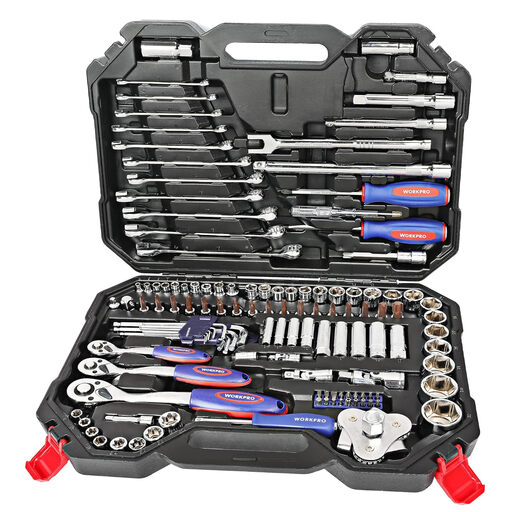
Why This Fits Their Persona: This set is ideal for the UK homeowner or car enthusiast who needs a comprehensive DIY tool kit. It covers a wide array of tasks, from assembling flat-pack furniture to performing basic car maintenance like oil changes or brake pad replacements, without the expense of a specialist professional kit.
It avoids the "inflated piece count" trap by providing a balanced selection of genuinely useful tools, including sockets, spanners and hex keys, rather than just filler. The durable blow-moulded case ensures tools stay organised.
Includes 1/4", 3/8" and 1/2" drive ratchets and sockets, offering great versatility. The tools are chrome-plated for rust protection.
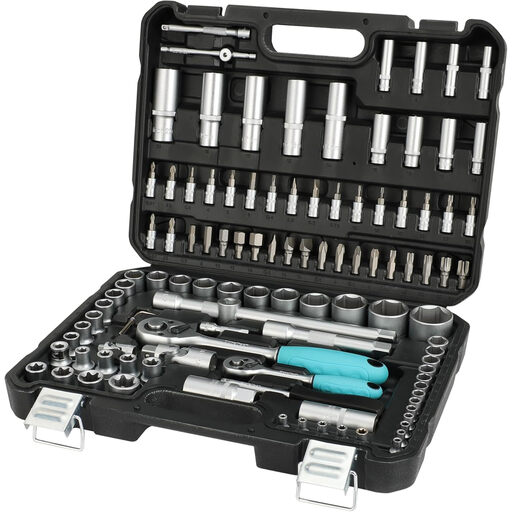
Why This Fits Their Persona: For those who use their tools daily and demand reliability, this professional socket set is built to withstand rigorous use. It's suited for automotive technicians or serious enthusiasts who need tools that won't fail under high torque.
This set directly counters the "substandard steel" trap by explicitly using heat-treated Cr-V for sockets and higher-hardness S2 steel for bits. The focus is on material integrity and durability, not just piece count.
The use of S2 steel for bits provides superior wear and impact resistance. The 72-tooth ratchets offer a good balance of precision and strength.
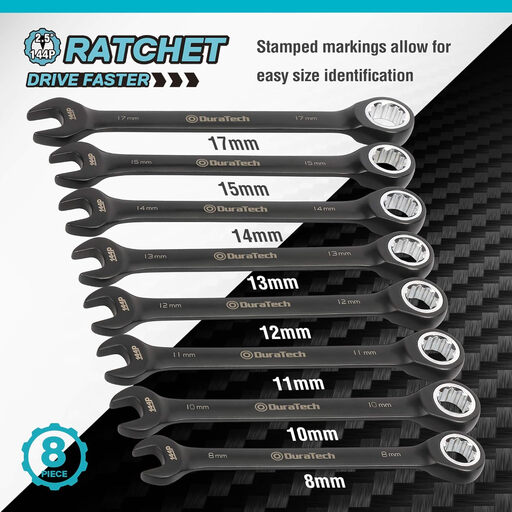
Why This Fits Their Persona: This is a specialist tool for any mechanic who has ever been frustrated by a bolt they can't reach. It's not a primary tool kit, but an essential addition for working in the confined spaces of modern engine bays, machinery or plumbing.
It avoids being a "master of none" by focusing on one high-performance feature. Instead of a huge, generic set, it delivers a specific solution to a common and frustrating problem, making it a high-value addition to a toolkit.
The 144-tooth ratchet gear requires only a 2.5-degree swing arc, offering exceptional access in tight spots. The included roll-up pouch provides convenient, organised storage.
We have compiled a complete, real-time list of products that fully satisfy these strict selection criteria and UK safety regulations.
1. What is the difference between a 1/4", 3/8" and 1/2" drive socket set? The drive size refers to the size of the square post that connects the ratchet to the socket. A 1/4-inch drive is for small, low-torque fasteners, like those found on interior car panels or electronics. A 3/8-inch drive is the most common all-rounder, perfect for general engine work and household repairs. A 1/2-inch drive is for heavy-duty jobs requiring high torque, such as loosening wheel lug nuts or suspension bolts. Many comprehensive kits include all three.
2. How can I prevent my tools from rusting? Rust is the enemy of any steel tool, especially in the UK's damp climate. To prevent it, always wipe your tools clean of grease, moisture and dirt after use. Store them in their case in a dry environment. For long-term protection, you can apply a very light coating of machine oil or a dedicated rust-inhibiting spray to the metal surfaces, especially the moving parts of a ratchet.
3. Is a metric or imperial socket set more useful in the UK? For modern work, a metric socket set is essential. Almost all cars and products manufactured in the last 30 years use metric fasteners (measured in millimetres). However, if you work on classic British cars, American vehicles or older machinery, you will frequently encounter imperial (SAE) sizes (measured in inches). For maximum versatility, a set that includes both a metric and imperial socket set is the most practical choice for a UK-based user.