
24/7 Customer Support

Free returns

Same-day & Next-day Delivery

Quality Guaranteed

Unlock Your Welcome Offers: FREE Delivery | Up to 80% OFF | Free 30-day JoyPlus trial
Download the APP
Buying a mechanics tool set can seem straightforward until a socket slips, a ratchet fails to reach a recessed bolt or half the advertised pieces turn out to be small screwdriver bits. For UK car owners, home mechanics and workshop tradespeople, the right kit should match the fasteners you work with, the available space and the level of torque required.
A carefully selected set can cover routine maintenance, motorcycle repairs and household jobs without forcing you to buy individual tools repeatedly. The key is to look beyond the piece count and assess the construction, drive sizes, measurements and storage system.
A 300- or 400-piece kit may include duplicate bits, small accessories and sizes you rarely use. It may still lack useful items such as deep sockets, spark plug sockets, extensions or a suitable torque wrench.
Check the actual contents list. For general vehicle maintenance, a practical combination usually includes 1/4-inch, 3/8-inch and 1/2-inch drives, ratchets, extensions, screwdriver bits, hex keys and a useful range of metric sockets.
Metric fasteners are common on vehicles sold and maintained in the UK, but imperial or SAE sockets can still be useful for older vehicles, imported models, machinery and certain bicycles or motorcycles. A set labelled “universal” may not include both measurement systems.
If you work on different vehicles, check whether the kit contains clearly marked metric and imperial sockets, and confirm which sizes are supplied in each drive format.
“Chrome vanadium” or Cr-V steel tools can indicate a suitable material for general fastening work, but material alone does not tell you how well a tool will suit demanding use. Look at heat treatment, chrome plating, ratchet tooth count, handle design and the manufacturer’s care instructions.
A fine-tooth ratchet can be convenient in restricted spaces, but it should not be used as a substitute for a breaker bar when a fastener is seized. Similarly, powered tools are designed to speed up removal and installation, not to replace controlled final tightening.
Drive size determines how a socket connects to the ratchet and how much force the assembly is generally intended to handle.
A useful socket set should also state whether sockets are shallow, deep or a mixture of both. Deep sockets can reach nuts on extended studs, while shallow sockets are easier to use where clearance is limited.
A 72-tooth ratchet wrench set typically requires a smaller swing arc than a coarse-tooth mechanism. This can make a difference when working around engine bays, suspension components or motorcycle frames. A quick-release button helps change sockets efficiently, while a reversible direction switch avoids removing the tool from the fastener.
For confined areas, a swivel-head ratchet or flex-head design may provide additional access. However, a flexible head should be locked or controlled properly before applying significant force.
A standard ratchet is not a measuring instrument. For wheel fasteners, engine components and other applications where the vehicle or component manufacturer specifies a torque value, use a torque wrench and follow the relevant service information.
When comparing digital models, check:
A torque wrench should be returned to its recommended storage setting after use, kept clean and protected from knocks. Do not use it as a general-purpose breaker tool unless the manufacturer specifically permits this.
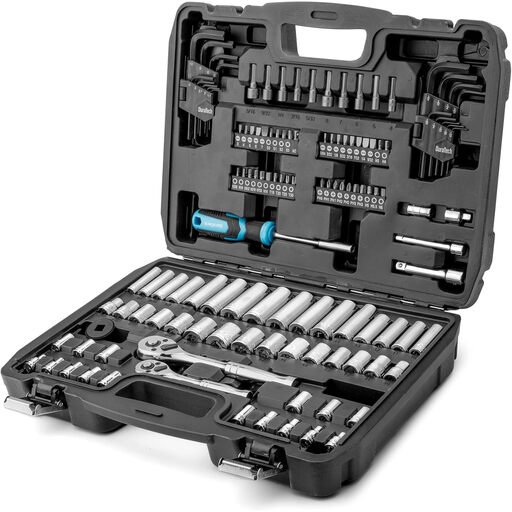
Why This Fits Their Persona: A practical starting point for UK drivers, new DIY users and motorcycle owners who need a broad selection in one carrying box.
The contents are specified rather than relying only on the headline piece count, with 47 metric and SAE sockets, two ratchets, extensions, hex keys and screwdriver bits.
Heat-treated Cr-V steel, high-visibility size markings, a 72-tooth ratchet and organised storage case.
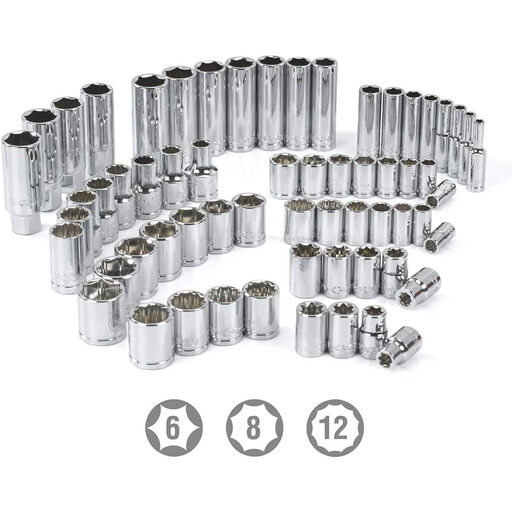
Why This Fits Their Persona: Suitable for a home garage, vehicle owner or workshop buyer who values broad coverage and labelled storage.
The four-tray blow-moulded case gives each tool a designated position, helping reduce misplaced pieces in a busy garage.
Includes 1/4-inch, 3/8-inch and 1/2-inch drive tools, metric and imperial sockets, spanners, bits and hex keys.
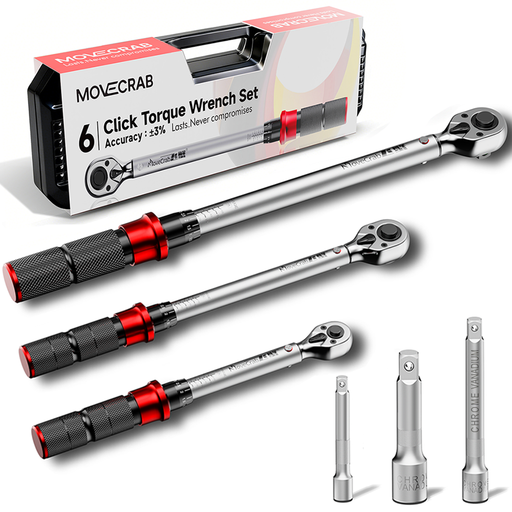
Why This Fits Their Persona: A choice for users working across bicycles, motorcycles, cars and industrial maintenance tasks with different torque requirements.
The three wrench ranges cover 5–25 N·m, 20–110 N·m and 40–220 N·m, rather than forcing one tool to cover every application.
Includes 1/4-inch, 3/8-inch and 1/2-inch extension rods; the listing states a ±3% deviation specification.
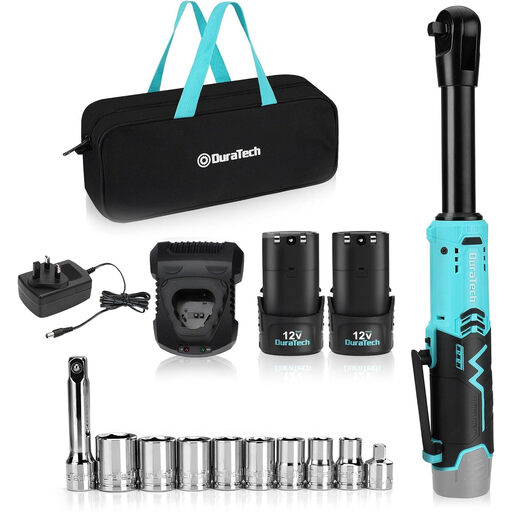
Why This Fits Their Persona: Useful for repeated fastening work in tight engine bays, motorcycle frames and areas where a hand ratchet is slow to operate.
The 3/8-inch drive, slim head, forward/reverse switch and LED light address access and visibility issues in confined spaces.
The kit includes two 2,000 mAh batteries, a quick charger, eight sockets, an extension rod and a storage box.
Clean grease and moisture from sockets and spanners after use, particularly during damp UK weather. Keep ratchet mechanisms lightly maintained according to the instructions, and store tools in their case or pouch rather than loose in a vehicle boot.
Avoid using extensions or pipes to increase force on a ratchet unless the manufacturer permits it. For powered tools, use the correct socket, allow the motor to cool during demanding work and keep batteries charged without exposing them to excessive heat or moisture.
We have compiled a complete, real-time list of products that fully satisfy these strict selection criteria and UK safety regulations.
It can cover routine tasks such as replacing trim fasteners, removing accessible bolts and carrying out general maintenance. Check the socket sizes, drive formats and accessories before purchase. Jobs involving wheel nuts, suspension or engine components may also require a suitable torque wrench, breaker bar or specialist automotive repair tools.
Metric sockets are a sensible starting point for many UK vehicles and household repairs. A set containing both systems gives wider coverage for older vehicles, imported models, machinery and specialist applications. Always match the socket precisely to the fastener to reduce the risk of slipping or rounding.
A cordless ratchet wrench can save time when repeatedly removing or installing fasteners, especially in narrow spaces. It is not normally intended to provide final torque control. Use it for running fasteners on or off, then tighten to the specified value with a hand tool or torque wrench where required.