
24/7 Customer Support

Free returns

Same-day & Next-day Delivery

Quality Guaranteed

Unlock Your Welcome Offers: FREE Delivery | Up to 80% OFF | Free 30-day JoyPlus trial
Download the APP
A reliable mechanics tool set is the foundation of any garage or workshop, whether you're a professional technician or a weekend DIY enthusiast. But choosing the right one can feel like navigating a minefield of marketing claims and confusing specifications. A poor choice doesn't just lead to frustration; it can result in stripped bolts, damaged components and wasted money.
As the Joybuy Product Recommendation Officer, I see where many buyers go wrong. Before you invest, let's look at the common pitfalls that can leave you with a box of disappointing metal.
To get a tool set that performs reliably for years, focus on the core specifications, not just the marketing headlines. Here are the non-negotiable factors to check.
The material determines a tool's strength and lifespan. For sockets, spanners and ratchets, look for heat-treated Chrome Vanadium (Cr-V) steel. This process hardens the metal, making it resistant to wear and deformation under high torque. For screwdriver bits, which face different stresses, S2 steel is a superior material known for its hardness and impact resistance, reducing the chance of the tip breaking or "camming out" of a screw head.
The finish is equally important for longevity. A fully polished or matte chrome finish provides a durable barrier against moisture and oil, which is essential for preventing rust in a typical UK garage environment.
The ratchet is the most-used component in any ratchet and socket set. Its design directly impacts your efficiency.
car repair tool kit often includes both 1/4" and 3/8" drives.A comprehensive socket set is crucial. Ensure the kit includes a full range of metric sizes, as these are standard on most modern vehicles. Deep sockets are essential for accessing nuts on long, threaded bolts. A quality spanner set is also a must-have for tasks where a socket won't fit, such as on brake line fittings.
Based on these practical criteria, we've matched some options to different user needs. These selections prioritise functional design and material quality over inflated piece counts.
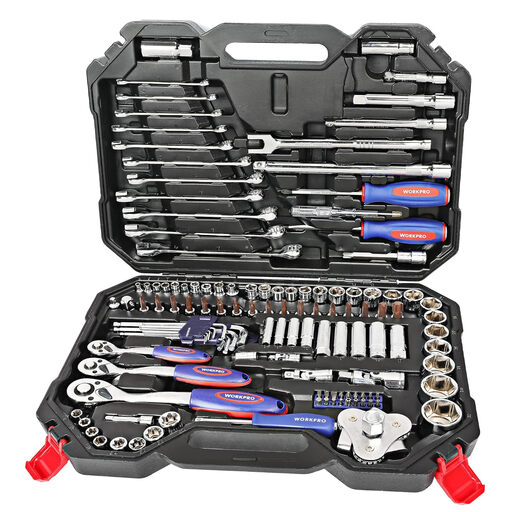
Why This Fits Their Persona: This is an ideal all-in-one DIY tool kit for someone tackling home repairs, flat-pack furniture and basic car maintenance like oil changes or battery swaps. It provides the core tools needed without the high cost or complexity of a professional-grade setup.
It sidesteps the "massive piece count" trap by focusing on genuinely useful tools. Instead of hundreds of obscure bits, it provides a balanced range of sockets, spanners and hex keys that cover most common tasks.
Includes all three common drive sizes (1/4", 3/8" and 1/2"), offering excellent versatility. The tools feature a triple-chrome-plated finish for corrosion resistance.
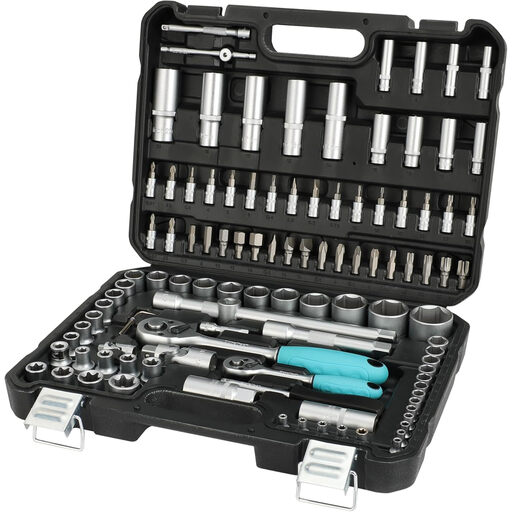
Why This Fits Their Persona: For the person who spends most weekends in the garage, this professional tool set offers the durability and precision needed for more involved jobs like brake replacements, suspension work and engine maintenance.
This set directly counters the "material mirage" by specifying the use of higher-grade S2 steel for its bits, providing greater hardness and wear resistance than standard bits found in cheaper kits.
The 72-tooth ratchets offer smooth operation, and the sturdy blow-moulded case is designed to keep every component securely organised, addressing the "case catastrophe" pitfall.
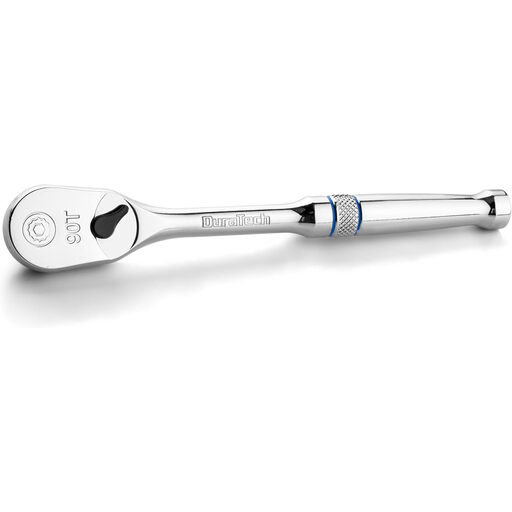
Why This Fits Their Persona: This isn't a full set, but a specific upgrade for a professional or serious hobbyist who already owns a hand tool kit but needs better performance in tight spaces. It's for someone who values precision and efficiency above all else.
By focusing on a single, high-performance component, it avoids the compromise of all-in-one kits. It delivers exceptional performance on one key parameter—access in confined areas—which is often a weakness in budget sets.
The 90-tooth gear requires only a 4-degree swing arc, making it significantly easier to work on bolts in restricted spaces like engine bays or behind dashboards. The enclosed head design also resists dirt and debris.
Drive size refers to the size of the square drive lug that connects the socket to the ratchet.
Generally, a higher tooth count is advantageous. A 90-tooth ratchet requires a smaller swing arc (4 degrees) than a 72-tooth ratchet (5 degrees), making it easier to turn fasteners in tight spaces. However, the teeth on a higher-count gear are smaller and can, in some designs, be more susceptible to breaking under extreme torque. For most users, a quality 72-tooth or 90-tooth ratchet will provide an excellent balance of access and strength.
Corrosion is the enemy of any tool collection. To prevent it, always wipe your tools clean of oil, grease and moisture with a dry cloth after each use. Store them in their case in a dry environment. For long-term storage, applying a very light coat of machine oil or a dedicated rust-inhibitor spray to the metal surfaces can provide an extra layer of protection, especially for tools stored in a damp garage or shed.