
24/7 Customer Support

Free returns

Same-day & Next-day Delivery

Quality Guaranteed

Unlock Your Welcome Offers: FREE Delivery | Up to 80% OFF | Free 30-day JoyPlus trial
Download the APP
A mechanics tool set can look impressive on a product page, yet still leave you without the socket, drive size or storage arrangement you actually need. A high piece count is not automatically useful, and a low price can become expensive if missing accessories force you to buy replacements individually.
Whether you maintain a car on a UK driveway, repair bicycles and motorcycles or handle household maintenance, compare the details below before choosing a socket set or wider DIY tool kit.
A 400-piece box may contain many duplicate bits, small accessories or sizes you rarely use. Meanwhile, a compact 100-piece mechanics tool set may include the essential ratchets, sockets, extensions and hex keys more efficiently.
Check the actual contents rather than relying on the headline number. Look for:
A 72-tooth or 90-tooth ratchet needs less movement to engage, which is useful in confined engine bays and workshop spaces. However, tooth count describes the working arc, not the maximum torque the tool can safely handle.
For stubborn fasteners, use the correct drive size and a suitable breaker bar where appropriate. Avoid using a small 1/4-inch ratchet as a substitute for a larger drive tool when a fastener is seized.
Polished or black chrome surfaces can make tools easier to wipe clean and may help resist surface corrosion. They do not, on their own, confirm the strength of the underlying tool.
Look for heat-treated chrome vanadium steel tools, clearly stated drive sizes and practical design features such as a quick-release ratchet. Always follow the manufacturer’s instructions and avoid using hand tools with powered impact equipment unless they are specifically rated for it.
A 1/4-inch drive is suited to smaller fasteners and lighter jobs, such as interior trim, bicycle components and compact household repairs. A 3/8-inch drive is a versatile middle option for many car and motorcycle tasks. A 1/2-inch drive is more appropriate for larger fasteners and higher-load vehicle work.
If you work on a mix of vehicles and household projects, a set containing two or three drive sizes can be more practical than buying one size in isolation.
UK vehicles generally use metric fasteners, so a metric socket set with common sizes such as 8 mm to 19 mm is a sensible foundation. An imperial socket set or combined metric and SAE selection can be useful for older vehicles, imported machinery and certain bicycles or equipment.
A ratchet with 72 teeth typically requires around a 5-degree swing arc, while a 90-tooth mechanism may require around 4 degrees. A 144-tooth ratcheting spanner is specified at a 2.5-degree swing arc in one of the options below. These figures are useful in tight spaces, but they should be considered alongside head size, handle comfort and the quality of the directional switch.
A quick-release ratchet allows faster socket changes, while a reversible mechanism lets you switch between tightening and loosening without removing the socket from the fastener.
For restricted access, flex-head ratchet spanners can be useful because the head pivots to approach a fastener from a more suitable angle. They should still be used carefully and kept aligned with the fastener to reduce the risk of slipping.
Heat-treated chrome vanadium steel is commonly used for sockets and spanners because it combines hardness with resistance to everyday wear. Clear size markings are particularly valuable when working in poor lighting or with greasy tools.
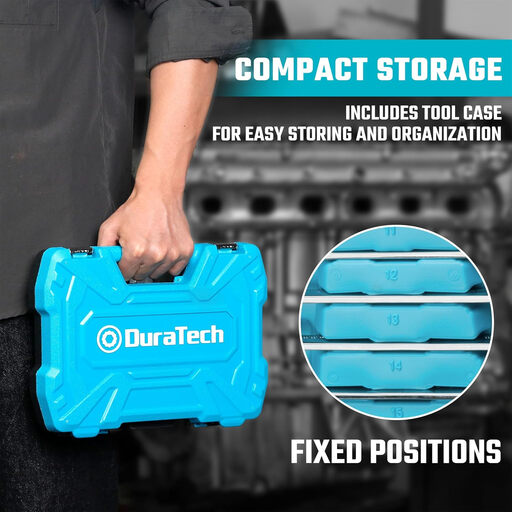
A tool set with carrying case also reduces the chance of losing small sockets and makes it easier to keep a kit in a garage, shed or vehicle. Check the case dimensions and weight before purchase, especially if it will be transported frequently.
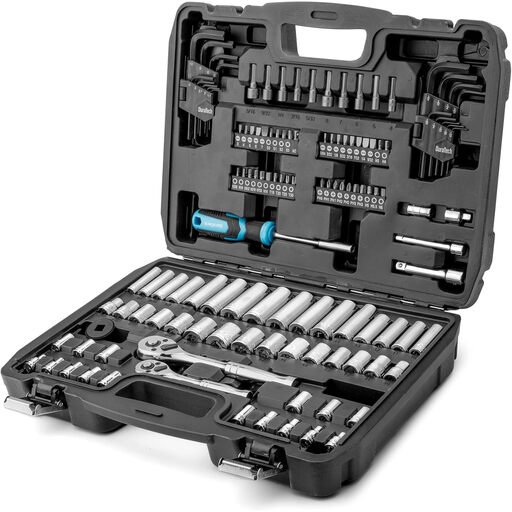
Why This Fits Their Persona: A practical starting point for UK households, occasional car work and small motorcycle repairs, with metric and imperial sockets in one case.
The contents are specified rather than presented as an unexplained piece count: 47 metric and SAE sockets, two ratchets, extensions, bits, nut-driver bits and hex keys.
Heat-treated Cr-V construction, 1/4-inch and 3/8-inch 72-tooth quick-release ratchets and a labelled carrying box.
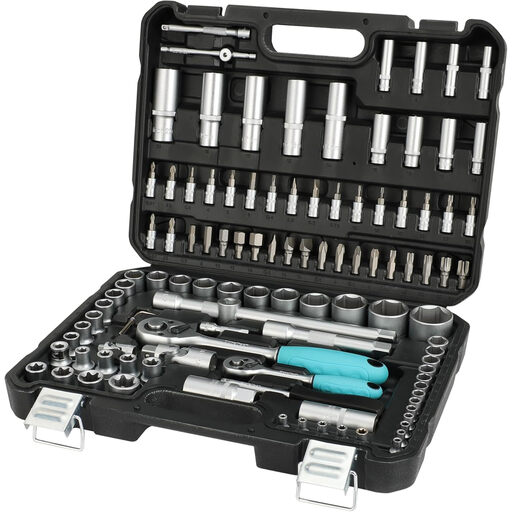
Why This Fits Their Persona: Suits regular workshop, vehicle and motorcycle maintenance where socket variety, extensions and organised storage matter more than a very large piece count.
It specifies the two drive sizes, socket material and included accessories, helping buyers compare working capability rather than relying on finish or promotional wording.
Includes Cr-V sockets, S2 bits, universal joints, extension bars and 72-tooth ratchets with quick-release buttons.
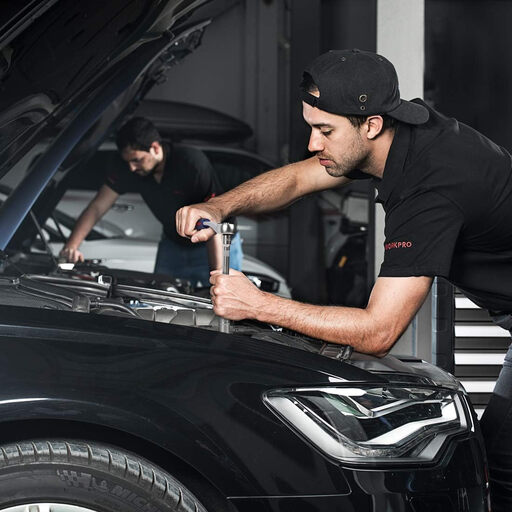
Why This Fits Their Persona: A wider option for car and motorcycle owners, tradespeople and workshop users who regularly need different socket formats and access accessories.
The larger count is supported by a stated range of 1/4-inch, 3/8-inch and 1/2-inch sockets, Torx sockets, spark plug sockets, bits and universal joints.
Three 72-tooth quick-release ratchets, multiple extensions and a blow-moulded case with dimensions stated for storage planning.
Why This Fits Their Persona: Particularly suitable for fasteners around engine bays, machinery and other areas where a straight handle is difficult to position.
The 180-degree flex head provides positioning options, while the clearly listed 8 mm to 19 mm range makes the metric coverage easy to assess.
Chrome vanadium steel construction, 72-tooth mechanism requiring a stated 5-degree swing arc and a labelled storage pouch.
We have compiled a complete, real-time list of products that fully satisfy these strict selection criteria and UK safety regulations.
Good storage and basic maintenance can help preserve a mechanics tool set:
Yes, provided it includes the appropriate smaller drive sizes, screwdriver bits, hex keys and common metric sockets. A 1/4-inch and 3/8-inch socket set is often sufficient for furniture, bicycles, fixtures and lighter vehicle work. Larger automotive repairs may require a 1/2-inch drive, specialist sockets or a torque wrench purchased separately.
For most modern UK cars and motorcycles, metric sockets are the practical starting point. Imperial sizes can still be useful for classic vehicles, imported equipment and machinery. A combined metric and imperial set reduces the need to buy a second kit when an unfamiliar fastener appears.
Hand tools do not normally have an ongoing energy cost. The more relevant costs are replacement pieces, missing accessories and storage. Compare the included drive sizes, socket range, case quality and warranty or returns information. Buying a slightly more complete kit can be more economical than adding individual ratchets, extensions and sockets later.