
24/7 Customer Support

Free returns

Same-day & Next-day Delivery

Quality Guaranteed

Unlock Your Welcome Offers: FREE Delivery | Up to 80% OFF | Free 30-day JoyPlus trial
Download the APP
As a Joybuy Product Recommendation Officer, my role is to help you navigate the crowded market of tools and equipment. A reliable mechanics tool set is a cornerstone for any garage or workshop, whether you're a weekend DIY enthusiast or a seasoned technician. However, the market is filled with sets that promise everything but deliver frustration. Flashy marketing and inflated piece counts can easily lead to a purchase you'll regret.
This guide cuts through the clutter. We'll highlight the common traps that catch out UK buyers and break down the essential features you should be looking for to find a durable and practical car tool kit that serves you well for years to come.
Before you add any kit to your basket, be aware of these frequent pitfalls. Recognising them is the first step to making a smarter purchase.
Many manufacturers boast about having hundreds of pieces. The reality is that these numbers are often padded with dozens of tiny, low-quality screwdriver bits or other fillers you will rarely, if ever, use. A 450-piece set isn't necessarily better than a well-curated 108-piece set if the latter contains the core sockets and spanners you actually need. You end up paying for quantity over quality and still find yourself missing a crucial 13mm socket.
Vague descriptions like "high-strength alloy" or "durable steel" are red flags. Without a specific material grade, you are likely buying tools made from inferior metal that can warp under pressure, round off bolt heads, or rust after a single damp winter in the garage. A quality automotive tool set will clearly state its material composition.
A tool set with case is meant to provide organisation and portability. However, many are poorly designed. Flimsy plastic clips that snap after a few uses, sockets that fall out of their slots the moment you close the lid and a layout that requires you to remove half the tools to reach the one you need are all common complaints. A good case should be robust and hold every component securely.
To avoid the traps, focus on the specifications that determine a tool's performance and longevity. Here are the non-negotiables.
For sockets, spanners and ratchets, the industry standard for good reason is Chrome Vanadium (Cr-V) steel. This alloy is heat-treated to provide high strength, toughness and resistance to abrasion and torque. It's what allows you to apply significant force without the tool bending or breaking. For screwdriver bits, look for S2 steel, which is harder and more resistant to wear, preventing the bit from stripping screw heads. Any set that doesn't proudly state it uses chrome vanadium tools is one to approach with caution.
The ratchet and socket set is the heart of most kits. Understanding these two features is crucial:
A good DIY tool kit should have a balanced selection. For UK use, a comprehensive range of metric sockets (typically 4mm to 19mm+) and a solid spanner set are essential. Check that the kit includes useful accessories like extension bars for reaching deep-set bolts, a universal joint for awkward angles and spark plug sockets if you plan on doing engine maintenance.
Based on these practical criteria, we've identified several tool sets that offer a solid combination of material quality, thoughtful design and genuine utility for different types of users.
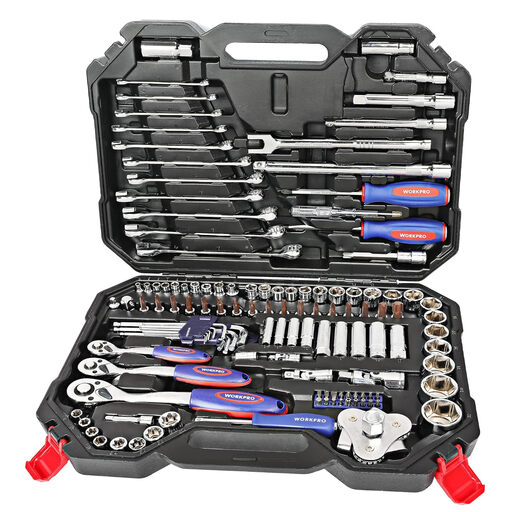
Why This Fits Their Persona: This set is an excellent starting point for home maintenance and basic car repairs. It provides a versatile mix of tools, including sockets in three different drive sizes (1/4", 3/8", 1/2"), spanners and hex keys, covering most jobs around the house and vehicle without being overwhelming.
Instead of an inflated piece count, it focuses on genuinely useful tools. The tools are made from heat-treated, chrome-plated steel for corrosion resistance and the blow-moulded case holds each component securely in its designated spot.
Includes three of the most common ratchet drive sizes (1/4", 3/8" and 1/2"), offering great versatility. The comprehensive selection makes it a one-stop solution for many common tasks.
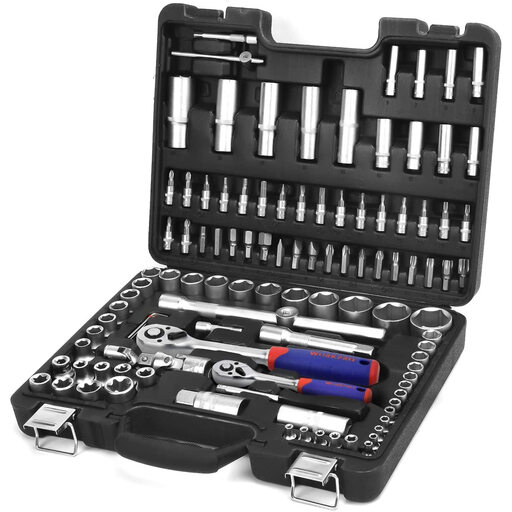
Why This Fits Their Persona: This set is focused squarely on mechanical work. It provides a comprehensive range of metric sockets for both 1/4" and 1/2" drives, perfect for someone who spends their weekends working on their car, from delicate interior jobs to heavy-duty suspension work.
It avoids filler by concentrating on being an excellent socket set. The tools are made from specified Chrome-Vanadium Steel (CVS) and the 72-tooth ratchets are ideal for tight engine bays. The robust case is designed for workshop use.
Features high-precision 72-tooth quick-release ratchets for efficient work. The comprehensive range of sockets and accessories, including spark plug sockets and universal joints, makes it a dedicated automotive tool set.
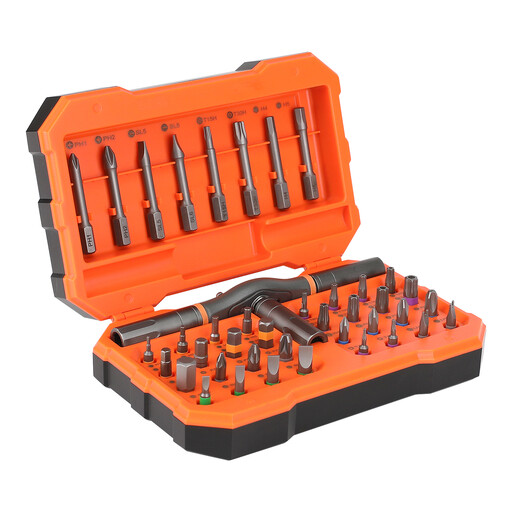
Why This Fits Their Persona: This isn't a traditional mechanics set, but it's perfect for someone who works on computers, bicycles, eyeglasses, or other intricate items. The focus is on a wide variety of high-quality bits and a versatile ratcheting handle for precision tasks.
It avoids the "mystery metal" trap by specifying that its bits are made from hard-wearing S2 tool steel. The piece count is meaningful, offering 40 distinct bits, including extended bits for reaching recessed screws, all housed in a compact, magnetic case.
The multi-form handle can be used as a standard screwdriver or a T-handle for extra torque. The inclusion of 45mm extended bits is a significant advantage for electronics and appliance repair.
We have compiled a complete, real-time list of products that fully satisfy these strict selection criteria and UK safety regulations.
Chrome Vanadium (Cr-V) is used for tools that need to withstand high twisting force (torque), like sockets and spanners. It's strong and slightly flexible to prevent shattering. S2 steel is a harder, more brittle steel used for screwdriver bits. Its hardness prevents the tip from deforming or "camming out" of a screw head, ensuring a longer life and protecting the fastener.
For most modern cars, motorcycles and general DIY in the UK, a comprehensive metric set is essential. Imperial (SAE) sizes are generally only needed for working on classic American vehicles, some older British cars, or specific imported machinery. For the average UK user, a metric-focused set offers the most value.
The chrome plating on most quality tools provides good corrosion resistance, but it's not foolproof. The best practice is to always wipe your tools clean and dry after use, especially if they've been exposed to moisture. For long-term storage in a damp garage or shed, a light wipe with a cloth containing a few drops of machine oil can provide an extra layer of protection for the steel.