
24/7 Customer Support

Free returns

Same-day & Next-day Delivery

Quality Guaranteed

Unlock Your Welcome Offers: FREE Delivery | Up to 80% OFF | Free 30-day JoyPlus trial
Download the APP
Buying metal cutting dies for card making can make handmade projects faster and more consistent, but choosing the wrong set may leave you with unusable shapes, incomplete cuts or designs that do not suit your die-cutting machine. Whether you create greetings cards, scrapbook albums or classroom projects, a low price alone does not indicate good value.
This guide explains the practical details to check before buying, then matches selected paper craft dies to different crafting needs.
Most metal die cuts are designed for manual or electronic die-cutting systems, but compatibility depends on the machine’s platform, cutting plates, sandwich arrangement and maximum working area. A die may be physically small enough to fit while still requiring a particular plate combination.
Always check:
If product dimensions are not listed, contact the seller before ordering rather than guessing.
A cutting die has a raised blade that separates paper into a shape. Embossing dies or embossing folders create a raised or recessed pattern, while some products are designed to cut and emboss in one project. Product titles can use these terms together, so read the description and product images carefully.
A decorative frame may produce an outline, a solid cut-out or a patterned panel. These results are not interchangeable when you are planning a layered card.
A highly specific design can be attractive but may only suit one occasion. For better value, consider how often you will use it and whether it can be combined with plain shapes, alphabet die sets or border designs.
For example, flower cutting dies, leaves and frames can work for birthdays, thank-you cards and weddings. Christmas cutting dies are useful for seasonal projects but may remain in storage for much of the year.
Look for clear material information such as carbon steel or metal construction. This confirms that the product is intended for repeated die-cutting, although it does not guarantee a particular lifespan. Thin, intricate patterns may need more careful handling than simple outline shapes.
Avoid bending dies to remove paper. Instead, use a pokey tool or fine tweezers to release small pieces, particularly from lace, lettering and foliage designs.
A die’s size affects where it can be used. Small motifs are suitable for layered cards, gift tags and scrapbook album decoration. Larger background or border dies can cover more of an A6 or A5 card but may require careful positioning.
Intricate scrapbooking cutting dies and die-cutting stencils often produce more attractive detail, but they may also require:
Check whether the die cuts a complete shape or creates a decorative opening in the paper.
Cardstock varies in thickness, coating and fibre density. A die that cuts standard craft paper may need additional pressure for heavier card. Test a small piece before using expensive patterned cardstock.
For children’s activities, teachers and family projects, supervise the use of cutting machines and store dies securely. Metal edges can be sharp even when the product is intended for paper crafts. Keep packaging and small components away from young children.

Why This Fits Their Persona: A four-piece set gives newcomers several shapes to practise with before investing in a larger collection of card-making supplies.
The listed carbon-steel construction provides clearer material information than a listing that only says “metal”. Check the individual sizes before ordering.
Four-piece format; intended for DIY craft and paper card making; suitable for testing different layouts.
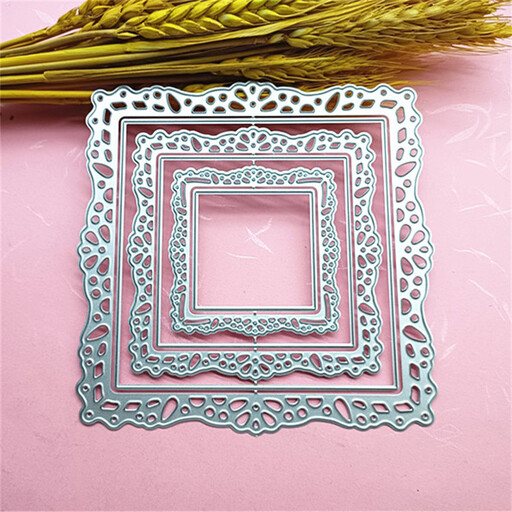
Why This Fits Their Persona: Crafters who prefer structured, layered designs can use a square lace panel as a feature background for formal cards and scrapbook pages.
Its description identifies it as a square hollow lace background, making the intended result easier to assess than a generic decorative listing.
Background format; lace-style cut-out pattern; intended for card making, embossing and scrapbook projects.

Why This Fits Their Persona: Frequent card makers, teachers and scrapbook users can create names, greetings and headings rather than relying only on pre-printed sentiments.
The listing specifies 26 capital letters and 10 numbers, so the character range is clearer than an alphabet-themed set with unspecified contents.
26 capital letters; 10 numbers listed; useful for personalised cards, albums and paper craft projects.
Store dies flat in magnetic wallets, labelled envelopes or storage pockets. Keeping them away from moisture helps reduce surface marking, while separating delicate designs can prevent them catching on one another.
Remove paper scraps after each use. For intricate metal die cuts, a release sheet or low-tack paper can make removal easier, but confirm that it is suitable for your machine. Do not apply oil or household cleaners to the cutting edge, as residue may transfer to paper.
For seasonal crafting, combine one themed die with versatile borders, frames and foliage. A Christmas design can then be paired with an alphabet die set for personalised greetings, while wedding card dies can be reused for anniversaries or formal invitations.
We have compiled a complete, real-time list of products that fully satisfy these strict selection criteria and UK safety regulations.
Yes, metal dies are designed for repeated paper-cutting use. Their usable life depends on the cutting edge, machine pressure, paper type, storage and frequency of use. Avoid forcing a die through a machine or bending it when removing paper.
Not necessarily. Confirm that your machine accepts thin metal dies and check its instructions for the correct cutting sandwich. Also compare the die’s dimensions with the machine’s working area before buying.
Cutting dies separate paper into a shape or create an opening. Embossing dies create texture or relief without necessarily removing paper. Some listings combine both terms because the design may support cutting and embossing as part of the same project; check the product details for the intended function.