
24/7 Customer Support

Free returns

Same-day & Next-day Delivery

Quality Guaranteed

Unlock Your Welcome Offers: FREE Delivery | Up to 80% OFF | Free 30-day JoyPlus trial
Download the APP
By Joybuy Product Recommendation Officer
Buying the wrong tools can turn a simple repair into a costly delay. A spanner that does not fit securely may round a fastener, while an oversized set can leave you paying for sizes you rarely use. For UK garages, home workshops and roadside maintenance, metric spanner sets should be selected according to fastener sizes, access restrictions and the amount of torque required.
A 20-piece set is not automatically more useful than a 10- or 12-piece set. Check which sizes are included. For many cars, bikes and household mechanical jobs, commonly used sizes include 8 mm to 19 mm, while larger fasteners may require 21 mm, 22 mm or beyond.
Some sets also include less useful duplicate sizes while missing practical mid-range options such as 13 mm, 15 mm or 17 mm. A clearly listed size range is more important than the headline piece count.
A conventional combination spanner set has an open end and a fixed ring end. It is straightforward and generally compact, but it must be lifted and repositioned after each turn.
A ratchet spanner set allows the ring end to turn without removing it from the fastener. This can save time in engine bays and under vehicle components. However, the ratchet mechanism needs sufficient clearance and should not automatically replace a solid spanner or socket for every high-torque task.
Long handles increase leverage, but not every spanner is designed for forceful loosening. A seized wheel bolt or suspension fastener may need a dedicated breaker bar, followed by a correctly sized socket. Avoid using ratcheting spanners as improvised breaker bars, as excessive force can damage their mechanism.
For regular automotive hand tools, chrome vanadium steel spanners offer a practical balance of strength, wear resistance and price. Heat treatment and drop-forging can support durability, but the finish also matters in a damp UK garage.
A matte or chrome-plated surface can make tools easier to wipe clean and helps resist surface corrosion. No finish removes the need for maintenance: wipe off oil and moisture before storing the set, particularly after winter repairs or outdoor use.
Most modern UK vehicles use metric fasteners, so a metric spanner set is the logical starting point. Imported vehicles, older equipment and some accessories may use imperial measurements, making metric and SAE spanners useful if you work across different vehicles or machinery.
Do not substitute a near-size imperial spanner for a metric one. Even a small mismatch can reduce contact with the fastener and increase the risk of slipping or rounding.
A 12-point ring end offers more starting positions than a six-point design, which can be useful where movement is restricted. A 15-degree offset may create additional clearance for your fingers and knuckles.
For confined areas, flex-head ratcheting spanners can be easier to position. A 180-degree flexible head and a small ratchet swing arc are particularly useful around brackets, pipework and engine components. For very tight spaces, a stubby spanner set may fit where a standard handle cannot, although the shorter handle provides less leverage.
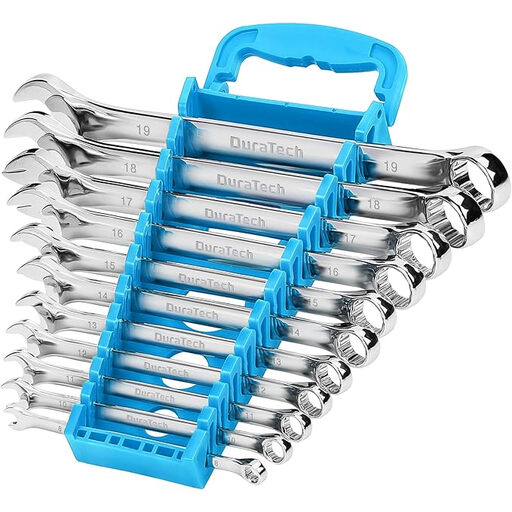
Why This Fits Their Persona: A practical starting point for home mechanics and DIY users who want broad metric coverage without buying separate tools for common repairs.
The set lists 12 useful sizes from 6 mm to 22 mm rather than relying only on its piece count. The sizes are stamped on both sides for easier identification.
Chrome vanadium steel, 15-degree offset ring ends, a storage pouch and a stated DIN 3113 specification.
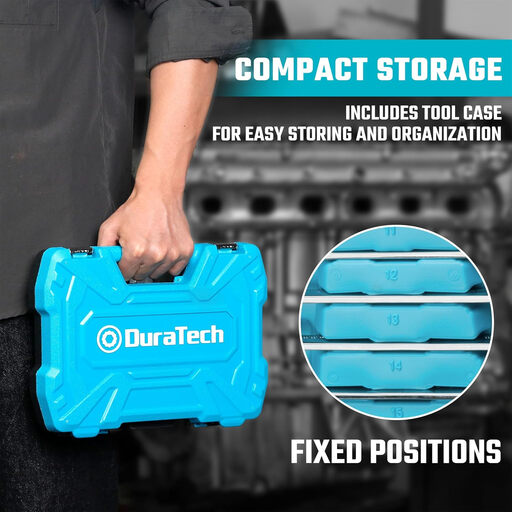
Why This Fits Their Persona: Suitable for frequent workshop use where access, repositioning speed and organised storage are more important than having the longest possible handle.
The flexible head is specified to tilt up to 180 degrees, while the 72-tooth mechanism requires a 5-degree swing arc for restricted spaces.
The 8–19 mm range covers 12 metric sizes, with chrome vanadium steel, directional markings and a storage case.
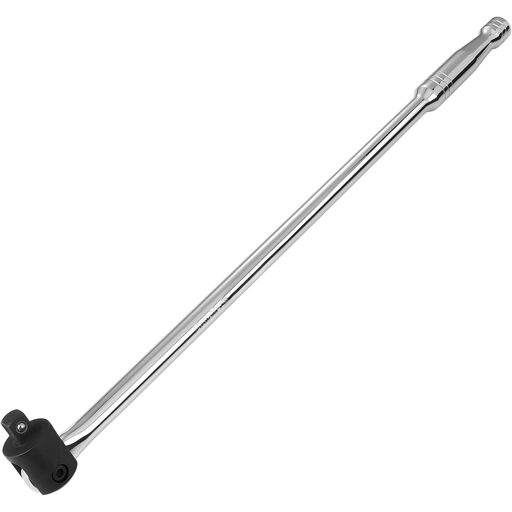
Why This Fits Their Persona: A useful companion for vehicle owners, garage workers and tradespeople dealing with tight wheel bolts or stubborn mechanical fasteners.
It is a dedicated 1/2-inch drive tool rather than a ratcheting spanner used outside its intended purpose. The head rotates through 240 degrees for positioning.
The handle is 60 cm long, includes a spring-loaded socket retention ball and is listed with torque up to approximately 780 Nm.
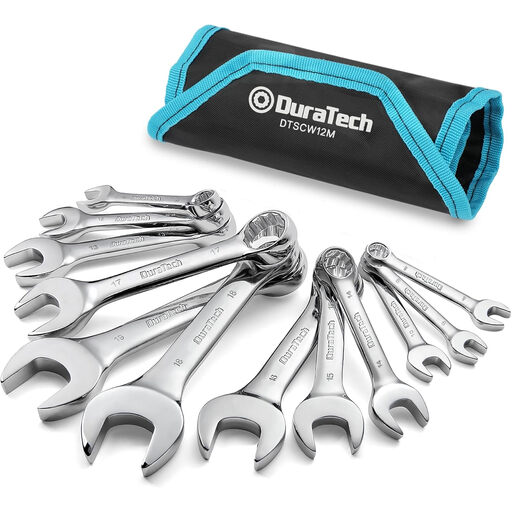
Why This Fits Their Persona: Designed for cramped engine bays, bicycle maintenance and fasteners positioned close to panels or surrounding components.
The shorter beam is intended for limited clearance, avoiding the common mistake of buying full-length tools that cannot be turned in confined areas.
The set includes 8–19 mm sizes, heat-treated chrome vanadium steel, 12-point ring ends and a roll-up carry pouch.
A spanner set covers many nuts and bolts, but a broader toolkit may be more practical for vehicle maintenance:
We have compiled a complete, real-time list of products that fully satisfy these strict selection criteria and UK safety regulations.
They are suitable for many modern vehicle fasteners, particularly in the common 8–19 mm range. Check your vehicle’s service documentation before purchasing, as some imported or older vehicles may require imperial sizes or specialist profiles.
Service life depends on frequency of use, applied force, storage and maintenance. Keep the tools dry, clean oil from the handles and use the correct size. Do not use a combination spanner as a hammer or extension bar, and use a breaker bar or impact-rated socket where the job requires higher torque.
It can be worthwhile if you regularly work in restricted spaces or want to reduce repositioning between turns. For occasional repairs, a standard combination spanner set may provide simpler operation and fewer moving parts. Many DIY tool sets work well when they combine fixed spanners with sockets and a suitable breaker bar.