
24/7 Customer Support

Free returns

Same-day & Next-day Delivery

Quality Guaranteed

Unlock Your Welcome Offers: FREE Delivery | Up to 80% OFF | Free 30-day JoyPlus trial
Download the APP
As a Joybuy Product Recommendation Officer, my role is to help you navigate the crowded market of household essentials. When it comes to something as seemingly simple as kitchen towels, it’s surprisingly easy to make a poor choice. A flimsy, non-absorbent towel isn't just an annoyance; it’s a waste of money and adds friction to your daily kitchen routine.
Many of us have been caught out by a few common purchasing traps. You might buy a multi-pack that looks like a bargain, only to find the towels shed lint over your clean glassware. Or perhaps you've been lured by claims of "super absorbency," but after a few washes, the towels become stiff and repel water. Another frequent issue is poor durability, where seams unravel and the fabric thins out within months, forcing you to buy replacements far sooner than expected. This guide will help you sidestep these pitfalls and identify what truly matters in a quality set of microfibre kitchen towels.
To avoid disappointment, focus on a few core parameters rather than marketing slogans. These objective details will give you a much clearer idea of a towel's performance and longevity.
The term "microfibre" refers to synthetic fibres, typically a blend of polyester and polyamide. This combination is what gives the material its remarkable ability to trap dirt, absorb liquid and dry quickly. However, the weave is just as important.
A quality microfibre towel should feel soft and plush, not thin or plasticky. The material is key to finding effective, lint-free dish cloths that won't leave frustrating fibres behind.
GSM stands for Grams per Square Metre. It’s a standard measure of a fabric's density and weight. While a higher GSM (typically 300-400 for kitchen towels) often indicates greater absorbency and a plusher feel, it’s not the only factor. A very high GSM towel might hold more water, but it will also take longer to dry. For a busy kitchen, a balance is needed. A mid-range GSM towel often provides the ideal combination of absorbency and quick-dry cleaning cloths performance, preventing musty smells from developing.
The durability of a kitchen towel often comes down to its construction. Look closely at the edges. A towel with securely stitched, overlocked edges is far less likely to fray and unravel after repeated machine washes compared to one with a simple, single-stitched hem. When buying a kitchen towel set, checking this small detail can be the difference between a set that lasts for years and one that looks worn in months. Opting for a well-constructed multi-pack tea towels set ensures you get consistent quality and long-term value.
Based on these practical criteria, we've matched several options to different household needs and preferences.
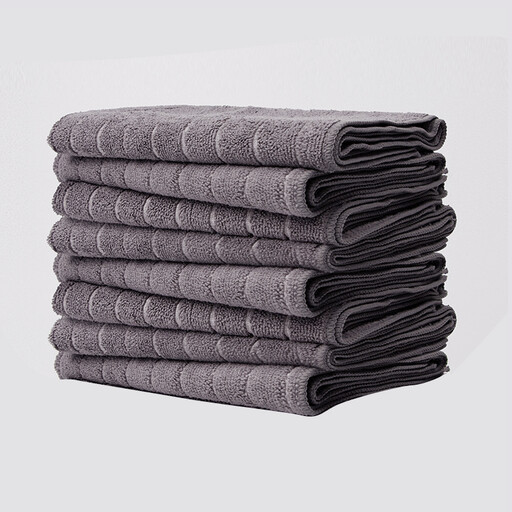
Why This Fits Their Persona: For anyone setting up a new home or looking for a complete refresh, this large 8-pack offers outstanding practicality. The generous quantity means you always have a clean towel on hand, and the neutral grey kitchen towels with a classic stripe blend seamlessly into almost any kitchen decor.
This set directly counters the "false economy" trap. Instead of buying a small, flimsy pack, you get a substantial number of durable, well-made towels, ensuring you won't need to repurchase them in a few months.
High-value 8-pack provides a full kitchen supply. The 40x60cm size is versatile for drying dishes, hands and surfaces.
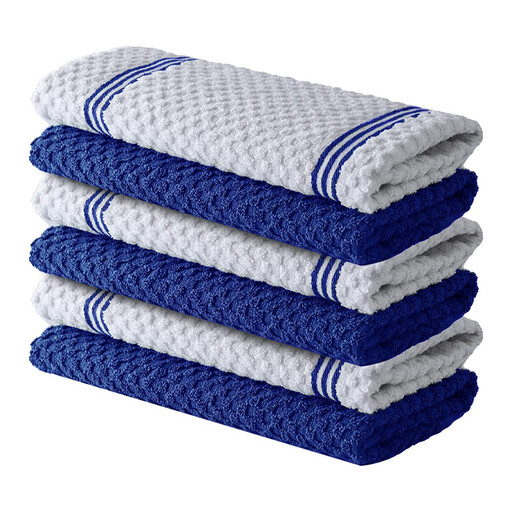
Why This Fits Their Persona: For those who see their kitchen as a curated space, aesthetics matter. This 6-pack in a vibrant blue allows for colour-coding or adding a deliberate pop of colour. The slightly larger 40x66cm size also gives them a more substantial, premium feel.
It sidesteps the pitfall of towels that shed lint and fade. The quality microfibre and dye process ensure the colour remains vibrant and the fabric stays intact and lint-free, wash after wash.
Available in multiple distinct colours (blue, red and yellow) for kitchen coordination. Soft, durable and highly absorbent tea towels.
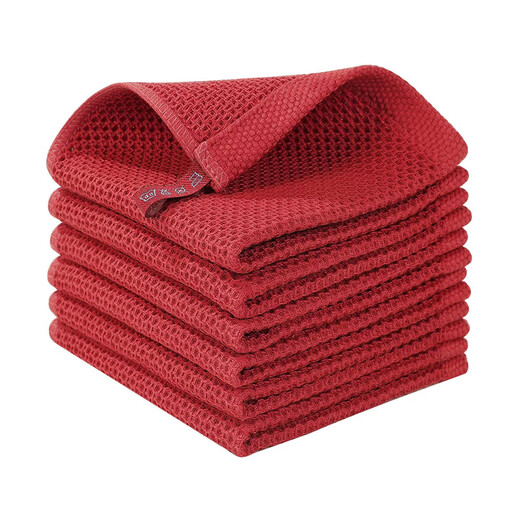
Why This Fits Their Persona: This user appreciates having the right tool for the job. The smaller 30x30cm size and honeycomb weave make these cloths perfect for specific tasks like wiping down counters, cleaning spills or polishing surfaces, rather than being a generic drying towel.
It avoids the "one-size-fits-all" trap where a large towel is cumbersome for small jobs. The specific honeycomb design is engineered for better scrubbing and absorption on a smaller scale, making cleaning more efficient.
Specialised honeycomb weave enhances cleaning power and absorbency. The compact size is ideal for targeted cleaning and easy handling.
We have compiled a complete, real-time list of products that fully satisfy these strict selection criteria and UK safety regulations.
To maintain their effectiveness, wash microfibre towels separately or with other non-linting synthetic fabrics. Crucially, do not use fabric softener or bleach, as these products clog the microscopic fibres and destroy their absorbent properties. Tumble drying on a low heat setting or air drying is recommended.
For a typical household, a set of 8 to 12 towels provides a comfortable rotation. This allows you to have a few in use simultaneously for different tasks (e.g., one for hands, one for dishes), while others are in the laundry and a clean set is ready in the cupboard. Starting with a multi-pack tea towels set is the most efficient way to build your supply.
Each material has its strengths. Microfibre excels at absorbing water quickly and leaving a streak-free, lint-free finish, which makes it an excellent choice for dish drying towels, particularly for glassware and polished cutlery. Traditional cotton is also highly absorbent but can sometimes leave fine lint behind and generally takes longer to dry out than its microfibre counterpart.