Quiet-booth meditation narrators
If your booth is already quiet and controlled, you may prioritise a detailed recording of a calm voice and want the option of USB recording now and an XLR setup later.


For a genuinely quiet booth, consider a cardioid condenser such as the RØDE NT1 5th Generation if detailed narration is your priority; its USB connection also allows direct recording to a computer. If fan or neighbouring-room noise remains audible, audition a close-address dynamic microphone instead, without assuming its pickup pattern or processing will remove that noise. Check your connection, monitoring and mounting needs, then record at several speaking distances before settling on a setup.
If your booth is already quiet and controlled, you may prioritise a detailed recording of a calm voice and want the option of USB recording now and an XLR setup later.
If you want to start without assembling a separate interface and preamp, a direct USB connection and a way to monitor your voice through headphones may matter most.
If the booth reduces echo but leaves fan hum, vibration or neighbouring-room noise, you may want to compare focused, close-miked recording with improving the booth itself.
Start with the sound of the booth at your normal speaking level, particularly during pauses. That determines whether a quiet-booth condenser or a close-address dynamic route is worth trying first.
Consider it when: The booth is already quiet and detailed, low-noise narration is the priority; RØDE specifies 4 dBA microphone self-noise for the cardioid NT1 5th Generation.
Keep in mind: That self-noise figure does not describe fan noise, reflections or other sounds in the booth.
Consider it when: Residual booth noise makes focused spoken-word capture a higher priority, or you want to audition a direct-USB recording workflow.
Keep in mind: Placement still matters, and manufacturer noise-control features are no substitute for checking a recording made in your own booth.
| Concern | What to check | Who this matters to |
|---|---|---|
| Vocal detail | Check pickup direction, microphone self-noise where stated, and the sound of a soft-voice test take. | If my booth is quiet, I want the calm narration and its pauses to sound clear without prioritising room-noise control. Around 36% of consumers put vocal detail first. |
| Simple recording | Check the USB connection, headphone monitoring and any software requirements for the controls you want. | Recording alone at a laptop, I would rather monitor my voice directly than build an interface-based setup straight away. For around 29% of consumers, a simple recording path is the main concern. |
| Residual noise | Check pickup pattern, shock isolation and how the microphone sounds with your booth's fan or other persistent noise. | When noise remains during quiet passages, I need to hear whether close-miked speech stays intelligible alongside it. Residual-noise control comes first for around 21% of consumers. |
| Future XLR setup | Confirm the available outputs and whether your intended interface provides the input and power the microphone requires. | If I plan to add an interface or mixer, I want a microphone that fits that recording chain rather than choosing solely for immediate USB use. Around 14% of consumers make XLR expansion their primary concern. |
RØDE's stated 4 dBA figure for the NT1 5th Generation describes the microphone, not the fan, ventilation or reflections around it. Those sounds can still be noticeable during pauses.
Make a test recording at your normal soft speaking level, including silence between phrases. If background noise intrudes, compare a close-address dynamic setup and changes to the booth before deciding.
Persistent noise can also mean more recording and editing time.
Neumann explains that moving closer to a directional microphone can increase bass response enough to make speech sound muddy or less intelligible.
Record the same passage at several repeatable distances, using a pop filter where appropriate, and choose the position that keeps quiet speech clear.
An XLR connection needs a suitable recording chain. In particular, Shure says the SM7dB requires +48 V phantom power when its active preamp is engaged, although it operates in bypass mode without that power.
Check the microphone's operating mode against your interface or mixer, and confirm the cables, mount and monitoring equipment needed for your arrangement.
Rights in your own narration do not give you permission to use somebody else's recording. PPL UK says recorded music used online needs the appropriate licence for the service.
Before releasing a meditation, confirm that the music rights cover how and where you intend to publish it, or use music for which you hold the necessary rights.
The NT1 5th Generation is relevant to an already quiet booth: it is a cardioid condenser with USB and XLR connections.
The MV7+ offers a USB-C and XLR dynamic spoken-word route; the SM7dB is an XLR dynamic option with an active preamp.
The AT2020USB-X is a cardioid USB condenser; the AT2040USB is a hypercardioid dynamic USB model for focused voice capture.
These two FIFINE dynamic microphones offer USB and XLR connection options for close spoken-word recording. Compare their supplied mounts and the space available in your booth rather than treating either as a substitute for testing residual noise.
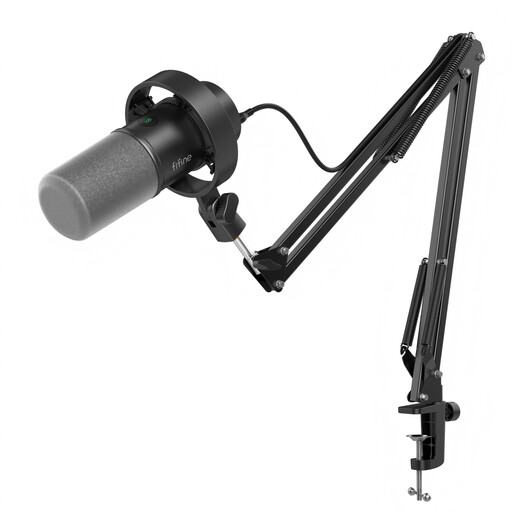 Image unavailable
Consider this kit if you want a boom-arm position for close narration in the booth.
The product name specifies USB and XLR connections, a mute button, headphone jack and gain knob. Check that the arm can be mounted where you need it and confirm which controls work with your chosen connection.
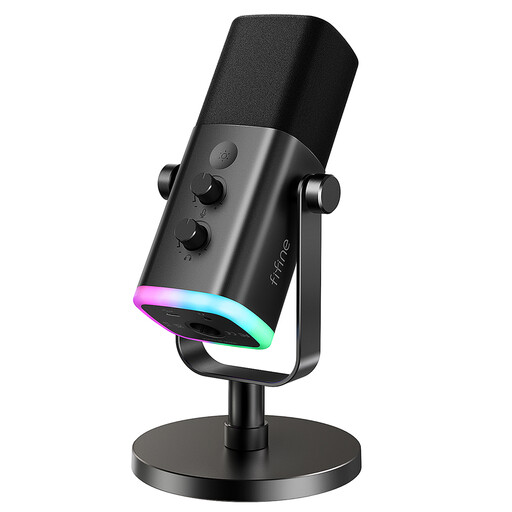 Image unavailable
Consider this model if a desktop stand suits your booth layout and you want the choice of USB or XLR recording.
The product name specifies a mute button, headphone jack and RGB light. Check where the stand places the microphone relative to your speaking position and confirm which controls work over XLR.
Choose USB for a direct computer connection if you do not want to assemble an interface-based setup now; choose XLR if an interface or mixer is already part of your plan. The RØDE NT1 5th Generation and Shure MV7+ provide both connection options, but check how monitoring and controls work in the mode you intend to use.
Speak towards its designated front, following the model's instructions rather than assuming the top is the speaking side. RØDE identifies the gold dot as the front of the NT1 5th Generation; test its position with any persistent unwanted sound in the booth.
A booth does not by itself prevent speech plosives or vibration travelling through a stand or desk. Check what the microphone supplies: RØDE includes a pop filter and shock mount with the NT1 5th Generation, while Audio-Technica specifies an internal pop filter and integrated shock mount for the AT2040USB.
The requirement depends on the microphone and its operating mode. Shure says the SM7dB needs +48 V phantom power with its built-in preamp engaged but works in bypass mode without it; check the manual for your chosen microphone and the capabilities of your interface or mixer.
You can publish it with music only when you have the rights required for that music and its intended use. PRS for Music explains that copyright can arise automatically in an original work when it is fixed, but that does not clear somebody else's recording; PPL UK says online use of recorded music requires the appropriate licence for the service.