
24/7 Customer Support

Free returns

Same-day & Next-day Delivery

Quality Guaranteed

Unlock Your Welcome Offers: FREE Delivery | Up to 80% OFF | Free 30-day JoyPlus trial
Download the APP
By Joybuy Product Recommendation Officer
Microwave ovens can look similar on a product page, yet their practical differences affect everyday convenience, kitchen space and long-term value. A compact 20L microwave may suit a student flat, while a family may need a 23L, 25L or larger cavity for dinner plates and serving bowls. A built-in model can create a tidy fitted-kitchen finish, but it requires accurate measurements and suitable installation.
Before buying, look beyond wattage and attractive features. These are three common pitfalls UK shoppers should avoid.
A stated capacity does not tell you whether your largest dinner plate, casserole dish or turntable will fit. Interior shape and turntable diameter matter just as much. Check the product dimensions and cavity measurements before ordering, particularly if you use square or oversized cookware.
For small kitchens, a 20L microwave can be practical and compact. A 23L or 25L microwave offers more room for family portions, but may require substantially more worktop depth.
Combination models can include microwave, grill, convection, baking and air-frying modes. These functions may reduce the need for separate appliances, but they usually take up more space and can have a steeper learning curve than a solo microwave.
If your main tasks are reheating soup, cooking ready meals and defrosting ingredients, a basic countertop model may be more suitable. If you regularly crisp pizza, brown cheese or bake small dishes, consider microwaves with grill or a combination appliance.
Manual microwaves use dials and can be quick to operate, but they may offer fewer automatic programmes. Digital microwaves usually provide a clearer timer, auto-cook settings and more precise input, although touch controls may be less convenient for anyone who prefers physical switches.
A built-in microwave should never be treated as a freestanding appliance unless the manufacturer specifically permits it. Cabinet cut-out sizes, ventilation and electrical connections must match the installation instructions. Built-in models should be installed by a suitably qualified person in line with applicable UK electrical requirements.
Measure the available area, including clearance around ventilation openings. Countertop microwaves should sit on a stable, heat-resistant surface and must not have their vents blocked. Allow the clearances specified in the manual rather than relying on a generic measurement.
Also check:
Microwave output is commonly listed in watts. Models around 700W to 900W are suitable for many everyday reheating and cooking tasks, but cooking times can vary between appliances. Follow the food packaging instructions and adjust when necessary.
Power levels control how energy is delivered. Lower settings can help with gentle reheating or thawing, while full power is useful for heating liquids and prepared meals. A dedicated microwave with defrost function may offer defrosting by time or weight, which is more convenient than manually estimating intervals.
A solo microwave focuses on microwave cooking, reheating and defrosting. Grill and combination models add browning or oven-style functions, but accessories such as racks and trays must only be used in the modes specified by the manufacturer.
Before purchasing, check whether the appliance includes:
Never use metal containers, foil or metal racks during microwave-only cooking unless the manual explicitly permits it for that mode. Do not operate any microwave empty, and do not use one with a damaged door, seal or safety interlock.
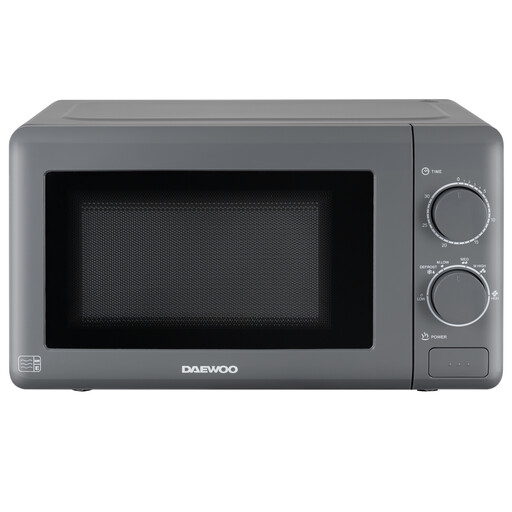
Why This Fits Their Persona: A straightforward countertop microwave for students, tenants and smaller households that want familiar dial controls without complex programming.
It focuses on core functions rather than unused multi-cooking modes, with a 20L cavity, six power settings and a 30-minute manual timer.
800W output, dedicated defrost setting and removable glass turntable. The matt grey finish is suited to neutral kitchen schemes.
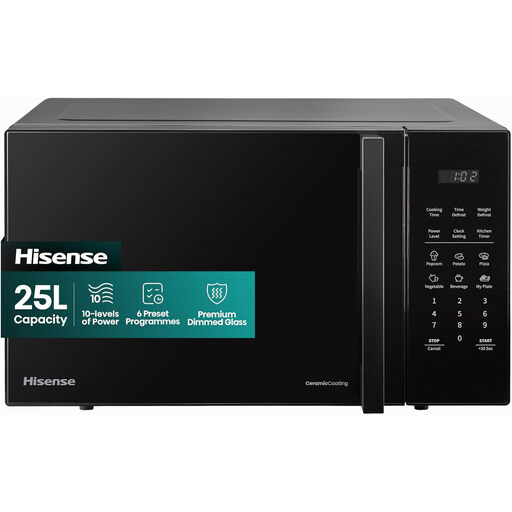
Why This Fits Their Persona: A larger digital option for households that value precise settings, a modern appearance and enough room for family portions.
The 25L capacity is supported by a stated 31.5cm turntable, helping shoppers assess plate compatibility instead of relying on litres alone.
900W output, 10 power levels, auto-cook programmes and auto defrost. It also includes a removable glass turntable and a 2-year manufacturer’s warranty.

Why This Fits Their Persona: Suitable for busy cooks who want microwave, air fryer, baking, reheating and defrosting functions in one countertop appliance.
Its listed modes and accessories are clearly identified, while the 26L capacity gives more usable room than compact solo models.
It offers 28 cooking presets, 10 power levels, an LED interface, an air-fryer basket and baking tray. Check the required countertop clearances before purchase.
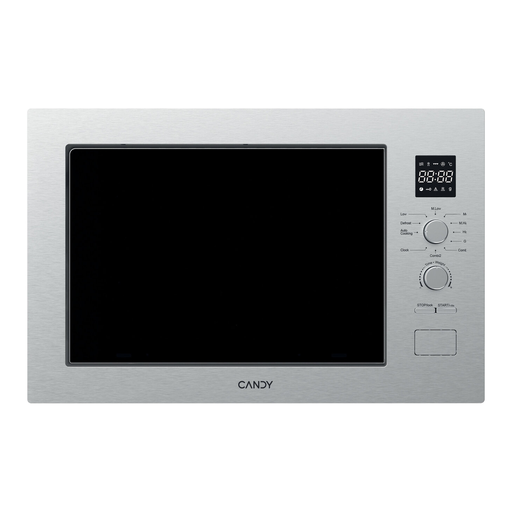
Why This Fits Their Persona: Designed for homeowners planning a flush fitted-kitchen appearance while retaining microwave and grill functions.
The listed 385mm height, 595mm width and approximately 388mm depth make cabinet planning more straightforward. Professional installation is required.
The 25L cavity combines an approximately 850W microwave with a 1200W grill, plus eight cooking functions and a child lock.
We have compiled a complete, real-time list of products that fully satisfy these strict selection criteria and UK safety regulations.
Clearance varies by model, so use the manufacturer’s instructions. As a general planning point, many appliances require open space around the sides, top and ventilation areas. Do not place a microwave against a wall or under a shelf if this blocks airflow.
Running cost depends on the selected mode, power draw, cooking time and household electricity tariff. A combination microwave may use more power during grill or convection cooking than during a short reheating cycle. Compare the appliance’s rated power and choose the mode that matches the task.
Lifespan depends on frequency of use, cleaning and maintenance. Avoid empty operation, overheating liquids, abrasive cleaning products and slamming the door. Stop using the appliance if the door, seal or controls are damaged, and follow the manufacturer’s guidance for servicing or replacement.