Staggered-meal reheaters
If different people heat one plate or bowl at a time, prioritise space for those dishes and controls everyone can use consistently. Reheat and defrost settings are worth comparing on the exact models under consideration.


If most meals are reheated separately, start with a solo microwave that fits the household’s usual dishes and has straightforward reheat and defrost controls. Consider a flatbed when a turntable restricts the containers you use, or a grill or combination model when people will regularly cook or brown individual meals. Check the exact model’s dimensions, ventilation instructions and permitted cookware before choosing.
If different people heat one plate or bowl at a time, prioritise space for those dishes and controls everyone can use consistently. Reheat and defrost settings are worth comparing on the exact models under consideration.
If rectangular containers, casserole dishes or large bowls are awkward on a turntable, compare flatbed cavities as well as turntable dimensions. The dish must still fit inside, and the appliance needs its specified ventilation space.
If separate mealtimes also mean cooking individual portions, consider whether grill, convection or combination functions match the meals people actually make, rather than choosing extra modes for reheating alone.
Decide whether the main task is reheating, fitting awkward dishes or cooking individual meals; then check that the chosen appliance fits the kitchen safely.
Choose when: Separate portions mainly need reheating or defrosting.
Trade-off: A solo model does not provide conventional oven-style browning or baking.
Choose when: People regularly want to brown or cook individual meals as well as reheat them.
Trade-off: Additional modes mean more controls to learn; check the exact model, as grill and convection functions vary.
| Concern | What to check | Who this matters to |
|---|---|---|
| Low-effort reheating | Compare reheat and defrost settings, power levels and the clarity of the controls. Check sensor or inverter features on the exact model rather than assuming they ensure even heating. | If I heat a portion after everyone else has eaten, I want settings I can use without repeated guesswork. Around 36% of consumers put reliable, low-effort reheating first. |
| Dish and container fit | Measure usual dishes against the cavity or turntable, then check the exterior dimensions and required clearance. | My rectangular meal container is no use to me if it cannot fit or rotate. For around 29% of consumers, fitting everyday cookware is the primary concern. |
| Cooking functions | Check whether the model offers a grill, convection cooking or both, and which accessories and cookware its manual permits. | When I cook a meal for one, I may want to brown or bake it rather than just warm it. Broader cooking functions come first for around 21% of consumers. |
| Installation and shared use | Confirm whether the model is freestanding or built-in, its ventilation requirements and an appropriate power connection. | With several people using the microwave throughout the day, I need a suitable place to install and use it safely. Around 14% of consumers prioritise installation and everyday operation. |
A large cavity will not help if a plate cannot rotate or the appliance is too deep for the worktop. A flatbed may accommodate rectangular dishes more easily, but still has size and ventilation requirements.
Measure your widest plate and usual containers, then compare them with the exact model’s interior layout, exterior dimensions and manual.
Grill and convection functions address different cooking tasks from routine reheating, while adding controls to learn.
Choose a solo model if reheating and defrosting dominate. Consider grill or combination functions when browning, baking or similar cooking is a recurring need.
Portion size, starting temperature and container shape can affect reheating. An automatic programme does not establish that food is hot throughout.
Follow the food packaging and appliance instructions, including stirring or standing where directed, and check that food is steaming hot and cooked all the way through before eating.
Electrical Safety First warns that a microwave used on an extension lead alongside other high-power appliances may overload the lead and create a fire risk.
Use a suitable wall socket, check the countertop model’s plug and follow its manual for ventilation and placement.
Relevant to households comparing larger solo microwaves with grill and combination alternatives.
Relevant when dish shape makes a flatbed cavity appealing, or when grill and convection modes are also wanted.
Relevant to comparisons between freestanding and built-in layouts, as well as solo, grill and combination types.
These choices cover solo microwaves for routine separate reheating and combination models for households that also want individual-meal cooking functions. Compare dish fit and the modes people will use before choosing between them.
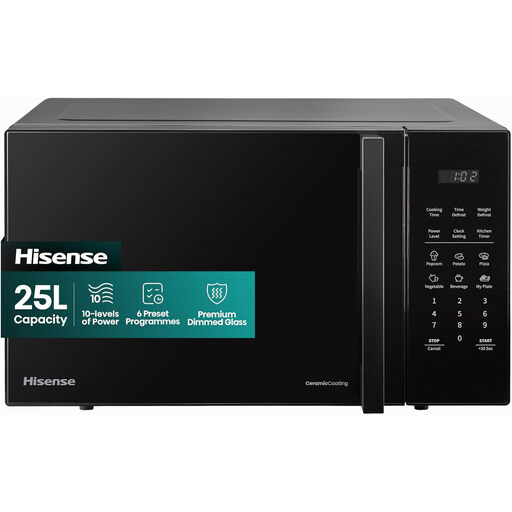 No image available
A solo option for households mainly reheating and defrosting separate portions.
The product name specifies 900W microwave output and auto defrost. Check your usual dishes against the model’s interior and confirm its exterior dimensions and ventilation requirements in the manual.
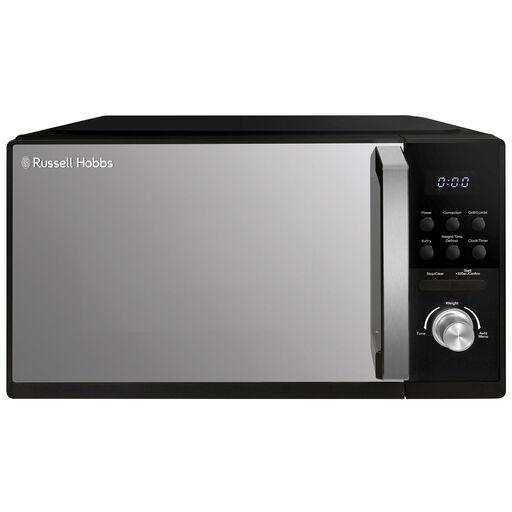 No image available
Consider this combination model if separate meals sometimes call for cooking beyond reheating.
Its product name identifies a digital 4-in-1 model. Check the exact cooking modes, permitted accessories and ventilation instructions against what your household will use.
 No image available
This model is relevant when individual meals may need functions beyond microwave reheating.
The product name lists 900W microwave output, a 1000W grill and smart app control. Confirm the exact modes and accessories for this variant, as its function labels differ across the product description; also check exterior dimensions and ventilation requirements.
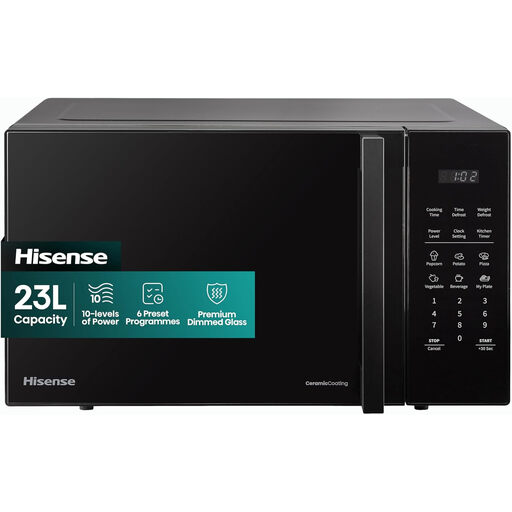 No image available
A solo model to consider when separate portions mainly need reheating or defrosting.
The product name specifies 800W output and auto defrost. Confirm the controls for this exact model before purchase, as its descriptions differ on whether they are touch or rotary; check dish fit and ventilation in the manual too.
 No image available
Consider this model if the household wants convection cooking as well as microwave use for separately timed meals.
The product name lists 900W microwave output and a smart moisture sensor. Check the cooking functions against your usual meals, and compare your cookware and available space with the exact cavity dimensions and installation instructions.
Choose a solo microwave when separate meals mainly need reheating and defrosting; consider a grill or combination model when people will also use its additional cooking modes regularly. Check the precise functions, since a grill model and one with convection do not necessarily offer the same options.
A flatbed can help when a turntable restricts rectangular dishes. Samsung’s buying guide notes that flatbed models omit the turntable, but you still need to measure your containers against the exact cavity and check the appliance’s exterior dimensions.
Follow the packaging and appliance instructions, including stirring or standing where directed, and check that food is steaming hot and cooked all the way through. Do not rely on an automatic reheat programme alone to judge the temperature of every portion.
Use a suitable wall socket rather than sharing an extension lead with high-power appliances. Electrical Safety First warns that a microwave may overload an extension lead used with other high-power products; also follow the exact model’s electrical and placement instructions.
A built-in microwave needs a model suited to the cabinet and its installation requirements. Samsung advises accredited-professional installation for its built-in microwaves; check the exact model’s cabinet cut-out, ventilation and installation instructions rather than using freestanding dimensions.