Family-meal reheaters
If several potatoes, plates or side dishes need warming, focus on usable cavity space and whether your dinnerware fits. Measure the dishes you use as well as the available counter space.


For a family meal, start with a microwave that fits the plates and number of potatoes you normally reheat; cavity capacity in litres cannot tell you that on its own. Consider an inverter model if heating control matters most, a flatbed if dish space is the sticking point, or a microwave with an air-fry function if a crisper finish matters enough to justify the extra cooking functions. Check the exact model and your dishes before choosing.
If several potatoes, plates or side dishes need warming, focus on usable cavity space and whether your dinnerware fits. Measure the dishes you use as well as the available counter space.
If unevenly warmed centres are your main frustration, look at the heating controls of the exact model. An inverter feature may be relevant, but a manufacturer's even-heating claim is not a guarantee of results.
If you want a crisper finish rather than simply a hot potato, consider a microwave with an air-fry function. It makes more sense when you will use those additional cooking modes regularly.
Check dish fit first for a family meal, then decide whether heating control or a crisp finish changes the type of microwave you need.
| Concern | What to check | Who this matters to |
|---|---|---|
| Dish and portion fit | Measure your largest plate and serving dish; compare them with the internal cavity dimensions or turntable diameter. Check the appliance's external footprint too. | I need to warm several portions without discovering that our dinnerware cannot fit together. Around 50% of consumers put dish and portion fit first. |
| Even reheating | Check the exact model's heating controls and follow its guidance on food arrangement, power level and standing time; wattage alone does not establish evenness. | When a potato's centre or filling is cooler than its edges, I care most about controlling the reheat. Roughly 30% of consumers prioritise even reheating. |
| A crisper finish | Confirm that the exact model offers an air-fry or other crisping mode, and consider whether you will use its additional functions. | I would rather use a crisping function than accept a softer skin, even if that means choosing a more complex appliance. About 20% of consumers put a crisper finish first. |
A stated capacity does not tell you whether your dinner plates fit on a round turntable or whether several dishes can sit together. That can mean reheating the meal in separate batches.
Measure your widest plate and serving dish, then check the turntable diameter or internal flatbed dimensions and the space the appliance needs on your counter.
Microwave output is only one specification. Panasonic describes inverter heating on its NN-SD27HSBPQ as a way to address hot and cold spots, but that model-specific claim is not an independent comparison.
If evenness is a priority, compare heating controls on the exact models you are considering and follow the manual's placement, timing and standing instructions.
Solo microwaves are described as suitable for heating leftovers and jacket potatoes. An air-fry function addresses a different need: pursuing a crisper finish.
Choose a combination model when crisp skins and its other cooking modes are regular priorities; otherwise, concentrate on dish fit and straightforward reheating controls.
Recycle Your Electricals advises recycling microwaves rather than placing them in the household rubbish bin.
If the appliance is safe and functional, consider passing it on. Otherwise, check your local electrical recycling options or a retailer's take-back service.
Its NN-SD27HSBPQ inverter turntable model and NN-SF464MBPQ flatbed model illustrate two different ways to approach family-meal reheating.
The MW101UK represents the microwave-and-air-fryer route for households that want a crisping function as well as reheating.
The K25MB21 is a conventional solo microwave worth considering when a measurable turntable matters more than added cooking modes.
These models offer solo, inverter and combination-microwave options for reheating family meals. Use their stated features as a starting point, then check plate fit and the functions you actually need.
 No image available
Consider this combination model if you want reheating alongside air-fry and grill options; compare your plates with its usable space before buying.
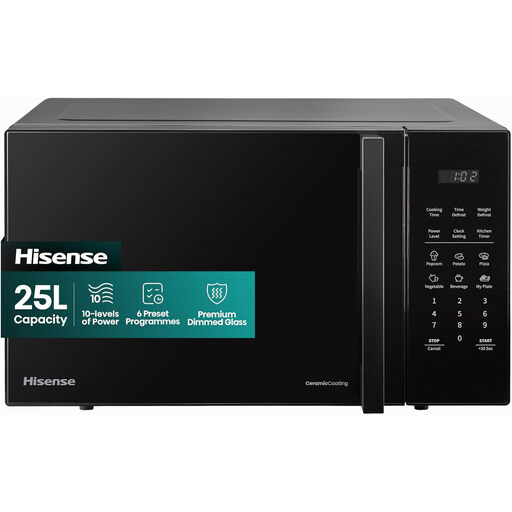 No image available
A straightforward reheating option if you do not need a crisping mode; confirm that your family dinnerware fits before relying on cavity capacity alone.
 No image available
Consider its combination functions if a crisping option matters alongside family-meal reheating. Check your dish dimensions and confirm the microwave output if you need to compare reheating specifications.
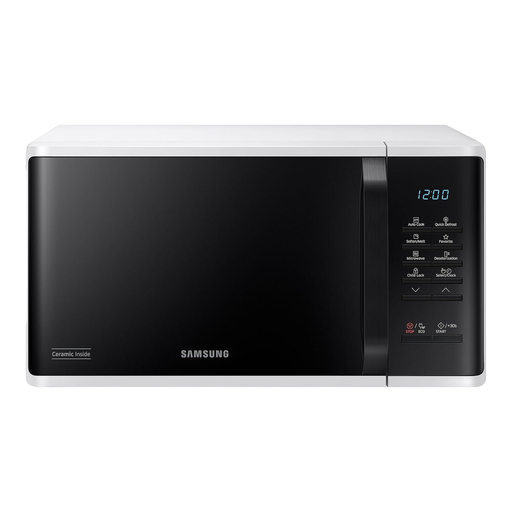 No image available
Suitable to consider for ordinary meal reheating if a solo microwave meets your needs; check its usable dimensions against the plates you serve with.
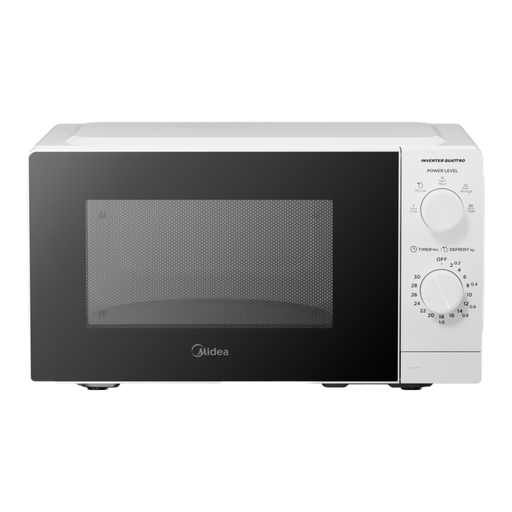 No image available
Consider this solo model if you want manual controls and an inverter feature, provided your usual plates fit its cavity. The feature name alone does not establish even-heating performance.
Choose by dish fit rather than litres alone: measure your everyday plates and any serving dishes, then compare them with the turntable diameter or internal flatbed dimensions. As model-specific reference points, a 315 mm turntable is listed for the Kenwood K25MB21, while Panasonic specifies a 27 L flatbed cavity for the NN-SF464MBPQ.
An inverter model is worth considering if heating control is your priority, but do not assume its results from the feature name alone. Panasonic says the inverter technology in its NN-SD27HSBPQ is designed to avoid hot and cold spots; follow the exact model's instructions for arranging food, selecting power and allowing standing time.
A model with an air-fry function gives you a way to pursue a crisper finish after microwave heating. Ninja describes that sequence for its MW101UK, but the texture result is a brand claim; choose a combination model if you expect to use the added cooking function regularly.
For food intended for a baby, the NHS advises heating it until steaming hot throughout, stirring microwave-heated food to remove hot pockets and checking its temperature before serving. Its guidance also says to reheat already-cooked food only once.
Recycle an old microwave rather than putting it in general rubbish. Recycle Your Electricals points to electrical recycling facilities and retailer take-back as options; check which service is available locally.