Families reheating leftovers
If beans, leftovers and plated meals are regular uses, check that your everyday bowl or dinner plate fits inside and can rotate freely.


For a family mainly reheating baked beans and leftovers, a freestanding solo microwave is the most direct choice: start with a cavity and turntable that fit your usual dishes, then choose controls you can use easily. Consider a larger inverter solo model for bigger dishes and sensor-led reheating, or a combination model if you will also use its grill or oven-style functions. Whichever type you choose, reheat food thoroughly in the centre.
If beans, leftovers and plated meals are regular uses, check that your everyday bowl or dinner plate fits inside and can rotate freely.
A larger turntable may matter if you often reheat food in a family-sized dish. Panasonic offers a 32L model with a 34cm turntable and an automatic reheating programme; measure your own dish before choosing.
If the microwave will also be used for grilling or oven-style cooking, compare combination models as well as solo ones. The extra functions need to earn their place in your routine.
For family beans and leftovers, check dish fit first, then the controls you will use daily; consider extra cooking modes only if they serve another regular task.
| Concern | What to check | Who this matters to |
|---|---|---|
| Dish and portion fit | Measure your widest covered bowl or plate, then compare its size with the turntable, internal clearance and appliance depth. | If our usual family dish cannot rotate freely, its stated capacity will not settle the choice for me; around 42% of consumers put dish fit first. |
| Simple, safe reheating | Compare power settings and controls you can use confidently, and check for a suitable UK plug and socket arrangement. | I mainly need a straightforward way to heat everyday portions and check they are thoroughly hot before serving; around 33% of consumers prioritise simple, safe reheating. |
| Extra cooking functions | Decide whether you will use grilling or oven-style cooking, then check the combination model’s dimensions and controls. | If the same appliance must handle other cooking tasks as well as leftovers, those additional modes matter to me; around 25% of consumers make broader cooking versatility their primary concern. |
A litre figure does not tell you whether a covered family bowl or dinner plate will fit and rotate. The product information lists a 28.8cm turntable for the Hisense H25MOBS7HUK, while Panasonic specifies 34cm for the NN-ST65QB.
Measure your usual dish, including handles and cover, and compare it with the turntable and available internal clearance. Check the appliance’s external depth against its intended position too.
Grilling and oven-style functions address different tasks from reheating beans. They also mean more controls to consider without changing the need to check dish fit.
Start with solo microwaves if reheating is the regular job. Consider a combination model when you can identify cooking tasks for its additional modes.
Electrical Safety First warns that metal and containers not designed for microwave use can cause problems, and that extension leads can be overloaded by high-power appliances.
Use clearly microwave-safe containers. For a countertop microwave, check for a fused UK 3-pin plug and use an appropriate wall socket rather than an extension lead.
Sensor reheat or inverter heating does not remove the need to check the food itself. The Food Standards Agency says reheated food should reach a safe temperature in the centre.
Follow the food-pack instructions where provided, and check that the centre is thoroughly hot before serving.
The freestanding H25MOBS7HUK is one option for reheating family portions.
The NN-ST65QB is a larger solo option for households using bigger dishes.
The RHMT2512B is a solo microwave to consider if adjustable power settings matter more to you than additional cooking modes.
The K25MB26 is a solo option for households reheating plated meals.
The MCF25310B is a combination option when reheating is not the appliance’s only job.
These built-in microwaves are relevant if you are planning a fitted kitchen appliance and want cooking functions beyond reheating. For a reheating-led purchase, check cabinet compatibility and dish fit before choosing either one.
 No image available
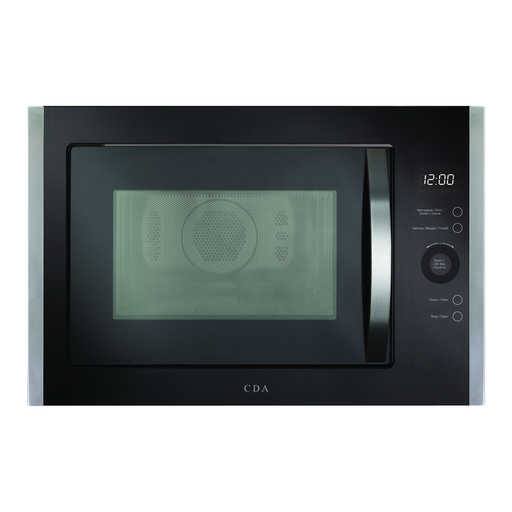
Consider this built-in model if you want to reheat family portions and also expect to use its grill or convection function.
Its listed capacity is 25L and its microwave output is 900W. Check that your usual dish fits and that the appliance suits your cabinet and installation arrangements.
 No image available
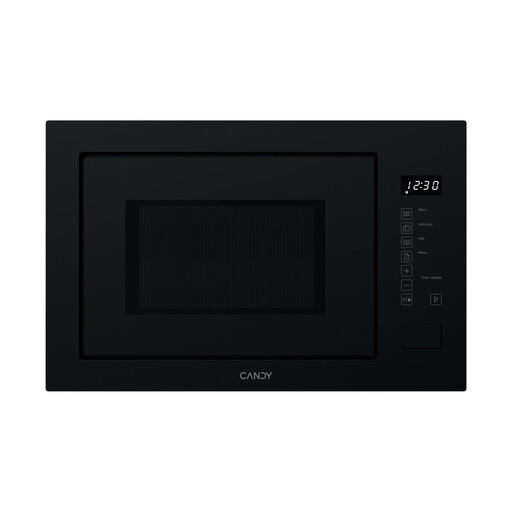
This built-in model is worth considering if a fitted appliance suits your kitchen and you need space for family portions.
The listed capacity is 25L. Before choosing it, check cabinet and installation requirements, microwave output, and whether your usual bowl or plate fits and rotates freely.
Yes, if reheating is the main task and your usual dish fits. Electrical Safety First describes solo microwaves as suitable for simple heating and reheating; consider a combination model if you will also use grilling or oven-style cooking.
Reheat them thoroughly until the centre is safely hot, rather than merely warming them. Follow any food-pack instructions and the Food Standards Agency’s reheating guidance; stirring partway through can help you address uneven heating, but still check the centre before serving.
Use a container clearly marked as microwave-safe and large enough for the portion. Electrical Safety First warns against metal and containers not designed for microwave use, including unsuitable foam trays and plastic storage bags.
A countertop microwave used in the UK should have a fused UK 3-pin plug. Electrical Safety First advises using an appropriate wall socket rather than an extension lead that could be overloaded alongside other high-power appliances.
Check your local authority’s or retailer’s current arrangements for recycling electrical appliances before disposing of it. An old microwave is electrical equipment, so do not assume it belongs in general household waste.