Couples making a mild curry or sauce
If you want a creamy sauce without a dominant coconut flavour, look for a mild-flavour description on a cooking coconut milk. A can's size or coconut content alone does not tell you how subtle it will taste.


For a date-night curry or sauce where you want a restrained coconut flavour, look for a culinary coconut milk with an explicit mild-flavour description. Sainsbury's describes Blue Dragon Coconut Milk this way, although that is a product claim rather than an independent taste test. Reduced-fat cooking milk is not necessarily milder, and a coconut drink should replace cooking milk only if the recipe accommodates its different formulation; check the pack for allergens and leftover instructions before serving a guest.
If you want a creamy sauce without a dominant coconut flavour, look for a mild-flavour description on a cooking coconut milk. A can's size or coconut content alone does not tell you how subtle it will taste.
A reduced-fat culinary coconut milk gives you a cooking-format option when richness is less important. Its lower fat content does not, by itself, establish a milder coconut flavour.
Culinary coconut milk and coconut drinks have different formulations. Check which format the recipe calls for before using a drink or barista product in a dinner sauce.
Start with the flavour you want, then check whether the recipe needs a cooking milk, a reduced-fat version or a drink-style product.
| Priority | What to check | Your needs |
|---|---|---|
| Coconut flavour | Look for an explicit mild-flavour description on a culinary product. Treat flavour and spice-mellowing descriptions as product claims, not taste-test results. | I want coconut in the background of a curry or dessert, rather than assuming every can will taste equally subtle. |
| Sauce richness | Compare standard and reduced-fat cooking milks using the same per-100g or per-100ml measure. Marks & Spencer lists 17.3g fat per 100g for its standard Coconut Milk and 9.3g for its Reduced Fat version. | A creamy cooking base matters to me, but I may choose a reduced-fat version when a less rich formulation suits the dish. Lower fat does not establish milder flavour. |
| Product format | Check whether the label describes a culinary coconut milk or a coconut drink. Koko describes Original Like Milk for drinks and cooking; Alpro positions Coconut Barista with Soya for coffee. | My recipe needs a cooking milk for its sauce, so I do not want to assume a drink-style product will behave the same way. |
| Saturated fat | Read the nutrition table on a like-for-like basis. Marks & Spencer lists 15.1g saturates per 100g for standard Coconut Milk and 8.2g for Reduced Fat; both exceed the NHS definition of high, which is more than 5g per 100g. | I want to compare the actual products going into the meal, rather than treating a reduced-fat label as a complete nutrition comparison. |
| Guests and leftovers | Check the physical pack's ingredients, precautionary allergen statement and opened-pack instructions. Sainsbury's says Blue Dragon Coconut Milk may contain peanuts and nuts. | When I cook for someone else, I need the label for the product I use and its specific instructions for any leftovers. |
Coconut drinks and barista drinks have different formulations from culinary coconut milk, so a substitution can change the body of a sauce.
For a curry or creamy soup, buy the cooking format specified by the recipe. Use a coconut drink where the recipe calls for a milk alternative or permits that substitution.
A lower-fat formulation does not establish how pronounced its coconut flavour will be.
If subtle flavour is the priority, look for an explicit mild-flavour description. Choose reduced-fat cooking milk for its stated formulation, not as a flavour guarantee.
Marks & Spencer lists 15.1g saturates per 100g for standard Coconut Milk and 8.2g per 100g for Reduced Fat. The NHS defines more than 5g per 100g as high in saturates, so the reduced-fat example also meets that definition.
Compare the packs using the same per-100g or per-100ml measure before deciding which formulation fits your recipe.
Precautionary allergen statements and opened-pack instructions are product-specific. Sainsbury's lists a possible peanut and nut presence for Blue Dragon Coconut Milk; its own-label coconut milk has different opened-pack instructions from Waitrose Essential Coconut Milk.
Check the exact pack before cooking for a guest, and follow that pack's refrigeration and use-within directions for leftovers.
These examples illustrate cooking milks, reduced-fat versions and drinks; a brand name alone does not identify the right format for a sauce.
Sainsbury's describes Blue Dragon Coconut Milk as a culinary product with a mild coconut flavour.
Koko Cuisine Coconut Milk is a cooking product; Koko Original Like Milk is a separate drink-style product.
Tesco Coconut Milk is a 400ml culinary can.
Sainsbury's own-label Coconut Milk is a 400ml cooking product for dishes such as curries and soups.
Marks & Spencer offers standard and Reduced Fat Coconut Milk for cooking.
Waitrose Essential Coconut Milk is a 400ml culinary product.
Alpro Coconut Barista with Soya is a coconut-and-soya drink positioned for coffee.
These two cooking-format options address different date-night priorities: an explicitly described mild coconut flavour, or a reduced-fat coconut milk for a curry or sauce.
 No image available
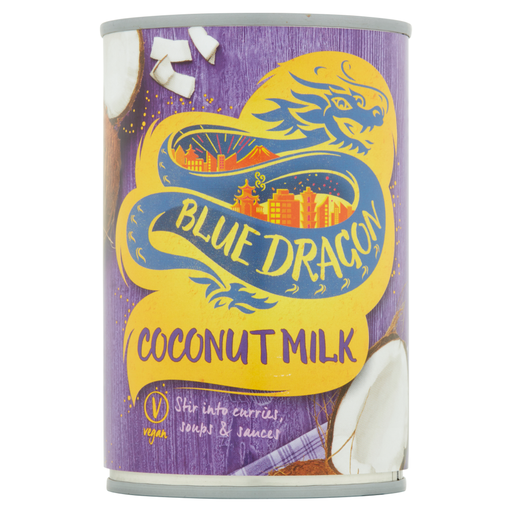
Blue Dragon describes this cooking milk as adding a mild coconut flavour to sweet and savoury dishes, making it relevant when a curry or sauce should not have a dominant coconut note. Its may-contain statement names peanuts and nuts; check the physical pack before serving someone with an allergy.
No image available
This reduced-fat cooking milk is an option when you want coconut milk for a curry or sauce but are choosing a different formulation from a standard can. Reduced fat does not establish a mild coconut flavour. Check the pack for allergens; after opening, the product directions call for transfer to a non-metallic container, refrigeration and use within 2 days.
Sainsbury's describes Blue Dragon Coconut Milk as having a mild coconut flavour and as helping to mellow spicy dishes. That is a product description, not an independent comparison of how coconut milks taste in a finished curry.
Not necessarily. Marks & Spencer lists less fat per 100g for its Reduced Fat Coconut Milk than for its standard version, but that comparison does not establish a milder coconut flavour. Look for a flavour description if subtlety matters most.
Use a coconut drink where the recipe calls for a milk alternative or allows that substitution. Koko Original Like Milk and Alpro Coconut Barista with Soya are drink-style products, so neither should be assumed to give a curry the same body as culinary coconut milk.
Follow the opened-pack directions for the product you used. Sainsbury's says to refrigerate its own-label Coconut Milk and use it within 3 days; Waitrose says to refrigerate unused Essential Coconut Milk and consume it within 2 days.
Read the ingredients and precautionary allergen statements on the actual pack before preparing the meal. For example, Sainsbury's lists a may-contain peanuts and nuts statement for Blue Dragon Coconut Milk; do not apply one product's statement to another can.