Easter hosts buying for several uses
If one carton needs to work with cereal, smoothies, hot drinks and recipes, a lightly flavoured everyday drink is a sensible starting point. Check whether its sweetness suits each planned use.


For a mild drink to use across an Easter food shop, start with an unsweetened almond drink, but check the flavour description and ingredients: unsweetened does not guarantee a neutral taste. Marks & Spencer lists 0.2 g sugars per 100 g for its unsweetened drink and 1.7 g per 100 g for its sweetened version. Choose a sweeter carton if that flavour suits the serving, or a barista version if coffee foam matters most; neither is automatically the mildest choice.
If one carton needs to work with cereal, smoothies, hot drinks and recipes, a lightly flavoured everyday drink is a sensible starting point. Check whether its sweetness suits each planned use.
A drink served on its own or in a dessert may call for a different flavour from one poured over cereal. Sweetened and unsweetened cartons can also have different ingredient lists, so compare the exact products.
If cappuccinos or other foamed coffees are the main use, look for a drink specifically labelled for barista use rather than assuming an everyday carton will foam in the same way.
Decide how the drink will be served, then compare sweetness, recipe and allergen information on the cartons you are considering.
Choose when: One carton needs to cover several foods and drinks without an intentionally sweetened recipe.
Bear in mind: Unsweetened cartons can still differ in almond flavour, ingredients and added nutrients.
Choose when: A subtly sweeter serving is what you want for drinking or desserts; Marks & Spencer describes its sweetened drink as creamy.
Bear in mind: The cited Marks & Spencer sweetened drink contains coconut sugar and lists more sugars per 100 g than its unsweetened counterpart.
Choose when: Foamed coffee is the main reason for buying; Plenish markets its Barista Almond M*lk as foamable.
Bear in mind: That Plenish barista recipe includes agave syrup, coconut milk, sunflower seed protein and oat fibre, unlike its standard three-ingredient drink.
| Priority | What to check | Your needs |
|---|---|---|
| Sweetness and flavour | Compare sugars on the same per-100 g or per-100 ml basis. Read the ingredients for added sugar, and treat a flavour description as the brand's description rather than a taste guarantee. | I want the drink to sit alongside cereal or recipes without adding sweetness I did not intend. Marks & Spencer lists 0.2 g sugars per 100 g for its unsweetened drink and 1.7 g per 100 g for its sweetened one. |
| Planned uses | Check the uses stated for the exact product. If foam matters, look for an explicit barista or foamable designation and compare its recipe with an everyday carton. | One carton for breakfast and baking would be convenient; if I am mainly making foamed coffee, I would look at a barista formulation instead. Plenish describes its standard Almond M*lk for cereal, smoothies, porridge, baking and coffee, and its Barista Almond M*lk for foamable coffee use. |
| Ingredients and additions | Read the full ingredient list and any listed calcium, iodine or vitamin additions. Compare almond percentages only where the exact products state them; percentage alone does not establish how mild a drink tastes. | I may prefer a short ingredient list, or I may want a carton that lists added nutrients. Rude Health Pure Almond lists water and 5% organic Italian almonds; the cited Marks & Spencer unsweetened drink lists calcium, iodine and vitamins B12 and D. |
| Allergens | Read the ingredient and allergen information on the exact carton, including any precautionary 'may contain' statement. Check again when buying for other people. | Before serving guests, I need to know whether anyone has a nut allergy. The Food Standards Agency identifies almonds as tree nuts; an almond drink is not a suitable substitute for a nut-allergic guest. |
Almond is a tree nut, so a dairy-free almond drink is still unsuitable for someone with a nut allergy.
Ask guests about nut allergies before buying for a shared meal. Read the exact carton and choose a different type of drink if a nut allergy is relevant.
Sweetness and almond flavour are separate considerations. Marks & Spencer lists 1.7 g sugars per 100 g for its sweetened almond drink, compared with 0.2 g per 100 g for its unsweetened drink.
Compare sugars on the same basis and check for sugar-containing ingredients before choosing the flavour you want.
A coffee-oriented recipe can differ from an everyday one. Plenish lists agave syrup, coconut milk, sunflower seed protein and oat fibre in its Barista Almond M*lk.
Choose a barista drink when foam is important; for cereal, baking and general serving, compare the ingredients and stated uses of a standard carton too.
These examples show how recipes within and across product lines differ; check the current carton before buying.
Its No Sugars Organic Almond Drink and Pure Almond offer different ways to approach a lightly textured drink.
The standard Almond M*lk and Barista Almond M*lk are presented for different serving needs.
Its unsweetened and sweetened almond drinks provide a direct comparison between two differently formulated 1 L cartons.
No Sugar, Original and Barista Almond are distinct product names in the Alpro line listed by Tesco Groceries.
Tesco Groceries has listed an own-brand Unsweetened Almond Drink 1 L alongside branded almond drinks.
These Alpro almond drinks offer a No Sugars option and a separate standard drink for everyday serving. Check the exact pack and recipe against your Easter plans.
 No image available
The No Sugars variant is an option when you want a carton for cereal, smoothies and hot drinks without choosing a sweetened recipe. The listing identifies an 8 x 1 L long-life pack. It contains almonds, so do not serve it to someone with a nut allergy; check the exact carton for allergen wording.
 No image available
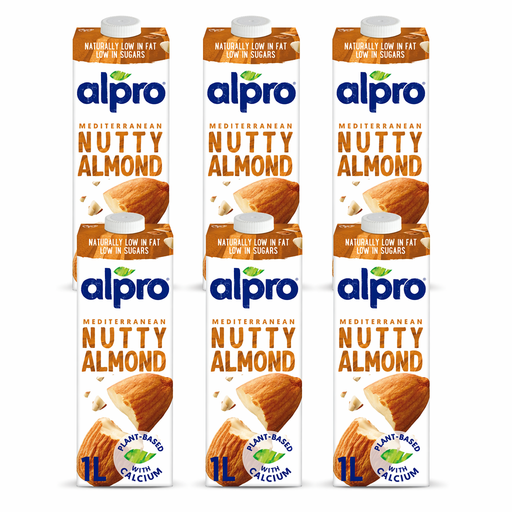
This standard almond drink is described for cereal, smoothies, hot drinks and cooking. Its listed ingredients include sugar, so do not treat it as the No Sugars variant. Confirm what the listing's '6' means for the pack contents before ordering. It contains almonds; check the exact carton's allergen wording if serving guests.
No. Unsweetened helps identify the sweetness route, but it does not settle how nutty a drink will taste. Rude Health describes its No Sugars Organic Almond Drink as subtly nutty, while Marks & Spencer lists 0.2 g sugars per 100 g for its unsweetened drink. If flavour is decisive for guests, compare ingredient lists and try the chosen carton before the meal.
Choose one if foamed coffee is an important part of brunch. Plenish describes its Barista Almond M*lk as foamable and intended for coffee, but its recipe differs from its standard drink. For cereal, baking and general serving, compare an everyday carton against those uses instead.
Do not serve almond drink to a guest with a nut allergy. The Food Standards Agency identifies almonds as tree nuts; being dairy-free does not make an almond-based drink suitable. Ask about allergies and choose another type of drink where necessary.
The Food Standards Agency says precautionary allergen labelling communicates that an allergen could be unintentionally present. Read both the ingredients and any precautionary statement on the exact carton, particularly when serving someone with an allergy.
Follow the unopened-storage and after-opening instructions on the exact carton. Check them when planning the shop so you know how the drink needs to be kept before it is served and after it has been opened.