What should you check before buying?
Decide first whether you want brewed black tea, a herbal infusion or an instant premix. Then compare the preparation directions and ingredients for the way you plan to serve it.
| Priority |
What to check |
Your needs |
| Tea base |
Check whether black tea is listed as the base or the product is labelled a caffeine-free herbal infusion. A name containing “chai” does not establish either. |
I want black-tea flavour as well as spices, rather than a spiced herbal drink. |
| Milk preparation |
Read the product’s milk-serving directions and infusion time. Sainsbury’s lists a water or simmering-milk method for Tea India Masala Chai; Tesco says PG Tips Chai can steep longer than its stated 2–4 minutes. |
Milk will go into my brunch chai, so I want a preparation method I can follow for that cup. |
| Spice blend |
Compare the named spices rather than relying on “spicy” or “strong” on the front of the pack. Spice flavour and black-tea strength are different considerations. |
I care which spices are in the drink, but I do not want a prominent spice flavour to stand in for the tea flavour I’m after. |
| Serving format |
Check bag count, loose-leaf preparation or individual sachets against the number of cups you expect to make. Instant mixes are stirred into hot water; tea bags and loose leaf need brewing. |
For several guests, I need a format that fits how I’ll serve the drinks, whether that means brewing cups or preparing sachets quickly. |
| Sweetness and ingredients |
With a premix, read the per-serving sugars and ingredient list, including milk-derived ingredients. Plain tea bags let you decide what to add after brewing. |
I’d rather set the sweetness and milk myself, or know what is already in an instant drink before serving it. |
Brand and product-line references
These examples show how chai formats and preparation directions differ; a brand name alone does not establish the strength of every blend it sells.
Tea India
Tea India Masala Chai is a bagged, Assam-black-tea blend with directions for serving with milk.
- Sainsbury’s lists 73% Assam black tea and a 3–5 minute infusion, with water and simmering-milk methods.
- The product page calls it a strong cup; that wording is not a measured comparison with other chais.
PG Tips
PG Tips Chai is a 70-bag black-tea option for serving repeated cups.
- Tesco lists black tea with 29% spices and a 2–4 minute brew, or longer for a stronger cup.
- That brewing advice does not establish its strength relative to another blend.
Tesco Finest
Tesco Finest Chai is a 50-bag black-tea-and-spice option.
- Tesco recommends leaving the bag for 4–5 minutes to brew.
- Its “Strength No. 02” designation is a pack label, not proof of extra-bold flavour across brands.
Twinings
Twinings offers black-tea chai in bagged and loose-leaf formats, with different spice blends and brewing directions.
- Twinings lists black tea in Classic Chai and gives a 2–3 minute infusion; its loose-leaf Spicy Chai has separate pot-brewing directions.
- Twinings describes Chai Ultra Spice as bold and spice-forward, but that brand description does not measure its black-tea strength against the other blends.
Pukka
Pukka Spiced Vanilla Chai is a herbal route when spices and an explicitly caffeine-free drink matter more than a black-tea base.
- Pukka describes the blend as caffeine-free, with cardamom, ginger, cinnamon and vanilla flavours.
- As a herbal blend, it is not a like-for-like choice for someone seeking black-tea flavour.
Clipper
Clipper Organic & Fairtrade Indian Chai is a bagged black-tea blend for shoppers considering those sourcing labels.
- Clipper Tea Shop lists black tea, cinnamon, orange peel, cloves and fennel seed among its ingredients.
- Choose it for its stated ingredients and sourcing labels rather than assuming a particular strength from the product name.
Joybuy option for quick brunch serving
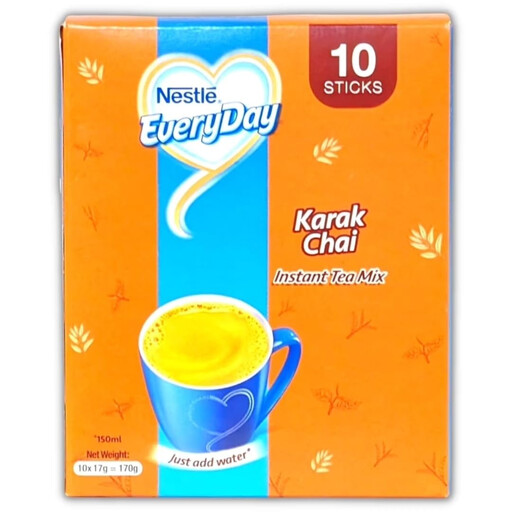
This instant karak option suits quick, individual servings of a pre-sweetened drink. It is a different format from brewing black-tea chai bags and adding milk yourself.
 No image available
Nestle Everyday Karak Tea 3in1, 10 × 17 g
For quick individual brunch drinks, the ten 17 g sachets are prepared by adding hot water and stirring. This pre-sweetened instant mix contains milk and soya; check the pack if you need to avoid either ingredient or want to control the drink’s sweetness.
View on Joybuy
Chai buying questions
What should I look for in a tea-led brunch chai?
Look for black tea as the base and preparation directions that suit how you will serve it. Sainsbury’s gives water and simmering-milk methods for Tea India Masala Chai; Tesco says a longer brew makes PG Tips Chai stronger. Neither direction is a standardised cross-brand strength measure.
Can I prepare chai bags with milk?
Yes, where the product’s directions allow it. Sainsbury’s says Tea India Masala Chai can be infused in simmering milk or a dairy-free alternative, or brewed in water before milk is added. Follow the directions on the particular pack you buy.
Is chai always caffeinated?
No. Tea India and Tesco Finest list black tea, while Pukka explicitly describes Spiced Vanilla Chai as caffeine-free. Check the exact blend rather than relying on the word “chai”.
Is instant karak the same as chai tea bags?
No. Instant karak can contain sugar and milk ingredients already mixed with tea extract, whereas brewed tea bags let you decide what to add. For example, Sainsbury’s lists 16 g sugars per 20 g serving for Riya’s Karak; check the serving information for the specific mix you choose.
Should I check the pack when buying chai again?
Yes, particularly if ingredients or allergens affect your choice. Tesco notes that food products can be reformulated, so check the label on the pack you receive rather than relying on an earlier listing.


