Daily iced-coffee drinkers
If you make iced lattes or cold brew regularly, look for a named cold-foam setting and a frothing fill line that suits one drink. A larger hot-milk limit does not tell you how much milk the appliance can froth.


Choose a frother whose exact model lists a cold-foam or cold-froth setting; a general claim that it froths milk does not establish that it can make foam without heating it. Then compare the frothing fill limit with the number of drinks you make, check guidance for your usual milk and read the cleaning instructions for each part.
If you make iced lattes or cold brew regularly, look for a named cold-foam setting and a frothing fill line that suits one drink. A larger hot-milk limit does not tell you how much milk the appliance can froth.
If you usually use oat, soya or another plant milk, seek guidance for the exact frother and milk type rather than assuming dairy results will carry over. Melitta says milk protein content affects the fineness and stability of foam.
If you make multiple iced drinks in a session, compare frothing capacity with the milk you use per drink and allow for repeat batches. If you also serve warm drinks, check which hot-milk and hot-foam functions the same model offers.
Start with cold-foam capability, then judge capacity, milk guidance and cleaning against the way you make drinks.
| Concern | What to check | Who this matters to |
|---|---|---|
| Cold-foam setting | Find an explicit cold-foam, cold-milk-foam or cold-froth setting for the exact model; check its foam fill line. | If I mainly make iced coffee, I need the milk frothed without heating it. Around 36% of consumers put a clearly identified cold-foam function first. |
| Results with your milk | Look for guidance or testing for the exact model and the dairy or plant milk you use. | My usual oat or soya drink needs to give me a texture I am happy to use, rather than simply working with dairy milk. Around 29% of consumers prioritise foam results with their preferred milk. |
| Batch size and functions | Compare the frothing maximum with your milk per drink, separately from the heating limit; check any other functions you would use. | When I prepare several drinks, repeated frothing cycles matter more to me than a large hot-milk figure. Roughly 21% of consumers place capacity and versatility first. |
| Cleaning | Check the instructions separately for the container, whisk, lid and electrical base. | If I use the frother often, I want to know which parts I can wash easily without damaging the appliance. Around 14% of consumers make cleaning and upkeep their primary concern. |
A frother described only in general terms might not have the non-heating cycle needed for an iced drink.
Look for a named cold-foam or cold-froth setting on the exact model page or in its manual before ordering.
Milk needs room to expand while frothing. Nespresso specifies 120 ml for frothing in the Aeroccino 4, compared with 240 ml for hot milk.
Compare your usual amount of milk per drink with the stated frothing maximum, not the heating capacity.
Milk formulation affects the result. Good Housekeeping UK found plant-milk foam from its tested Melitta Cremio slightly less uniform than dairy foam; Melitta also says higher protein content supports finer, more stable foam.
Check guidance for your exact model and try it with the oat or soya drink you normally use.
Care instructions differ by model and component: dishwasher-safe accessories do not necessarily mean the container or electrical base can go in too.
Follow the exact manual and keep the electrical base out of water.
The Cremio is an automatic jug frother with cold and warm froth settings, as well as milk heating.
The compact Aeroccino 3 and Aeroccino 4 both offer cold foam for small batches.
The MFF02 offers a compact cold-foam option, while the MFF11 adds light and dense cold-froth programmes.
The MilkEasy Plus is an automatic frother with hot and cold preparations for dairy and plant milk.
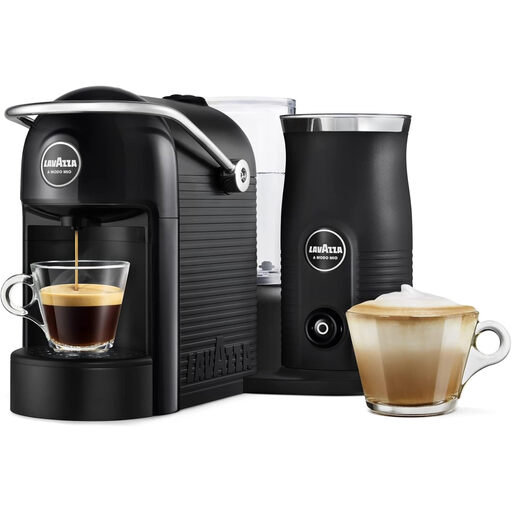
This Joybuy choice combines a pod coffee machine with a hot-and-cold milk frother, rather than offering a standalone frother. Check that a combined machine fits your coffee setup as well as your cold-foam needs.
 No image available
Consider this combined pod coffee machine and frother if you want cold milk foam alongside your coffee. Its listed frother is described as hot and cold; check the frothing fill limit, component-cleaning instructions and capsule compatibility against your routine before buying.
No. Check that the exact model explicitly lists cold foam, cold milk foam or cold froth. Nespresso lists cold foam for the Aeroccino 4, and Melitta specifies a cold-froth mode for the Cremio.
You can use those milks with a model whose guidance identifies them, but the texture can vary with the milk. Melitta lists oat, soya and lactose-free milk for its Cremio and says higher protein content supports finer, more stable foam; that guidance does not establish the same result for every frother or milk formulation.
Use the exact model’s frothing limit, which may be lower than its hot-milk limit. Nespresso specifies 120 ml for frothing and 240 ml for hot milk in the Aeroccino 4; Melitta specifies 100–150 ml for frothing in the Cremio.
Only the parts identified as dishwasher-safe in the exact model’s instructions should go in. Nespresso permits Aeroccino 4 components other than the base in a dishwasher up to 70°C but says not to dishwasher-clean the Aeroccino 3; Melitta identifies the Cremio lid and whisk as dishwasher-safe while directing users to wipe its container.