Hosts making several lattes
If two or more friends want milk drinks together, compare maximum frothing capacity with your intended portions. The hot-milk capacity is not necessarily the amount you can froth in one cycle.


For several guest lattes, choose an automatic frother by its stated frothed-milk capacity, not its often larger hot-milk limit; a compact model may mean making drinks in rounds. A steam-based appliance is worth considering if hands-on texture control matters more to you than one-button operation. For straightforward hosting, weigh batch size alongside the programmes you will use and how the appliance is cleaned.
If two or more friends want milk drinks together, compare maximum frothing capacity with your intended portions. The hot-milk capacity is not necessarily the amount you can froth in one cycle.
If you want to practise controlling milk texture for latte art, a steam-based appliance offers a more hands-on process. Dualit describes its Cino as a continuous-steam model; that approach also asks more of the person making the drink.
If you usually make one or two drinks and have limited storage, a compact automatic frother may be enough. The Smeg MFF02 and Nespresso Aeroccino 4 each list a 120 ml frothing limit, so plan on repeat cycles for a larger group.
Start with the amount of foam you need for one round of lattes. Then decide whether drink options, cleaning or storage will have the greatest effect on how you use the frother.
| Concern | What to check | Who this matters to |
|---|---|---|
| Batch size | Compare the maximum frothed-milk fill level with the number and size of drinks you plan to serve. Do not use the hot-milk line as the foam limit. | When friends want their lattes together, I do not want to stop halfway through to froth another batch; around 33% of consumers would put batch size first. |
| Texture and drinks | Look for the hot-milk, hot-foam or cold-foam options you will use, or consider whether you want hands-on steaming. | If I make different milk drinks, I want a choice of textures rather than one foam setting; roughly 27% of consumers would make texture and drink flexibility their main concern. |
| Cleaning | Check which removable parts can go in a dishwasher and how the electrical base must be cleaned. | After serving several drinks, I want to clean the frother without a lengthy routine; around 20% of consumers would prioritise easy cleaning. |
| Space and value | Compare appliance size and the functions you would use against the smaller batches a compact model may require. | With limited cupboard space, I would rather accept smaller batches than store a larger appliance; roughly 20% of consumers would put space and value first. |
The two limits can differ considerably: Nespresso lists 400 ml for hot milk but 225 ml for foam in the Aeroccino XL, while Smeg UK lists 600 ml for heating and 250 ml for whipping in the MFF01DGBUK.
Work out how many cycles your guest drinks need using the frothing limit in the model’s instructions, and stay below its foam fill line.
Nespresso’s Aeroccino 4 and Smeg’s MFF02 each list a 120 ml maximum frothing capacity. Whether one cycle covers more than one drink depends on the portions you make.
If several friends want lattes at once, compare a larger frothing capacity or plan to serve the drinks in rounds.
Dualit presents its Cino steamer as a hands-on route to controlling milk texture. That is a different process from selecting a programme on an automatic whisk frother, not a requirement for making a latte-style drink.
Choose a steamer if you want to practise texture control; otherwise, focus on automatic models’ capacity, useful programmes and cleaning requirements.
Dishwasher instructions can apply to a jug or other removable components without including the powered base. Nespresso excludes the base from the dishwasher-safe parts of its Aeroccino XL.
Follow the instructions for the specific model, keep its electrical base out of the dishwasher and dry washable parts as directed before reassembly.
Dualit offers automatic frothers in different sizes as well as the steam-based Cino.
Smeg’s cited automatic models span the compact MFF02 and the multi-programme MFF01 range.
Nespresso’s Aeroccino frothers are separate milk-preparation appliances, including the XL and Aeroccino 4.
These choices cover a standalone milk frother and a pod coffee machine with an integrated frother. Check how much milk each can froth per cycle before relying on it for a full round of guest drinks.
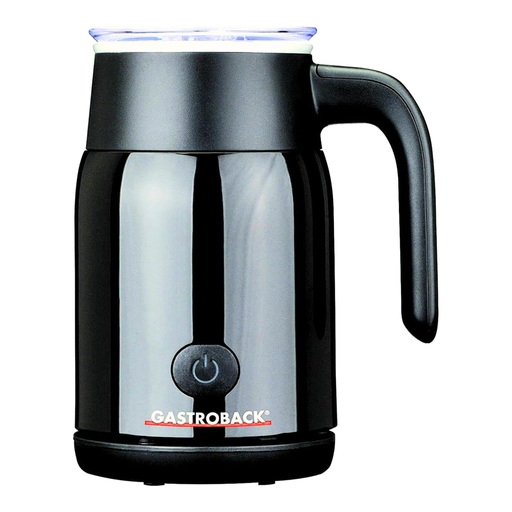 No image available
This standalone frother is an option if you already make coffee separately. Check its frothed-milk fill line against the portions you plan to serve guests.
Rated power: 500 W. Check the cleaning instructions for its removable parts before buying.
 No image available
This pod coffee machine combines coffee preparation with a hot and cold milk frother and includes a glass mug. It suits someone considering both functions in one appliance rather than a standalone frother.
The listed capacity is 1.1 L; check which part of the machine that figure describes. Confirm the milk-frothing limit, capsule compatibility and cleaning instructions before planning several guest drinks.
Choose a capacity that covers the milk portions you want to froth in one round, using the foam limit rather than the hot-milk limit. For comparison, Dualit lists 540 ml for the Milk Frother Max, Smeg UK lists 250 ml for the cited MFF01 model, and Nespresso lists 225 ml for the Aeroccino XL; the number of lattes each makes depends on your portions.
No: an automatic whisk frother can prepare milk for latte-style drinks without the hands-on process of steaming. Consider a steamer if practising direct texture control matters to you; Dualit describes its Cino as a continuous-steam appliance, rather than an automatic whisk frother.
Only the parts identified as dishwasher-safe for that model should go in the dishwasher. Nespresso says the Aeroccino XL’s parts are dishwasher-safe except for its base, so check the instructions before washing a jug, whisk or lid and keep the electrical base out.
For a UK online purchase, GOV.UK says customers generally have 14 days from receiving an item to tell the seller they want to cancel, followed by another 14 days to return it. Remedies for faulty or misdescribed goods are separate from a change-of-mind cancellation; check the seller’s return process without treating its voluntary policy as a limit on statutory rights.