Online shoppers choosing skimmed milk
Compare the delivered pack size and whether it is fresh, filtered or UHT milk. Those formats come with different storage instructions, so the category name alone does not settle the choice.


For online delivery, choose a smaller fresh bottle if its quantity and post-opening period suit your household, a larger filtered bottle if you use milk regularly and have fridge space, or UHT cartons for an unopened cupboard back-up. A multipack of 1-litre cartons is not the same as portable lunchbox portions: check the exact pack format and storage directions before ordering.
Compare the delivered pack size and whether it is fresh, filtered or UHT milk. Those formats come with different storage instructions, so the category name alone does not settle the choice.
A smaller bottle may be easier to finish within its stated period after opening. For example, M&S says its 568ml fresh skimmed milk is best consumed within three days of opening.
Check for an actual single-serve container rather than assuming a milk multipack contains portable portions. A standard bottle or 1-litre carton also needs its own storage instructions followed.
Start with how much milk you will use, then check the container, storage label and any substitution settings before placing the order.
Consider it: M&S’s 568ml fresh bottle suits a smaller quantity if you can use it within its stated three days after opening.
Bear in mind: It must be kept refrigerated at 0°C to +5°C and is a bottle, not a lunchbox portion.
Consider it: For regular household use, Waitrose & Partners states that its filtered skimmed milk stays fresh for up to one month unopened and seven days once opened.
Bear in mind: Its 2-litre bottle needs fridge space and must be kept below 5°C; follow the date and directions on the pack.
Consider it: A 1-litre UHT carton offers an unopened back-up instead of another fresh bottle.
Bear in mind: Waitrose & Partners says its 1-litre UHT skimmed milk needs refrigeration below 5°C and use within five days after opening; the carton is not a single-serve pot.
| Priority | What to check | Your needs |
|---|---|---|
| Pack format | Read the container size and the number of containers. Confirm whether a multipack holds portion-sized units or full-size cartons. | I need a portion for a lunchbox, not simply several larger cartons delivered together. |
| Amount used | Compare capacity with the exact product’s period after opening and its refrigeration directions. | A smaller quantity makes sense if I am unlikely to finish a larger opened bottle in time. |
| Date and storage | Check the date label, the unopened storage directions and what changes after opening. GOV.UK distinguishes use-by dates, which concern safety, from best-before dates, which concern quality. | I need to know where the delivered milk goes straight away and how to store it once opened. |
| Product label | Check the exact product’s ingredients and nutrition information if those details affect your choice; do not rely on the search category alone. | I want the skimmed milk I ordered, with a label I can check against the rest of my grocery order. |
| Substitutions | Review the retailer’s substitution setting and inspect any replacement for changes in size, fresh or UHT format, and storage directions. Sainsbury’s says it may offer substitutes unless you ask it not to. | If I chose UHT for cupboard storage, a substituted fresh bottle would change my plans. |
A multipack can contain full-size cartons rather than small containers ready to put in a lunchbox.
Check the capacity of each container and its storage instructions before ordering for that use.
Post-opening directions differ by product: M&S states three days for its 568ml fresh bottle, Waitrose & Partners seven days for its filtered bottle, and five days for its 1-litre UHT carton.
Choose a quantity you expect to use within the exact pack’s stated period, while following its date label and refrigeration instructions.
A replacement can change the milk from fresh to UHT, alter its capacity or take up different fridge space. Sainsbury’s says substitutes may be offered unless the shopper has asked otherwise.
If the exact format matters, adjust your substitution preference and check any replacement at delivery before keeping it.
These retailer listings illustrate pack and storage differences; a brand reference does not mean every format is available in every order.
Tesco lists own-label fresh skimmed milk in different bottle sizes, including 568ml and 2.272L.
Tesco lists Cravendale Filtered Fresh Skimmed Milk in a 2L bottle.
Waitrose & Partners lists filtered fresh skimmed milk and a separate 1-litre UHT skimmed milk.
M&S lists fresh skimmed milk in 568ml, 1.136L and 2.272L bottles.
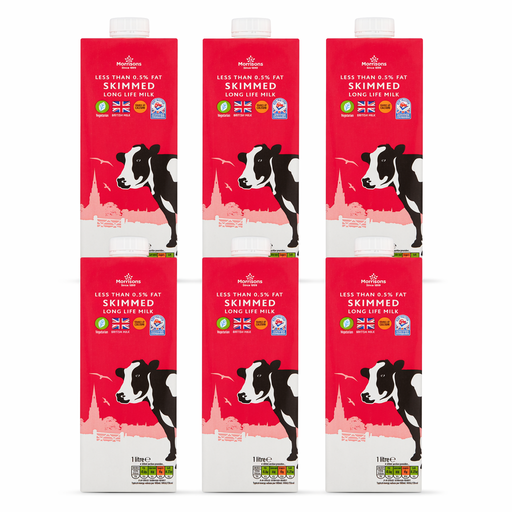
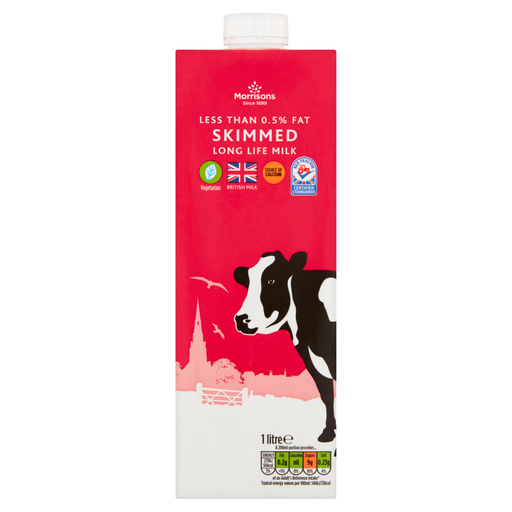
These Morrisons UHT options are for an unopened cupboard back-up. The six-pack contains 1-litre cartons; neither option should be mistaken for portion-sized lunchbox pots.
 No image available
For an unopened cupboard back-up, this pack contains six 1-litre UHT skimmed milk cartons, not lunchbox-sized portions. Follow each carton’s storage directions after opening.
 No image available
This 1-litre UHT carton is an unopened back-up option, not a single-serve lunchbox pot. Follow the carton’s storage directions after opening.
Not necessarily. The Tesco, Waitrose and M&S bottles and cartons discussed here do not establish a portion-pot format, and the Morrisons six-pack contains 1-litre cartons. Check each container’s size and storage instructions if you need milk for a lunchbox.
No. NHS guidance says 1% fat or skimmed milk should not be given as a main drink to children under five. A skimmed-milk multipack should not be assumed suitable for that purpose.
Check its size, whether it is fresh or UHT, and its storage directions before keeping it. Sainsbury’s says shoppers can refuse an item at delivery; Waitrose & Partners says an unwanted item can be returned to its driver for a refund. These are the retailers’ stated delivery arrangements, not a rule for every shop.
Check the exact pack’s date label and directions for storage before and after opening. GOV.UK explains that use-by dates concern food safety, while best-before dates concern quality; where packaging requires refrigeration after opening, it says to keep the food at 5°C or below.