What should you check?
Start with the milk-fat category, then compare the nutrition panel and storage instructions for the amount and format you actually use.
| Priority |
What to check |
Your needs |
| Fat and saturates |
Compare whole, semi-skimmed, 1% and skimmed milk. Check fat and saturates per 100 ml on the pack; Dairy UK lists 3.7 g, 1.8 g and 0.3 g fat per 100 ml for standard whole, semi-skimmed and skimmed milk respectively. |
I usually buy whole milk but want to reduce fat. Semi-skimmed is a change to consider; if I want to cut fat further, I can compare 1% and skimmed milk. |
| Carbohydrate and sugars |
Read both values on the nutrition panel, using a consistent per-100 ml or per-100 g basis when comparing packs. Consider how much milk goes into drinks, cereal or cooking; do not treat a lower-fat label as a carbohydrate claim. |
Milk is part of what I pour or drink, so I want to account for the amount I use rather than assume skimmed milk has no sugar. |
| Taste and use |
Consider whether the milk works for the drinks or recipes in which you use it. If creaminess matters, try a smaller amount of a lower-fat category before changing all your usual uses. |
I want a lower-fat option I will use in tea, cereal or cooking, without assuming every milk-fat category will taste the same to me. |
| Storage and pack size |
Check whether the unopened carton needs refrigeration, its date label, and its instructions after opening. Compare pack size with how quickly your household uses milk. |
Some weeks I use milk slowly, so I need a carton and storage routine that fit the instructions on the pack. |
Brand and product references
These examples show why the exact product label matters; a brand name alone does not settle the milk-fat or storage choice.
Cravendale
Its filtered semi-skimmed milk is an option to examine if you have already decided on semi-skimmed milk and need to plan around opened storage.
- Tesco states that the 2L filtered semi-skimmed product lasts seven days after opening and up to three weeks unopened.
- Check the date and storage directions on the carton you receive, along with its nutrition panel; the freshness claim is not a diabetes-specific benefit.
M&S
Its standard and filtered semi-skimmed products illustrate a storage difference within the same milk-fat category.
- M&S lists 1.8 g fat and 1.1 g saturates per 100 g for its standard semi-skimmed milk.
- The standard product says to consume within three days after opening; the filtered product says within seven days. Follow the directions on the product selected.
Waitrose
Its own-label semi-skimmed milk provides a fresh-milk example with nutrition figures shown per 100 ml.
- Waitrose lists 1.8 g fat, 1.1 g saturates and 4.8 g sugars per 100 ml for its Essential British Free Range Semi-Skimmed Milk.
- Its stated opened-life period is three days. Organic or farm-origin descriptions on other products do not replace a comparison of the nutrition panels.
Morrisons
A long-life semi-skimmed product offers a format to consider when unopened, ambient storage matters.
- Joybuy describes the named Morrisons Long Life British Semi Skimmed Milk as UHT and instructs cool, dry storage before opening.
- That particular listing is marked no longer available. Its directions say to refrigerate after opening and use within three days; check the exact carton when choosing another product.
Skimmed UHT milk options on Joybuy
These Morrisons skimmed UHT options represent the further fat-reduction route, rather than the full choice between whole, semi-skimmed and skimmed milk. Check the pack size, nutrition panel and storage directions for the option you are considering.
 No image available
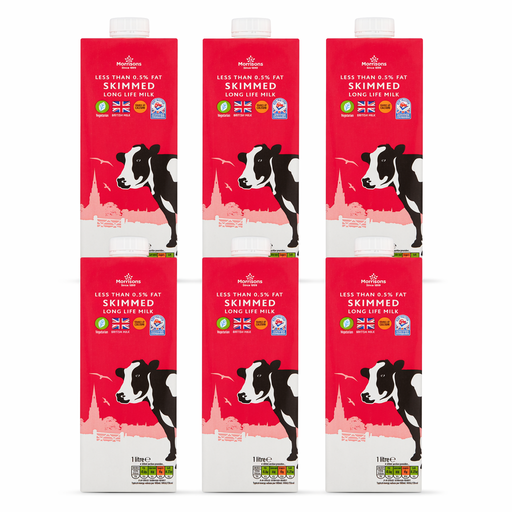
Morrisons British UHT Skimmed Milk, 1 litre × 6
Consider this six-carton UHT bundle if you want skimmed cow's milk and can use its pack size. The product information directs cool, dry storage before opening, then refrigeration and use within three days after opening. Skimmed milk is not carbohydrate-free: check the current pack's carbohydrate and sugars figures and the amount you use. The product description states that it is not suitable for children under five.
View on Joybuy
 No image available
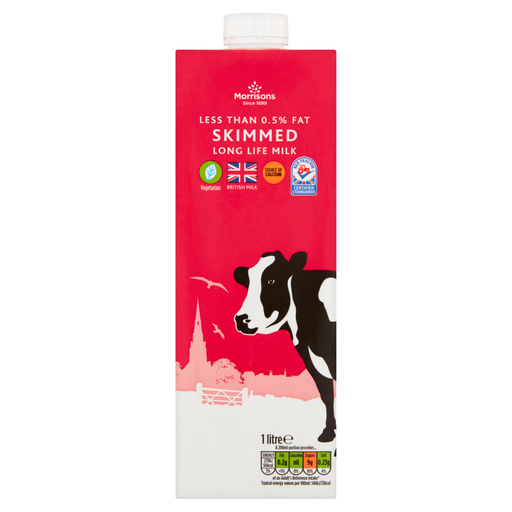
Morrisons British UHT Skimmed Milk, 1 litre
This skimmed UHT listing is another option if reducing milk fat is your priority. Check the listing and carton for the pack quantity before choosing it. The product information directs refrigeration after opening and use within three days; its description states that it is not suitable for children under five. Check carbohydrate and sugars on the current pack rather than treating skimmed as carbohydrate-free.
View on Joybuy
Questions about choosing milk
Should I switch from whole to semi-skimmed milk if I want less fat?
Semi-skimmed milk is a lower-fat cow's-milk option to consider. Dairy UK's standard figures list 1.8 g fat per 100 ml for semi-skimmed milk and 3.7 g for whole milk; Diabetes UK says semi-skimmed and skimmed milk are as nutritious as full-fat milk with fewer calories. Check the pack's carbohydrate figures separately.
Does semi-skimmed or skimmed milk have no sugar?
No. A lower-fat designation does not mean the milk is sugar-free or carbohydrate-free. Read carbohydrate and sugars on the exact pack, and consider the amount you add to a drink or meal.
When might I choose 1% or skimmed instead of semi-skimmed?
Consider 1% or skimmed milk when reducing fat further matters more to you than the taste or texture of semi-skimmed milk. The NHS suggests these categories for people trying to cut down on fat. Compare the packs' nutrition panels and try the milk in the uses that matter to you.
How long does semi-skimmed milk keep after opening?
Follow the instruction on the particular carton. Marks & Spencer specifies three days after opening for its standard semi-skimmed milk and seven days for its filtered semi-skimmed product. A UHT carton can also require refrigeration after opening, so do not use its unopened storage directions as a guide to opened life.
Does a low-fat label make milk specifically suitable for diabetes?
No. The label describes fat content, not a diabetes-specific benefit or the milk's carbohydrate content. Compare the full nutrition panel and the amount you use when choosing between milk-fat categories.


