What should you check?
Decide whether the shake is a drink with lunch or an intended meal replacement, then compare the exact variant’s label and the amount you will consume.
| Priority | What to check | Your needs |
|---|
| Added and total sugars |
Check the no-added-sugar claim, ingredients and sugars per 100ml and per bottle. The NHS distinguishes free sugars from naturally occurring milk sugars, which still appear in total sugars. |
I want to reduce added sugar without assuming the drink contains no sugar. If I also avoid sweeteners, I need to read the ingredients. |
| Drink or meal replacement |
Look for an explicit meal-replacement label and its use conditions if you plan to replace lunch. Sainsbury’s describes its cited SlimFast shake as a meal replacement for weight control, with use tied to a calorie-controlled varied diet and active lifestyle; protein content alone does not establish that purpose. |
Am I packing a drink to go with food, or deliberately replacing the meal? That decision changes which product category I should consider. |
| Ingredients and allergens |
Read the exact variant’s ingredient and allergen declarations. Tesco lists milk, barley and sweeteners for its cited Mars no-added-sugar drink; Yazoo says its Kids Chocolate variant has no artificial sweeteners, but it remains milk-based. |
Milk, barley or sweeteners may affect which variant I choose, regardless of the claim on the front of the bottle. |
| Amount consumed |
Compare figures on the same basis and check bottle size. Tesco lists the Mars drink as 400ml and gives sugars per 100ml; the per-100ml figure is not the amount in the whole bottle. |
If I expect to finish the bottle at lunch, I want to assess that amount rather than a smaller labelled portion. |
| Preparation and storage |
Check whether the drink is ready to consume or needs milk and a cup. Tesco says to refrigerate its cited Mars drink after opening and consume it within three days; Sainsbury’s says its cited Crusha mix must be refrigerated after opening and used within one month. |
For a desk lunch, I need a format I can prepare and store according to its own label. |
Brand and product-line references
Claims about sugar and sweeteners apply to the named variants, not every drink sold under a brand.
Yazoo
Yazoo sells standard flavoured milk drinks as well as a Kids Chocolate no-added-sugar variant.
- Yazoo lists 4.7g sugars per 100ml for Kids Chocolate and says it contains no artificial sweeteners.
- Yazoo’s standard Strawberry variant lists sugar as an ingredient and 8.7g sugars per 100ml. Both cited variants are milk-based.
Müller FRijj
The cited FRijj Chocolate is a conventional, ready-to-drink dairy milkshake in a 330ml bottle.
- Müller lists 3.7g protein per 100ml for this Chocolate variant.
- Its listed ingredients include sugar syrup and fructose, and Müller reports 11.4g sugars per 100ml.
Mars Chocolate Drinks
The cited Mars Chocolate Flavoured Milk Drink is a 400ml ready-to-drink, no-added-sugar variant.
- Tesco lists 6.5g sugars per 100ml for this variant despite its no-added-sugar claim.
- Its listed ingredients include sweeteners, milk and barley. Check the whole-bottle figures if you intend to drink all 400ml.
Joybuy product options
This ready-to-drink option is for someone planning to replace an office lunch with a shake, rather than choosing a flavoured milk drink to accompany food.
 No image available
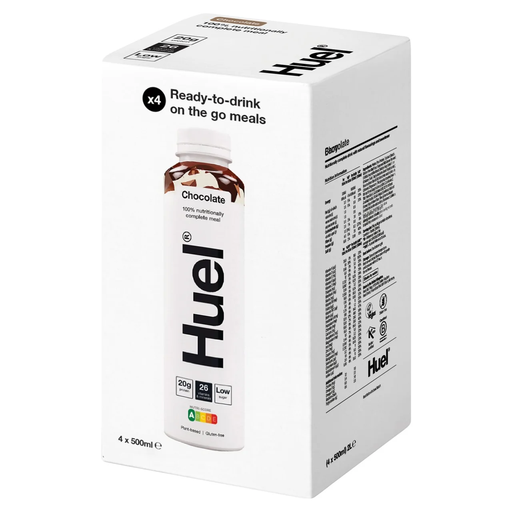
Huel Ready-to-Drink Complete Meal Chocolate, 4 × 500ml
This ready-to-drink chocolate complete-meal shake is an option for a planned lunch replacement and comes as four 500ml bottles. Check the bottle’s sugar, sweetener and allergen information, and follow its meal-use directions rather than using it to replace an otherwise varied diet.
Joybuy
Frequently asked questions
Does “no added sugar” mean a milkshake contains no sugar?
No. The NHS explains that naturally occurring milk sugars appear in total sugars on food labels but are not free sugars. Tesco lists 6.5g sugars per 100ml for its cited Mars no-added-sugar milk drink, so check both the claim and the nutrition panel.
Can a standard milkshake replace my packed lunch?
Do not treat its protein content as a meal-replacement label. A conventional flavoured milkshake can be the drink or treat alongside lunch; if you intend a weight-control meal replacement, choose a product labelled for that purpose and follow its stated diet conditions.
What if I avoid sweeteners?
Read the ingredients on the exact variant. Tesco lists sweeteners for its cited Mars no-added-sugar drink, and Sainsbury’s describes its cited Crusha no-added-sugar mix as a product with sweeteners; Yazoo says its Kids Chocolate variant contains no artificial sweeteners. Confirm the label on the pack you buy.
How should I store a milkshake after opening?
Follow that product’s label. Tesco says to refrigerate its cited Mars ready-to-drink bottle after opening and consume it within three days; Sainsbury’s says to refrigerate its cited Crusha syrup after opening and use it within one month. Those instructions should not be applied to other drinks.
Does “no added sugar” tell me whether a drink contains milk?
No. The claim concerns added sugar, not allergens. The cited Mars drink contains milk and barley, while the cited Yazoo and FRijj drinks are milk-based; check the allergen statement on the exact product before choosing it.


