Solo leftovers cook
You want to chop a small, boneless cooked portion for a filling, sauce or pie without setting up a large appliance. Look for a model intended for small quantities and check that its manual permits your intended ingredients.


For one small portion of cooked meat, start by considering a mini chopper with controls that let you stop and check the texture, provided its manual permits the task. A compact full food processor is more useful if you also regularly slice or grate ingredients, but its larger bowl and extra parts take more space and cleaning. Check the exact model's instructions for cooked meat, food temperature and suitable loads before buying.
You want to chop a small, boneless cooked portion for a filling, sauce or pie without setting up a large appliance. Look for a model intended for small quantities and check that its manual permits your intended ingredients.
You want to stop at a coarse or fine chop rather than process everything to a paste. Short bursts and a chance to inspect the contents matter more to you than a large bowl.
You also want to slice or shred ingredients regularly. A compact full processor may justify its bowl and attachments if the supplied parts cover those other jobs; KitchenAid distinguishes these functions from typical mini-chopper tasks.
Decide whether this is mainly a one-portion chopping job or part of broader food preparation, then compare bowl size, control and the attachments you would actually use.
| Concern | What to check | Who this matters to |
|---|---|---|
| Small-portion practicality | Check the bowl capacity, the maker's small-quantity guidance and which parts can be removed for washing. | When I only chop one portion, I want a manageable bowl and little washing-up afterwards. Around 50% of consumers would put small-portion practicality first. |
| Texture control | Look for stated pulse or speed controls, and check the exact model's permitted use. | If I need a coarse chop for a filling, I want to stop and inspect it before it becomes too fine. Texture control would be the main concern for around 30% of consumers. |
| Other preparation jobs | List the slicing or shredding tasks you do regularly and check which attachments come with the processor. | When I prepare several ingredients as well as meat, I want the extra functions to justify the space and washing. For around 20% of consumers, those other jobs would take priority. |
A general chopping description does not establish which meat types, loads or food temperatures a particular model permits.
Read the exact model's manual before buying. Do not put bones or hard pieces into it unless the manufacturer explicitly allows them.
Slicing and shredding attachments can be useful, but a larger bowl and more parts also mean more to store, assemble and wash.
Choose the larger format for preparation jobs you expect to do regularly, not solely for its number of attachments.
Motor power does not, by itself, tell you whether you can stop at the texture you want. Controls and the model's loading instructions matter too.
Check for pulse or speed settings and follow the manufacturer's processing guidance.
Good Housekeeping UK's mini-chopper overview is a broader category ranking, not a cooked-meat-mincing result for every model it lists.
Use a ranking to identify models worth examining, then check each model's food-use instructions and capacity for your task.
Kenwood offers small choppers including the CH180B and the 500 ml Easy Chop CHP61.100WH.
The KitchenAid 5KFC3516 is an 830 ml mini chopper with two speeds and pulse action.
Bosch's compact MultiTalent 3 processor range is relevant when meat chopping is one of several preparation jobs.
These choppers have substantially different stated bowl capacities. Compare how each fits a one-person portion, and check its exact instructions before using it for cooked meat.
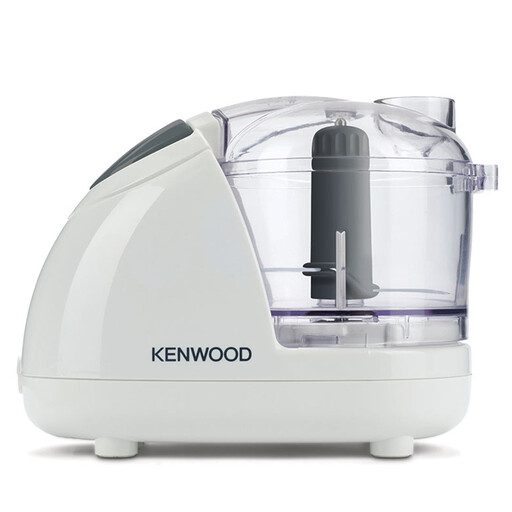 No image available
Consider its 350 ml bowl if your usual job is one small portion; the model has two speeds and a dishwasher-safe bowl. Check the CH180B manual before processing cooked meat, including its permitted temperature and load, and follow the stated 30-second continuous-use limit.
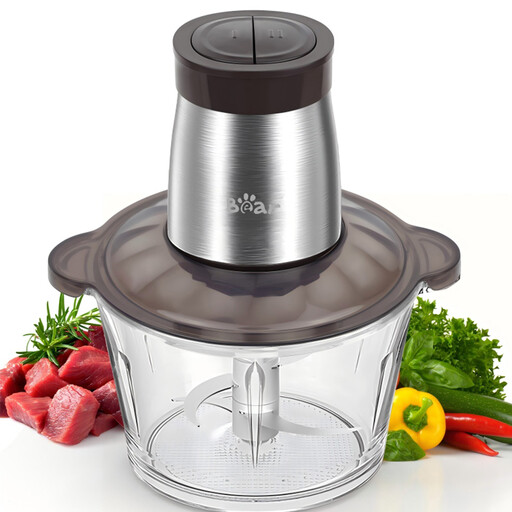 No image available
The listing describes meat chopping, but its 2 L rated capacity calls for checking how well the permitted load matches one portion. It specifies two speeds and 304 stainless-steel blades. Check the manual before processing cooked or hot meat; the listing excludes bones, ice and frozen food and specifies a 40-second maximum continuous run followed by a rest, with further cooling instructions after three consecutive cycles.
Consider a mini chopper if chopping one small portion is the main job and its manual permits cooked meat. A compact full processor makes more sense if you will also regularly use slicing, grating or other included attachments; KitchenAid distinguishes the two appliance formats by these additional functions.
Pulse or adjustable-speed controls let you pause and inspect the food between short runs, subject to the model's instructions. KitchenAid specifies two speeds and pulse action for its 5KFC3516, while Kenwood specifies pressure-sensitive two-speed control and pulse for the CHP61.100WH.
Clean the food-contact parts as directed in the exact model's manual, taking care when handling the blade. Check which components are dishwasher-safe and which must be washed without submerging them; those instructions vary by model.