Single-portion dessert makers
If you need crumbs for one topping or a small individual base, compare usable working capacity with container size. For example, the listed figures for the Kenwood CH180’s container and working capacity differ.


For one serving, start with a chopper’s usable working capacity and how you will stop at the crumb texture you want, rather than choosing by wattage or container size alone. An electric model with pulse or speed control suits someone who wants to adjust processing without repeated manual pulls; a manual pull-chopper avoids mains power but takes more effort. A larger bowl makes more sense if biscuit crumbs are only one of several food-prep jobs.
If you need crumbs for one topping or a small individual base, compare usable working capacity with container size. For example, the listed figures for the Kenwood CH180’s container and working capacity differ.
If a recipe calls for coarse or fine crumbs, the way you control processing may matter more to your choice than wattage. Documented options include the Kenwood CH180’s speeds and pulse function and the gradual pulls of Tefal’s manual chopper.
If you only make crumbs now and then, consider the parts you will need to wash and store, or whether you would rather use a chopper without mains power. Russell Hobbs and Tefal specify different cleaning arrangements for their models.
Decide whether a small usable batch, control over crumb size or simple occasional use would make the biggest difference to your choice.
Consider it when: you mainly make one small portion. The Kenwood CH180 is listed with a 0.15 litre working capacity, two variable speeds and pulse.
Trade-off: that small working capacity leaves less room when you want crumbs for several portions.
Consider it when: you also expect to prepare sauces, dressings or larger batches. KitchenAid lists an 830 ml bowl, two speeds and pulse action for the 5KFC3516.
Trade-off: a larger stated bowl does not establish how well the chopper handles your smallest biscuit portion.
Consider it when: you want to work without mains power and watch the chop through a clear bowl. Tefal says additional pulls make the chop finer on its K1330404.
Trade-off: it requires repeated pulling, and Tefal names nuts rather than biscuits among this model’s uses.
| Concern | What to check | Who this matters to |
|---|---|---|
| Small usable batch | Compare working capacity with container capacity where both are stated; they need not be the same. | If I only need enough crumbs for one dessert, I want a bowl suited to a small amount rather than extra capacity for its own sake. Around 50% of consumers would put the small usable batch first. |
| Crumb texture | Look for pulse or speed controls on an electric model, or gradual pulls and a clear bowl on a manual one. | For a topping or base with a particular texture, I want to judge when to stop chopping. Roughly 30% of consumers would make texture control their primary concern. |
| Occasional-use convenience | Check care instructions for the bowl, blade and lid separately, and decide whether you want to use mains power. | If I make crumbs infrequently, washing the parts or finding a socket may matter more to me than extra functions. Around 20% of consumers would prioritise straightforward occasional use. |
The Kenwood CH180 is listed with a 0.35 litre container but a 0.15 litre working capacity. Comparing container figures alone can therefore obscure a difference that matters for a small portion.
Compare published working capacities when available, and check whether the amount you normally make suits the model you are considering.
Wattage alone does not tell you when to stop at coarse or fine crumbs. The documented control methods differ between models: the Kenwood CH180 has speeds and pulse, while Tefal’s K1330404 becomes finer with more pulls.
Choose a control method you would use, then inspect the crumbs as you process them.
Tefal says the K1330404 bowl and blades are dishwasher-safe but directs users to rinse its lid in the sink.
Check the care instructions separately for the bowl, blade, lid and, on an electric model, the motor unit.
Change-of-mind returns and remedies for faulty goods are different. Citizens Advice explains that an in-store change-of-mind return generally depends on the seller’s policy, while many distance purchases have a cooling-off period; faulty goods may give rise to legal remedies.
Read the retailer’s change-of-mind conditions before using the chopper, and keep your purchase details in case you need to report a fault.
Kenwood has documented small-batch and larger-capacity electric models. The CH180 is listed with a 0.15 litre working capacity, two variable speeds and pulse, and the EasyChop CHP61.100WH with a 0.5 litre working capacity.
Russell Hobbs names crumbling biscuits among the uses of its Food Collection Mini Chopper 22220, a 500 ml, one-speed model.
The Pixie CCH32U is listed with a 0.7 litre working capacity, pulse control, an auto-reversing blade and dishwasher-safe parts.
Tefal’s 5 Second Chopper K1330404 is a manual pull-chopper with a clear 500 ml bowl, locking lid and non-slip base.
KitchenAid lists an 830 ml work bowl, two speeds and pulse action for its 5KFC3516 mini food chopper; the manufacturer also says it can make breadcrumbs.
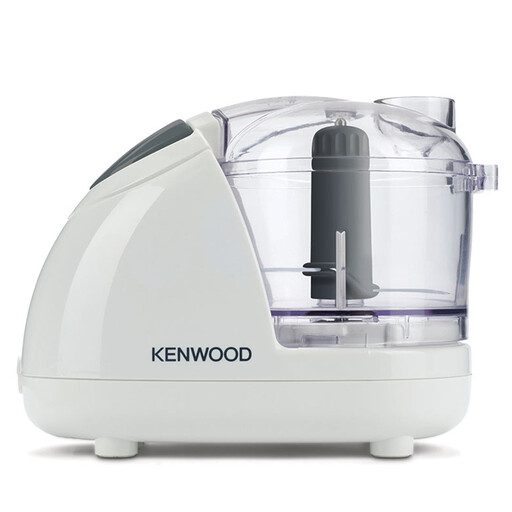
This electric mini chopper is an option to assess for a small crumb-making task; check whether its bowl handles your usual one-person amount.
 No image available
For a one-person portion, check that the amount of biscuits you normally process suits this model; its 350 ml bowl figure does not establish a minimum workable batch.
The product name specifies 300 W, two speeds and a dishwasher-safe bowl.
Compare working capacity where it is published, rather than relying only on the container figure. The Kenwood CH180 is listed with a 0.35 litre container and a 0.15 litre working capacity; those figures help you compare sizes but do not guarantee a minimum amount of biscuits it can process.
Wattage alone is not a fineness rating. For a chosen texture, consider controls you can stop and inspect: The Kenwood CH180 is listed with variable speeds and pulse, while Tefal says additional pulls make the chop finer on its manual K1330404.
Check the instructions for each component of the exact model. Russell Hobbs says the 22220’s removable bowl, lid and blade are dishwasher-safe; Tefal says the K1330404’s bowl and blades are dishwasher-safe but directs users to rinse its lid in the sink.
Keep your purchase details and model number so you can identify the appliance when contacting the seller or manufacturer. Electrical Safety First explains that product registration can help a manufacturer contact you about a fault or safety recall; Citizens Advice distinguishes change-of-mind returns from remedies that may apply to faulty goods.