Dinner-party dessert makers
If you are making a substantial biscuit base, bowl capacity and the ability to pause and inspect crumb size matter more than they would for a small topping.


For a dinner-party dessert, choose a mini chopper with a bowl that suits your planned batch and controls that let you stop to inspect the crumbs. A larger stated bowl may mean fewer reloads, while a compact model takes less storage space; check the manual’s fill and cleaning instructions rather than choosing by wattage alone.
If you are making a substantial biscuit base, bowl capacity and the ability to pause and inspect crumb size matter more than they would for a small topping.
If biscuit crumbs are an occasional task, you may prefer a smaller appliance that is easier to store, even if preparing a party-sized quantity takes several loads.
If the chopper will also be used for herbs, nuts, dips or sauces, check the exact model’s stated functions and instructions rather than assuming those tasks suit every chopper.
If biscuit crumbs are a one-off need, consider crushing them manually before buying an appliance; Nigella Lawson describes using a potato masher for this task. If you want a chopper for this dessert and other preparation, start with batch size, then consider texture control and storage.
| Concern | What to check | Who this matters to |
|---|---|---|
| Batch capacity | Compare stated bowl volume with the manual’s maximum-fill guidance for the ingredients you plan to process. | If I am making a large biscuit base, I would rather avoid repeatedly filling and emptying a small bowl. Around 40% of consumers put fewer loads first. |
| Crumb texture | Look for a stated pulse control and instructions that let you pause to inspect the crumbs. | For a topping or base where crumb size matters, I want to stop before the pieces become finer than intended. Texture control comes first for around 40% of consumers. |
| Storage and clean-up | Check the appliance’s size and identify exactly which removable parts the manual permits you to put in a dishwasher. | In a small kitchen, I need somewhere to keep the chopper and a manageable wash-up after guests leave. Around 20% of consumers prioritise storage and clean-up. |
Stated bowl size is not the same as the amount of broken biscuit a manufacturer permits in one load. Smaller bowls can mean repeated filling and emptying.
Check the manual’s fill guidance alongside bowl volume before planning how many loads you will need.
A wattage rating does not establish the crumb texture a particular biscuit will produce. The ability to stop and inspect the mixture matters when you want a particular size.
Check for an expressly stated pulse function, then follow the model’s processing instructions and inspect the crumbs between bursts.
A dishwasher-safe claim for removable parts does not extend to the electrical base.
Check the manual for the bowl, lid and blade separately, and follow its cleaning instructions for the motor unit.
If you only need biscuit crumbs once, manual crushing may meet the need without taking up cupboard space afterwards.
Consider a chopper if you also expect to use its stated functions for other food-preparation tasks; otherwise, try a manual method.
Cuisinart UK lists a 900ml bowl and pulse operation for the Mini Prep Pro ECH4U, making its stated capacity worth considering for a larger crumb batch.
Kenwood GB lists a 500ml capacity and pulse control for the Easy Chop CHP61.100WH, a smaller-bowl option for buyers willing to work in batches.
Ninja UK identifies pulse technology on the Master Prep Advantage QB800UKBK, which is relevant if you want to pause while checking crumb size.
These Joybuy choices range from a 350ml mini chopper to larger-bowl food choppers. For a biscuit dessert, weigh storage space against the number of loads you can accept, and check the exact model’s instructions for processing biscuit pieces.
 No image available
Consider this smaller-bowl model if storage matters more to you than preparing all the crumbs in one load.
The product name states a 300W rating, two speeds and a dishwasher-safe bowl. Check its fill instructions before using it for broken biscuits.
 No image available
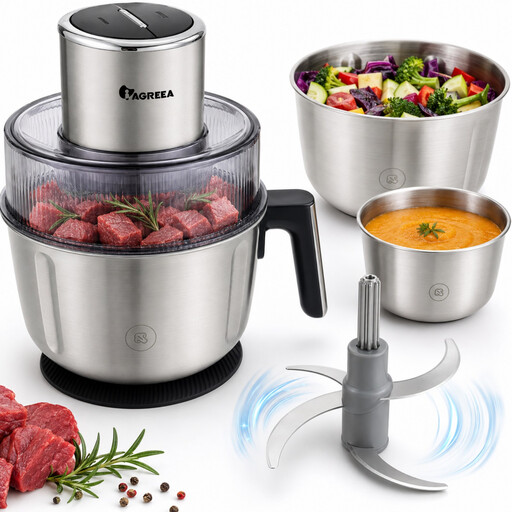
Consider its larger stated bowls if you want room for party preparation, but check that the instructions permit your intended biscuit-crumb task and fill amount.
The product name specifies 2.5L, 2.2L and 1.8L 304 stainless steel bowls, two speeds and a 350W rating. Check the cleaning instructions for each part.
 No image available
Consider the two stated bowl sizes if you prepare different quantities, then check the controls and instructions before choosing it specifically for biscuit crumbs.
The product name specifies glass bowls of 2L and 0.6L and a 300W rating. Confirm the permitted fill for the larger bowl before planning a party-sized batch.
Choose a stated bowl size that suits both your planned batch and your storage space, then check the manufacturer’s maximum-fill instructions. Cuisinart UK lists 900ml for the Mini Prep Pro ECH4U, while Kenwood GB lists 500ml for the Easy Chop CHP61.100WH; neither figure guarantees a particular amount of biscuit fits in one load.
Look for pulse control so you can stop and inspect the pieces between short bursts. Cuisinart UK states pulse operation for the ECH4U, and Kenwood GB lists a pulse function for the CHP61.100WH; follow the chosen model’s processing instructions.
Only put a part in the dishwasher when the exact model’s instructions permit it. Cuisinart UK describes removable components of the ECH4U as dishwasher-safe, and Kenwood GB lists dishwasher-safe tools for the CHP61.100WH; neither claim includes permission to put the motor unit in a dishwasher.
Check the guarantee terms for the exact model and the seller you intend to use. In particular, confirm the applicable duration, what is covered and how to request support rather than assuming terms for another model apply.
Check the applicable product marking and seller information for the market where it will be supplied; a marking alone does not establish that a particular listing meets every requirement. GOV.UK guidance updated on 21 August 2026 says CE marking continues to be recognised alongside or instead of UKCA marking in Great Britain where the applicable rules allow it. Northern Ireland has different market processes, so check the relevant supply route there.