Family-meal breadcrumb makers
If you want crumbs for a family meal with fewer reloads, compare useful capacity and the maker’s loading guidance. Pulse control is worth considering when you need to stop at a particular texture.


Choose a mini chopper by how much bread you need to process at once: a small bowl may mean repeat loads, while a larger useful capacity gives you more room without guaranteeing that a family-meal batch will fit. If crumb texture matters, look for pulse control; before buying, check the exact model’s bread-loading and cleaning instructions.
If you want crumbs for a family meal with fewer reloads, compare useful capacity and the maker’s loading guidance. Pulse control is worth considering when you need to stop at a particular texture.
If you make crumbs occasionally and also prepare small amounts of herbs, garlic or dips, a compact chopper may suit you. Be prepared to process bread in stages when a recipe needs more.
If the appliance will handle other everyday prep as well as breadcrumbs, compare its stated uses, supplied blade and attachments, controls and care instructions. Check those details for the exact model rather than assuming every chopper handles the same ingredients.
Start with the amount of bread you normally need for a meal, then decide how much control over crumb texture, cleaning effort and cupboard space matters to you.
| Concern | What to check | Who this matters to |
|---|---|---|
| Usable capacity | Compare useful capacity where stated, not just bowl volume. Check the maker’s bread-loading limit rather than converting litres into a number of slices. | I want enough crumbs for a family meal without repeatedly emptying and refilling the bowl; around 33% of consumers put usable capacity first. |
| Crumb texture | Look for pulse control or speed settings and follow the model’s operating instructions. | Coatings and toppings may call for different crumb textures, so I want to stop processing when the crumbs suit the recipe; for around 25% of consumers, texture control is the primary concern. |
| Cleaning | Check which removable parts are dishwasher-safe and how the blade and motor base should be cleaned. | When I use the chopper regularly for meal prep, I want cleanup to be manageable; cleaning comes first for around 25% of consumers. |
| Compact, varied use | Compare the stated ingredient uses, supplied attachments and appliance dimensions. | I have limited cupboard space and want the appliance to help with other small prep jobs too; around 17% of consumers primarily value that combination. |
For its Choppeo MB603BG1, Tefal describes a 2 L glass bowl but a 1 L useful capacity. Comparing only the larger figure could give the wrong impression of how much can be processed at once.
Compare useful capacities where available, then check the exact model’s loading guidance before planning a family-meal batch.
Kenwood positions its CH180 for small quantities. That can suit occasional crumbs, but processing a family-meal quantity in stages takes more handling.
If avoiding repeat loads is important, compare its capacity with mid-size and larger useful-capacity models before choosing.
Dishwasher-safe parts do not mean the electrical base can go in the dishwasher. Tefal specifies that the dishwasher-safe removable parts of its Choppeo MB603BG1 exclude the base.
Check the care instructions for your exact model, handle the blade carefully and clean the base as directed by its maker.
The 5KFC3516 is an 830 ml mini chopper for breadcrumbs and other small prep jobs, according to KitchenAid.
Tefal offers different chopper sizes, including the 500 ml Multi Moulinette MQ723140 and the Choppeo MB603BG1 with a stated 1 L useful capacity.
Kenwood describes the CH180 as a chopper for small quantities and simple, occasional prep.
Lakeland describes its 700 ml Mini Food Processor and Chopper as suitable for breadcrumbs alongside other prep tasks.
These choices cover a larger useful-capacity chopper for family-meal prep and a compact chopper for smaller loads. Check the exact model’s instructions before relying on either for your intended quantity of bread.
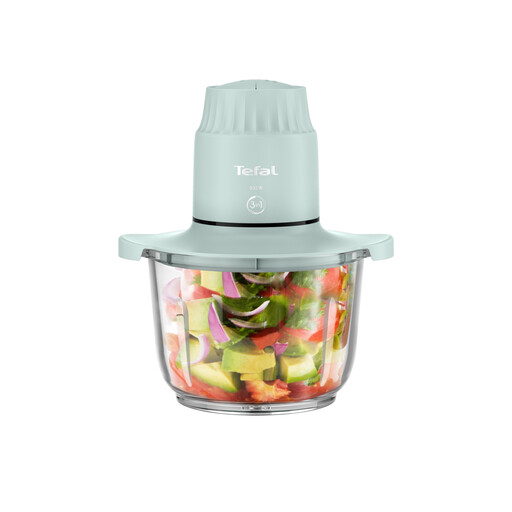 No image available
Consider this larger-capacity option if reducing reloads matters, but check the MB603165 instructions before using it for breadcrumbs or assuming your intended bread load will fit.
Joybuy describes this variant as having a 1 L useful capacity and a borosilicate glass bowl.
 No image available
Consider this compact option if you are comfortable making crumbs in smaller loads rather than relying on one family-meal batch.
Its product title specifies a 350 ml bowl, 300 W motor and two speeds, and describes the bowl as dishwasher-safe. Check the model’s bread-loading and care instructions.
Choose by the quantity of bread you usually process at once: a 500 ml bowl is more likely to require stages, while a larger useful capacity gives you more room. It does not guarantee a one-load result. Tefal, for example, distinguishes its Choppeo MB603BG1’s 2 L bowl from its 1 L useful capacity, so check loading guidance for the model you want.
Pulse control lets you stop and assess the texture as you process. KitchenAid says the pulse function and two speeds on its 5KFC3516 can take results from coarse to fine; follow the instructions for your chosen model’s loading and operation.
Check the individual parts rather than putting in the whole appliance. Tefal says the dishwasher-safe removable parts of its Choppeo MB603BG1 exclude the base, while Kenwood describes the CH180 bowl as dishwasher-safe. Follow the exact model’s care instructions for its blade and electrical base.
Yes, if long-term use matters to your decision, check what support applies to the exact model. Tefal makes a 15-year repairability claim for the Choppeo MB603BG1; that claim should not be assumed to cover a different Choppeo variant.