Cooks who want distinct chicken pieces
For wraps, pies, salads or sandwiches, you may want visible pieces rather than a fine mixture. Look for a way to stop and inspect the chicken as you chop.


Choose an electric mini chopper with controllable speeds if you regularly prepare small portions of cooked chicken and want less hand effort. A manual pull chopper suits occasional portions when you prefer not to use a socket, but you supply the chopping force. Whichever you choose, check the texture between short runs or pulls; a small bowl may mean repeat batches when preparing several servings.
For wraps, pies, salads or sandwiches, you may want visible pieces rather than a fine mixture. Look for a way to stop and inspect the chicken as you chop.
A compact bowl can suit a small meal when setup and washing matter as much as chopping. Check which removable parts can go in the dishwasher; instructions differ between models.
For occasional chopping away from a socket, a pull-cord model offers a manual option. The trade-off is the effort needed to pull the cord.
Choose it when: You chop cooked chicken regularly and want to control a small portion without repeated hand pulls.
Trade-off: It needs power, and a compact bowl may require several batches for a larger recipe.
Choose it when: You prepare occasional small portions and want a tool that does not need a socket.
Trade-off: You provide the chopping effort, which can matter more with frequent use.
Choose it when: You routinely prepare cooked chicken for several servings rather than loading a mini bowl repeatedly.
Trade-off: A larger appliance takes more storage space and may involve more assembly and washing for a single portion.
| Concern | What to check | Who this matters to |
|---|---|---|
| Chicken texture | Look for pulse, speed or incremental pull control, and a bowl that lets you inspect the contents. | If I want recognisable pieces for a filling, I need to stop before the chicken becomes too fine; around 36% of consumers put texture control first. |
| Small-portion cleanup | Compare bowl size and the exact washing instructions for the bowl, blades and lid. | When making one or two portions, I want preparation and washing to stay manageable. Around 29% of consumers primarily value quick small-batch cleanup. |
| Batch capacity | Compare the stated bowl capacity with your usual quantity, and check the model's filling limit. | For several servings, I would rather avoid repeatedly emptying and reloading a small bowl; around 21% of consumers make batch capacity their main concern. |
| No-mains use | For a manual model, check its intended foods, lid and base, and removable-part cleaning instructions. | If I only chop chicken occasionally, I may prefer a pull cord to finding a socket and accept the hand effort. Around 14% of consumers put no-mains simplicity first. |
Motor power does not establish how chunky cooked chicken will remain. The Telegraph's UK mini-chopper guidance notes that higher wattage does not always mean better results.
Compare the available controls, bowl capacity and blade configuration, then use short runs so you can inspect the texture.
A 500 ml bowl may suit a small meal but require repeated loading when preparing several portions.
Compare your usual quantity with the bowl capacity and the maker's filling limit; consider a larger processor if repeat batches would be inconvenient.
Repeated batches also add preparation and washing time.
Cleaning instructions vary. Tefal says the K1330404 bowl and blades are dishwasher-safe, while its lid should be rinsed in the sink.
Follow the instructions for your exact model, and handle exposed blades carefully when washing.
Chopping does not make poorly stored leftovers safe. GOV.UK advises eating refrigerated leftovers within 48 hours or freezing them if that will not be possible.
Cool cooked food and refrigerate it within one to two hours, keep the fridge between 0 and 5°C, and check storage before using the chicken.
Kenwood's CHP61.100WH is a compact electric option with a stated 500 ml bowl and two-speed pressure-sensitive control.
Tefal has both the manual K1330404 pull chopper and the electric MQ714140 mini chopper, offering different ways to control a small portion.
The Ninja Professional Chopper 200W is another compact-electric model to compare when looking at mini choppers.
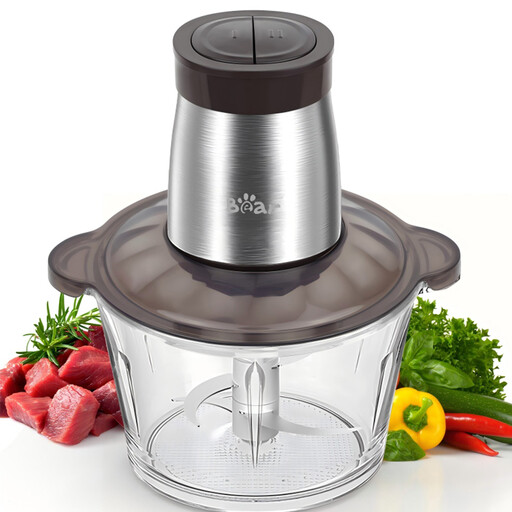
For cooks preparing larger quantities of chicken, this 2 L electric chopper is an alternative to a small-bowl mini chopper. Check whether its size suits the portions you normally prepare.
 No image available
Consider this model if you need more bowl capacity for chopping meat than a typical small-portion mini chopper offers; its listing does not establish a particular cooked-chicken texture.
The product name specifies a 2 L capacity, 300 W power, two speeds and 304 stainless-steel blades. The listing limits continuous operation to 40 seconds, calls for at least two minutes' rest between runs and says to let the appliance cool for 15 minutes after three consecutive cycles.
Check the bowl and blade cleaning instructions and confirm the plug type before buying for UK use. Do not immerse the main unit in water.
Yes, provided the chicken has been stored safely and the appliance is suitable for the food you are chopping. Chopping does not make poorly stored leftovers safe: GOV.UK advises eating refrigerated leftovers within 48 hours or freezing them if that will not be possible.
Use short pulses or pulls and inspect the chicken between them if you want distinct pieces. Kenwood specifies pressure-sensitive control for the CHP61.100WH, while Tefal says additional pulls make the K1330404 manual chopper's result finer; neither feature guarantees a particular texture.
Tefal says its K1330404 can chop boneless meat, making it an option to consider for boneless cooked chicken. That manufacturer statement does not establish how it will handle every portion size or desired texture.
It depends on the exact model and component. Kenwood says the CHP61.100WH tools are dishwasher-safe; Tefal says the K1330404 bowl and blades are dishwasher-safe but its lid should be rinsed in the sink. Follow your model's instructions rather than putting the whole appliance in the dishwasher.
Consider a larger processor if you routinely chop cooked chicken for several servings and a mini bowl would require repeat batches. For a single portion, weigh that capacity against the larger appliance's storage, assembly and washing needs.