Consumers sharing a kitchen
If several people use the chopper, you may put removable, cleanable parts first—particularly when raw-food residue or allergens could be carried between uses.


For cooked chicken in a shared kitchen, start with a mini chopper whose food-contact parts can be removed and cleaned between users. Choose bowl capacity for your usual portion, then compare controls that let you stop and check the texture; wattage alone cannot tell you how finely the chicken will be chopped. In a food-business kitchen, the appliance must also fit the site’s arrangements for keeping raw and ready-to-eat food separate.
If several people use the chopper, you may put removable, cleanable parts first—particularly when raw-food residue or allergens could be carried between uses.
For chicken fillings or a meal for one or two, a compact 350–500 ml bowl may suit the usual job, provided the portion fits the model’s loading instructions.
If you regularly chop chicken for more than one meal, a larger compact bowl may reduce reloading. Controls that let you pause and inspect the texture are also worth considering.
Settle how the chopper will be cleaned between users, then compare bowl size with your usual portion and check how you will control the chopping.
| Concern | What to check | Who this matters to |
|---|---|---|
| Cleaning and cross-contact | Check which of the bowl, lid and blade can be removed and which are dishwasher-safe. Plan how users will clean the parts and worktop between uses. | When other people use the chopper, I need to clean food-contact parts before the next turn, especially where raw food or allergens are handled; around 31% of consumers put cleaning and cross-contact control first. |
| Bowl capacity | Compare the stated bowl volume with your usual portion, and follow the model’s loading instructions rather than treating bowl volume as a food limit. | For several portions, I want to avoid repeatedly loading the bowl; roughly 25% of consumers make batch capacity their primary concern. |
| Texture control | Look for a stated pulse function or speed settings, and check the instructions for operating limits. | If I need chopped chicken rather than a very fine mixture, I want to pause and inspect it as I go; around 25% of consumers put texture control first. |
| Shared storage | Check the appliance’s dimensions where stated and whether its bowl, blade and cable can be stored together safely. | With little shared cupboard space, I need a chopper that is straightforward to put away after cleaning; approximately 19% of consumers prioritise compact storage and handling. |
A power rating does not establish whether a chopper will give your cooked chicken the texture you want or accommodate your usual portion.
Compare bowl size and controls as well as wattage. Follow the model’s loading and operating instructions, stopping to inspect the result.
Removable parts can make cleaning more practical, but they do not clean the worktop or prevent cross-contact if users leave residue behind. Food Standards Agency MyHACCP guidance addresses separation of raw and ready-to-eat food in food-business settings.
Agree how the bowl, lid, blade and surrounding surface will be cleaned after use. In a food-business kitchen, follow the site’s controls for keeping raw and ready-to-eat preparation apart.
A small bowl can be easier to store, but several portions of chicken may require repeated loading.
Compare your usual portion with the model’s bowl size and loading instructions before choosing between a small and a larger compact chopper.
Repeat batches also mean more preparation and clean-up time in the shared space.
The KitchenAid UK 5KFC3516 is a larger compact option with an 830 ml work bowl, two speeds and pulse action.
Salter’s Mini Chopper Pro has a 350 ml bowl for small chopping jobs.
The Food Collection Mini Chopper 22220 offers a 500 ml bowl for routine small chopping jobs.
The Ninja Professional Chopper 200W appears in Good Housekeeping UK’s mini-chopper test list as runner-up.
These electric choppers are options to assess for cooked-chicken preparation in a shared kitchen. Compare their stated bowl and cleaning features with your usual portion and the parts everyone will need to wash.
 No image available
Consider its 350 ml bowl for small portions of cooked chicken if your usual amount fits the model’s loading instructions.
The product name specifies 300 W, two speeds and a dishwasher-safe bowl. Check the instructions for cooked-chicken loading and how to clean the lid.
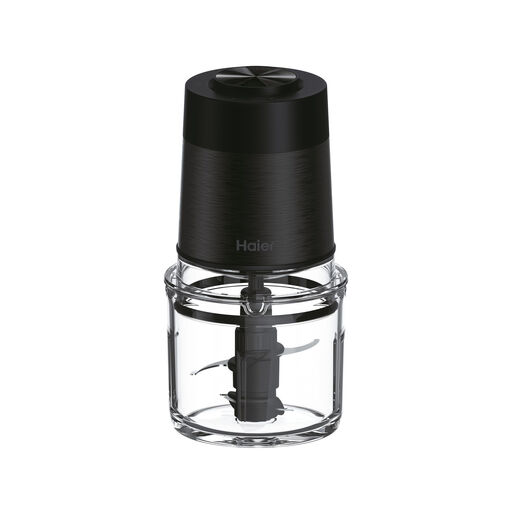 No image available
Consider this for shared-kitchen chopping if a glass jar suits your handling and storage needs, subject to the model’s instructions for your usual cooked-chicken portion.
The product name specifies 550 W, double-stacked blades, two-speed control and a dishwasher-safe bowl. Check its capacity and the lid-cleaning instructions before choosing it.
Not necessarily in an ordinary household, provided the chopper and surrounding surfaces are cleaned between uses and cross-contact is controlled. In a food-business kitchen, Food Standards Agency MyHACCP guidance calls for potential cross-contamination between raw and ready-to-eat foods to be identified and eliminated through the kitchen’s arrangements.
Check the bowl, lid and blade separately because the cleaning instructions can differ by component. Russell Hobbs UK lists all three as removable and dishwasher-safe on its Food Collection Mini Chopper 22220; Salter identifies the bowl and blades of its Mini Chopper Pro as dishwasher-safe.
Process it in short bursts and stop to inspect the texture, following the selected model’s operating instructions. KitchenAid UK lists two speeds and pulse action for its 5KFC3516, but those controls do not remove the need to check the result as you go.