Small-batch dinner-party cooks
If you are preparing cooked meat for fillings, sauces or toppings and can portion it into several loads, pay attention to working capacity and how easily you can empty the bowl.


A mini chopper can suit cooled, boneless cooked meat if its instructions permit that use and you can work in small batches. For a large dinner-party quantity, compare the repeated filling and emptying with using a larger food processor or dedicated mincer; whichever you choose, check the model’s temperature, meat-processing and cleaning instructions.
If you are preparing cooked meat for fillings, sauces or toppings and can portion it into several loads, pay attention to working capacity and how easily you can empty the bowl.
If the recipe calls for a coarse or fine mince rather than a purée, look for a way to stop and inspect the meat as you chop. Kenwood lists pulse operation for its CHP61, while Tefal says the number of pulls changes the fineness of its manual 5 Second Chopper.
If you entertain occasionally and have limited storage space, a small appliance may be easier to accommodate. Check which parts can be removed and washed after handling meat.
Decide first whether you can manage several small loads. Then choose the level of texture control you want and check the exact appliance instructions before processing cooked meat.
Consider it when: You can divide the meat into small portions and want powered chopping with a controllable stop.
Trade-off: Refilling takes time, and operating limits vary by model; Kenwood’s CHP61 instructions limit continuous processing of heavy loads such as meat to 10 seconds, followed by two minutes of cooling.
Consider it when: You want to adjust the chop by hand. Tefal specifies boneless meat for its 500ml 5 Second Chopper.
Trade-off: Repeated dinner-party batches mean repeated pulling; check its instructions for your cooked-meat preparation.
Consider it when: The quantity makes repeated mini-chopper loads impractical; Kenwood positions its high-capacity food processors for larger meals and batch cooking.
Trade-off: A larger appliance needs more storage space, and you still need to check its instructions for the intended meat preparation.
| Concern | What to check | Who this matters to |
|---|---|---|
| Batch capacity | Compare working capacity, rather than total bowl volume, with the amount your recipe needs. | If I need enough mince for several guests, I want to know how often I will have to stop and refill. Around 45% of consumers put batch capacity first. |
| Minced texture | Look for pulse or gradual manual control, plus the model’s guidance on processing meat. | For a filling that needs a distinct mince rather than a purée, I want to inspect the texture as I go; roughly 33% of consumers make texture control their primary concern. |
| Cleaning and storage | Check which parts are removable and dishwasher-safe, and whether the bowl has a storage lid. | When clearing up after guests, I want parts I can clean and an appliance I can put away easily. Compact storage and cleanup come first for about 22% of consumers. |
A bowl’s total volume does not tell you how much meat it can process evenly at once. Russell Hobbs, for example, states a 1L bowl but a 500ml working capacity for the Desire 27131.
Compare the stated working capacity and fill guidance with your recipe. If the number of loads would be inconvenient, consider a larger appliance.
Cooked food is not automatically suitable for every chopper: the instructions for Kenwood’s CHP61 range prohibit processing hot ingredients.
Follow the temperature instructions for your exact model and cool cooked meat in line with food-safety guidance before storing it.
A power rating cannot, on its own, tell you whether a chopper will produce the texture your dish needs or what meat-processing limits apply.
Check the controls, bowl capacity and instructions for meat alongside the stated power.
A storage lid or dishwasher-safe part does not replace appropriate cooling and refrigeration of prepared meat.
Food Standards Scotland advises cooling cooked meat as quickly as possible before putting it in the fridge or freezer, and says food should not be reheated more than once.
Its CHP61 electric mini chopper is relevant if you want a compact bowl with pulse and two-speed controls.
Its manual and electric choppers offer different approaches to controlling a small batch.
The Desire 27131 is relevant if a glass bowl, storage lid and removable parts matter to you.
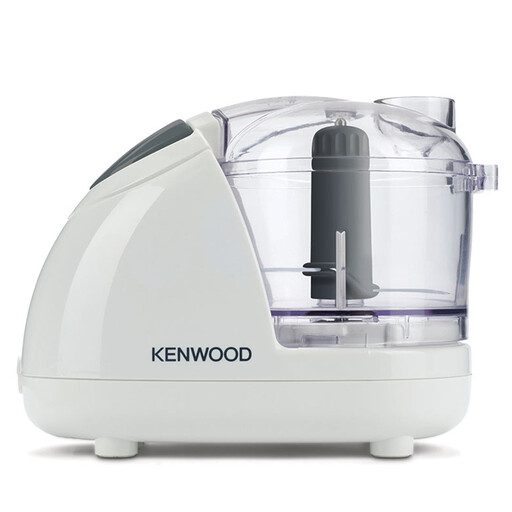
This compact electric chopper is a choice to consider for small portions. Before choosing it for dinner-party meat preparation, check its instructions for cooked-meat use and how much meat can be processed per load.
 No image available
Consider this compact model if you plan to prepare small portions and can check the usable meat capacity before buying. Its product title states a 350ml bowl, 300W power, two speeds and a dishwasher-safe bowl; check the CH180B instructions for cooked-meat use, hot-food restrictions and operating limits.
Not unless the instructions for your exact model permit it. The instructions for Kenwood’s CHP61 range explicitly prohibit hot ingredients; follow your appliance manual and cool cooked meat appropriately before storage.
Follow the operating limit for your model rather than assuming it can run continuously. The Kenwood CHP61 range instructions limit heavy loads such as meat to 10 seconds of continuous processing, followed by a two-minute cooling interval; another model may have different instructions.
Cool it as quickly as possible, then put it in the fridge or freezer, as Food Standards Scotland advises for cooked meat. Its guidance also says not to reheat food more than once.