Dinner-party prep cooks
If leeks are going into several dishes or a substantial serving, look at usable bowl capacity to judge how often you will need to empty and reload it. Controls that let you stop and check the cut also matter.


If leeks are a substantial part of a dinner-party meal, compare usable bowl capacity and chopping controls before wattage: a 1L or 1.19L bowl can mean fewer loads than a 0.5L chopper, while a smaller bowl suits modest quantities and tighter storage. Check the controls and removable parts on the particular model; bowl volume alone does not establish how much you can chop in one load or what texture you will get.
If leeks are going into several dishes or a substantial serving, look at usable bowl capacity to judge how often you will need to empty and reload it. Controls that let you stop and check the cut also matter.
If you usually chop only a modest amount of leek alongside herbs or other aromatics, a smaller bowl may be easier to store. Allow for extra loads when preparing more food for guests.
When several dishes are in progress, removable food-contact parts can simplify washing up. Check the instructions for the exact bowl, blade and lid rather than assuming the whole appliance is dishwasher-safe.
Start with the amount of leek you need to prepare, then weigh control over the cut against cleaning and cupboard space.
| Concern | What to check | Who this matters to |
|---|---|---|
| Batch capacity | Compare stated useful or work-bowl capacity, not just the vessel size. Consider how a 0.5L bowl fits your prep compared with a 1L or 1.19L bowl. | When leeks make up a substantial part of a meal for guests, I would rather empty the bowl fewer times than store the smallest machine; around 42% of consumers put batch capacity first. |
| Chop control | Look for pulse action or more than one speed, and stop between short bursts to inspect the cut. | If the leeks need to keep a discernible chopped texture, I want chances to stop before processing them further; roughly 33% of consumers prioritise chop control. |
| Cleaning and storage | Confirm which of the bowl, blade and lid are removable and dishwasher-safe, and check the appliance dimensions against your storage space. | With limited cupboard space and several dishes to wash up, I would favour an appliance I can put away and clean easily; around 25% of consumers place compact storage and clean-up first. |
Motor wattage does not tell you how much leek fits in a load or which controls you can use to adjust the cut.
Compare the stated capacity and controls alongside wattage, then check which parts you can remove for cleaning.
A bowl's total size and its stated usable capacity can differ, which matters when you plan how many loads dinner-party prep will take.
Use the model's useful-capacity or fill guidance for batch planning rather than filling the vessel to its lid.
A small bowl may suit a topping or side dish but require repeated loading when leeks are a substantial ingredient.
Choose a larger stated working capacity if fewer loads matter more to you than compact storage, or plan time for several batches.
Raw food can contaminate equipment used later for ready-to-eat ingredients. GOV.UK's food-business guidance calls for separating raw foods from fruit and vegetables and cleaning food-contact equipment.
Keep raw and ready-to-eat preparation separate, and clean and disinfect the chopper's food-contact parts and work area after preparing raw food.
Tefal's Choppeo MB603BG1 and Eco Respect MQ80E840 illustrate a choice between a larger stated usable capacity and a smaller bowl for modest quantities.
The 5KFC0516 is a larger-bowl food chopper to consider when both batch room and incremental control matter.
Kenwood positions the CH180B for smaller quantities, making it more relevant to a modest amount of leek than a large guest-sized load.
The Food Collection Mini Chopper 22220 is a 0.5L option for smaller quantities and occasional prep.
These Joybuy choppers include larger-bowl options for preparing more leek and a small-bowl option for modest quantities. Compare each model's stated capacity and controls with the amount you intend to chop.
 No image available
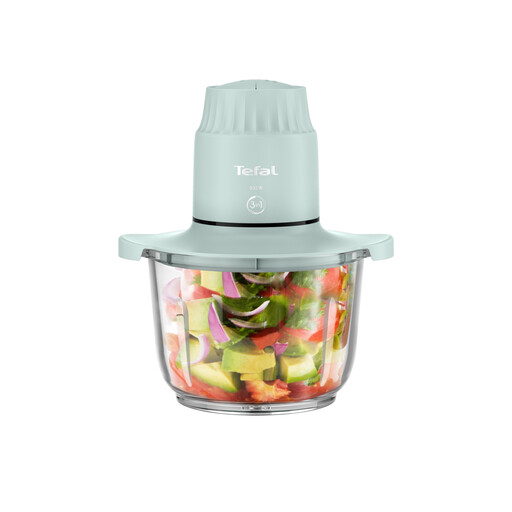
Consider this larger-bowl option if leeks are a substantial part of the meal. The product name states a 1L capacity and a borosilicate-glass bowl; check the fill guidance when planning each load.
 No image available
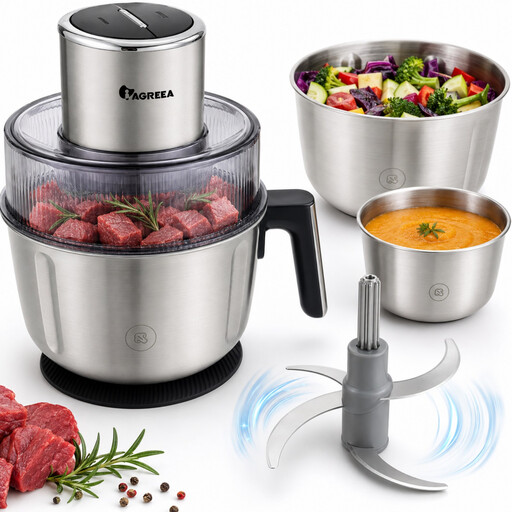
If you want a choice of bowl sizes while preparing several dishes, this model is listed with 2.5L, 2.2L and 1.8L nesting 304 stainless-steel bowls. Its name specifies two speeds and triple-curved blades; check the usable fill guidance for the bowl you select.
 No image available
The two stated bowl sizes give you a larger vessel for substantial prep and a smaller one for modest quantities. Check the 2L bowl's usable fill guidance before treating its full volume as chopping capacity.
 No image available
Kenwood GB positions the CH180B for smaller quantities, so its stated 350ml bowl is more suited to a modest amount of leek than a substantial guest-sized load. The product name specifies two speeds and a dishwasher-safe bowl; plan for repeated loads if you need more.
 No image available
This larger stated capacity may suit a substantial amount of leek, provided you check how much the bowl can hold during chopping. The product name specifies two speeds and 304 stainless-steel blades; confirm the cleaning instructions for the food-contact parts.
Start by comparing a stated 1L or 1.19L working capacity if leeks are a substantial ingredient for several guests. A 0.5L chopper can suit a smaller quantity, but plan for more loads and check each model's usable fill guidance.
Use short bursts and inspect the texture between them. Pulse action or more than one speed gives you ways to adjust processing, but neither guarantees a particular cut.
No. Check the instructions for the exact bowl, blade and lid, and clean the motor base as the manufacturer directs rather than assuming it can be immersed or machine-washed.
Keep raw food separate from ready-to-eat ingredients, and clean and disinfect food-contact equipment and work surfaces after raw-food preparation. GOV.UK gives this separation and cleaning advice in its guidance for food businesses; follow the chopper manufacturer's instructions for its individual parts.