Single-portion chicken prepper
If you mainly chop cooked chicken for a sandwich, wrap, salad or filling, a small bowl and control over the texture matter more than a set of large-batch attachments.


For one portion of cooked chicken, start with a compact chopper with pulse control if its manual confirms it can handle your usual quantity. A larger food processor makes more sense when you will also slice, grate or prepare bigger batches, but its bowl and attachments take more space to store and clean.
If you mainly chop cooked chicken for a sandwich, wrap, salad or filling, a small bowl and control over the texture matter more than a set of large-batch attachments.
If cupboard space is limited but you also prepare herbs, sauces or breadcrumbs, look for a compact chopper that suits those recurring jobs as well as your usual chicken portion.
If slicing, grating, mixing or preparing several portions will be regular tasks, a full food processor may justify the additional bowl size and attachments.
Choose for the portion and tasks you prepare most often, then check how much control the appliance gives you over texture and cleaning. A stated bowl capacity does not tell you the smallest quantity its blades will process effectively.
| Concern | What to check | Who this matters to |
|---|---|---|
| Bowl size and storage | Compare your usual portion with the bowl size and check the appliance’s storage dimensions. | When I usually prepare just one serving, I do not want a large bowl and attachments taking up cupboard space. Around 50% of consumers put small-batch size and storage first. |
| Texture control | Look for pulse control and check the blade guidance for the exact model. | For a filling, I want to stop while the chicken is still in pieces rather than continue to a finer texture. Roughly 30% of consumers make texture control their primary concern. |
| Cleaning and food handling | Check which removable parts are dishwasher-safe and how the bowl, lid and blade must be cleaned. | If the appliance may also touch raw poultry, I need to clean it thoroughly before preparing ready-to-eat chicken. About 20% of consumers place cleaning and food handling first. |
For one cooked-chicken portion, a larger bowl and attachment set add equipment to store and wash. Those features are more relevant if slicing, grating, mixing or batch preparation will be regular jobs.
Choose for your usual batch, and move to a larger processor only for functions you expect to use.
Capacity describes the bowl’s volume, not how well its blade will catch a small amount of cooked chicken or what texture it will produce.
Check the exact model’s manual for blade guidance and any stated minimum quantity before ordering.
GOV.UK food-business guidance warns that equipment used for raw poultry can transfer bacteria to ready-to-eat food.
Keep raw and ready-to-eat preparation separate where possible. Otherwise, thoroughly wash and disinfect the bowl, lid, blade and work surfaces before chopping cooked chicken.
Processing cooked chicken does not restart its storage time. GOV.UK advises eating leftovers within 48 hours or freezing them if that will not be possible.
Use chicken that has been cooled and chilled safely, and keep track of when it was originally cooked.
Its compact choppers include the 830 ml 5KFC3516 and 1.19 L 5KFC0516.
Its MultiTalent 3 MCM3501MGB is a food processor for buyers who will use more than chopping functions.
Kenwood offers both mini choppers and food processors; John Lewis & Partners lists the CH180 mini chopper and a 1.3 L MultiPro Go.
The BN800UK is relevant if food processing, blending and a personal cup would all be useful.
These compact choppers are options to consider for one-person cooked-chicken prep. Check each model’s guidance for your usual portion and desired texture before choosing.
 Image unavailable
Consider this compact model if you usually prepare a small portion and want two speed settings. Its stated features include a dishwasher-safe bowl; check the manual for its minimum workable quantity and the texture you want from cooked chicken.
The model instructions limit continuous motor operation to 30 seconds.
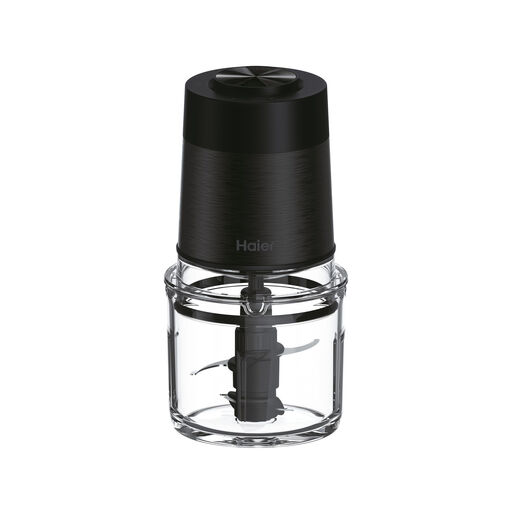 Image unavailable
Consider this chopper if a glass bowl and two speed settings suit your preparation routine. It has double-stacked blades and a bowl described as dishwasher-safe; check its bowl capacity, minimum workable quantity and controls for the texture you want before buying.
Start by considering a compact chopper rather than choosing the largest capacity available. KitchenAid positions its 830 ml 5KFC3516 for small volumes, but even a compact bowl’s stated capacity does not tell you its minimum effective load; check the exact model’s manual against your usual portion.
Choose a model with pulse control, use short bursts and stop to check the texture. KitchenAid specifies pulse control on its 5KFC3516, but the result still depends on the portion, blade and how long you process it.
Yes, if the equipment is thoroughly washed and disinfected between raw-poultry and ready-to-eat preparation; keeping the tasks separate where possible reduces the risk of cross-contamination. GOV.UK food-business guidance identifies equipment and surfaces used for raw poultry as a route for transferring bacteria.
No. Chopping does not restart the storage period: GOV.UK advises eating leftovers within 48 hours or freezing them if that will not be possible. Start with chicken that has already been cooled and chilled safely.